Space heater running cost calculator: cost per hour, day and month from watts, hours, duty cycle and EIA's electricity rate
kWh = watts / 1,000 x hours x duty cycle; cost = kWh x rate. A 1,500 W heater on 8 hours a day at EIA's 18.31 cents is 12 kWh, $2.20 a day, $65.92 a month.
- Verified
- Updated
- 6 min read
- 6 sources
Shop links on this page are affiliate links: a purchase may earn us a commission at no extra cost to you. Disclosure
Short answer
A space heater’s running cost is kWh = watts / 1,000 x hours x duty cycle, then cost = kWh x your electricity rate. Duty cycle is the share of the time the heating element is actually on; the worst case, and the calculator’s default, is 100 percent. EIA’s Electric Power Monthly, Table 5.6.A, puts the US average residential rate at 18.31 cents per kWh for July 2026. A 1,500 W heater on for 8 hours at full duty is 1,500 / 1,000 x 8 = 12 kWh, which is $2.20 a day and $65.92 over a 30-day month; the same heater at 50 percent duty is 6 kWh and $32.96 a month, and the 900 W setting at full duty is 216 kWh and $39.55 a month. EIA’s unit page gives 3,412 Btu per kWh, so 1,500 W is 5,118 BTU/h and 900 W is 3,071 BTU/h. Any resistance heater at the same watts and hours costs the same.
A space heater saves money only when it lets you lower the central thermostat; run on top of normal central heat, it adds the whole figure below to the bill.
Space heater cost per hour, day and month
Formula: kWh = watts / 1,000 x hours x duty cycle; cost = kWh x rate; BTU/h = watts x 3.412 (EIA: 1 kWh = 3,412 Btu). Default rate 18.31 cents per kWh is EIA's US average residential price for July 2026 (Electric Power Monthly, Table 5.6.A); replace it with your bill. Duty cycle is your estimate: no primary source prints a typical cycling fraction, so 100 percent is the worst case and a plug-in meter gives the real one.
What is the formula?
Watts is the figure on the heater’s label; the two presets are 1,500 W and 900 W; type your own label figure. Duty cycle is the fraction of the hours the element is drawing power: a satisfied thermostat switches it off, so it runs near 100 percent in a cold room and far lower in a small warm one.
| Line | Formula | Where each input comes from |
|---|---|---|
| kWh per hour | watts / 1,000 x duty cycle | watts from the label; duty cycle is your estimate, or a plug-in meter’s kWh reading divided by the hours it ran |
| kWh per day | kWh per hour x hours per day | the hours the heater is switched on |
| Cost per day | kWh per day x rate ($/kWh) | rate from your bill, or EIA’s 18.31 cents per kWh (US average residential, July 2026) |
| Cost per month | cost per day x days per month | 30 by default |
| BTU/h | watts x 3.412 | EIA’s unit page: 1 kWh = 3,412 Btu |
Dividing watts by 1,000 turns watt-hours into kilowatt-hours, the unit a bill prices. The BTU/h line converts the electrical input so it can be compared with a furnace figure; it is not a separate rating.
What does a worked example look like?
A 1,500 W plug-in heater, the rating on the Amazon Basics ceramic heater listing, at EIA’s July 2026 rate of 18.31 cents per kWh.
- Per hour at full duty: 1,500 / 1,000 = 1.5 kWh, times $0.1831 = $0.27.
- Per day at 8 hours: 1.5 x 8 = 12 kWh, $2.1972, rounded to $2.20.
- Per month at 30 days: 12 x 30 = 360 kWh, $65.92.
- Same heater at 50 percent duty: 6 kWh a day, $1.10, and $32.96 a month.
- The 900 W setting at full duty: 0.9 x 8 x 30 = 216 kWh, $39.55 a month.
- Left on 24 hours a day at full duty: 1,080 kWh and $197.75 a month.
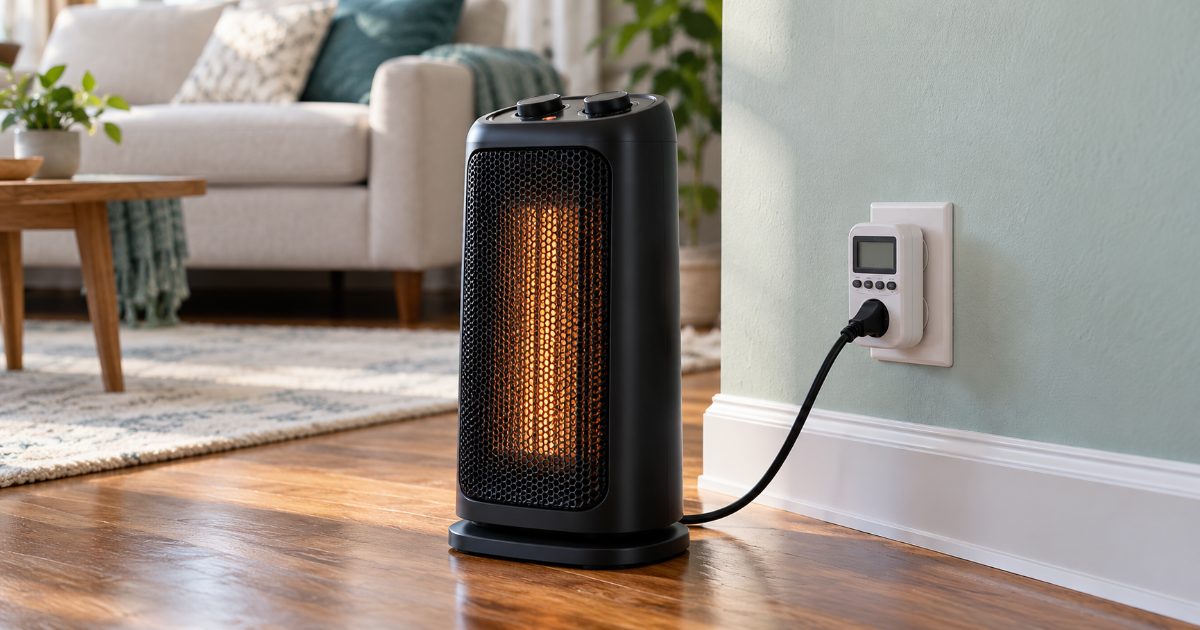
The duty cycle is the estimate. A P3 Kill A Watt P4400 between heater and wall shows accumulated kWh; divide it by the hours run, then by the label kilowatts, for the real duty cycle.
Does the brand change the bill?
No. Every electric resistance heater turns the watts it draws into heat, so a cheaper or dearer 1,500 W unit costs exactly what the list says. What differs is the thermostat, fan and safety features, which the space heater review compares. A heater that trips the breaker is an amps question: see the tripping-breaker guide.
When does a space heater save money?
DOE’s Home Heating guide describes space heaters as providing “supplemental heat to a specific room”, and says portable heaters “are used when the main heating system is inadequate or when central heating is too costly to install or operate”. DOE’s Home Upgrades page says: “You can save as much as 10% a year on heating and cooling by simply turning your thermostat back 7°-10°F for 8 hours a day from its normal setting.”
Those two sentences are the whole case. Heating one occupied room while the house sits at the setback can net out ahead; running the heater with the central thermostat unchanged adds the full calculator figure. No DOE or EIA page compares the two numerically, so this page prints no dollar comparison.
NFPA’s heating page says space heaters and heating stoves account for 30 percent of home heating-equipment fires and 73 percent of the deaths; keep 3 feet of clearance from anything that burns, and switch the heater off when leaving the room or going to bed.
Where do the numbers come from?
The rate is EIA’s Electric Power Monthly, Table 5.6.A, released 24 September 2026: 18.31 cents per kWh for US residential customers in July 2026, against 17.45 cents in July 2025, a one-month national average. The 3,412 Btu per kWh conversion is EIA’s units page; the heater and setback wording is DOE’s; the fire figures are NFPA’s, all read on 2026-10-03.
Two gaps stayed open: no primary source prints a typical thermostat duty cycle, so 100 percent is a stated worst case, and DOE’s Energy Saver pages on portable heaters and thermostats returned 404, so the PDF and the Home Upgrades page stand in. The space heater deal check covers which discounts are real.
Measure before you buy a second heater
A heater bought to cut the bill only works if the central thermostat comes down with it. Before buying anything, run a Kill A Watt P4400 under the heater you already own for one cold evening and type its kWh into the calculator. Skip the meter if the heater runs flat out in an unheated garage: there the 100 percent default is already the answer, and the question is the watt setting, not the brand.
Frequently asked questions
How much does a 1,500 watt space heater cost per hour?
A 1,500 W heater with its element on the whole hour uses 1.5 kWh. At EIA's US average residential rate of 18.31 cents per kWh for July 2026 that is 27.5 cents an hour, and a 900 W setting is 16.5 cents. If the thermostat cycles the element off half the time, halve both figures. Your own bill rate replaces the EIA average.
What is duty cycle and why does the calculator default to 100 percent?
Duty cycle is the fraction of the running time the heating element is actually drawing power. A heater with the thermostat satisfied cycles off, so a cold room at full blast is near 100 percent and a small warm room may be far lower. No primary source prints a typical fraction, so the default is the worst case and a plug-in meter reading replaces the guess.
Does a cheaper space heater cost less to run?
Not at the same wattage. Every electric resistance heater turns the watts it draws into heat, so two 1,500 W heaters on for the same hours use the same 1.5 kWh an hour whatever their price or brand. The bill changes only with the watt setting, the hours, and how much of that time the thermostat keeps the element on.
Is a space heater cheaper than turning up the furnace?
DOE's Home Heating guide calls space heaters supplemental heat for a specific room, used when the main system is inadequate or central heat is too costly. DOE also says turning the thermostat back 7 to 10 F for 8 hours a day can save as much as 10 percent a year. The saving exists only if the heater lets you make that setback.
Which electricity rate should I type in?
The rate on your own bill in cents per kWh, including delivery charges billed per kWh. The default, 18.31 cents, is EIA's US average residential price for July 2026 from Electric Power Monthly Table 5.6.A, up from 17.45 cents in July 2025. State averages in that table spread widely around the national figure, so it is a placeholder, not your rate.
Fact sheet and how to cite this page
- Answer
- Space heater kWh = watts / 1,000 x hours x duty cycle, and cost = kWh x your rate. At EIA’s July 2026 US average residential rate of 18.31 cents per kWh, a 1,500 W heater running 8 hours a day at 100 percent duty uses 12 kWh and costs $2.20 a day, $65.92 over a 30-day month; at 50 percent duty the month is $32.96.
- Formula
kWh = watts / 1,000 x hours per day x duty cycle (0 to 1); cost per day = kWh x rate ($/kWh); cost per month = cost per day x days; BTU/h = watts x 3.412- Inputs
- Watts: 1,500 or 900 as presets; type your heater’s label figure
- Hours per day: 8
- Days per month: 30
- Duty cycle: 100 percent (worst case, element on the whole time); lower it if the thermostat cycles
- Electricity rate: 18.31 cents per kWh (EIA, US average residential, July 2026)
- Output
- 1,500 W x 8 h = 12 kWh a day, $2.20 a day, $65.92 a month; at 50 percent duty 6 kWh, $1.10 and $32.96; 900 W x 8 h x 30 days = 216 kWh, $39.55 a month; 1,500 W = 5,118 BTU/h
- Assumptions
- Duty cycle is the reader’s estimate, not a sourced figure: no primary source gives a typical thermostat cycling fraction, so the default is 100 percent and a plug-in meter is the way to replace it
- EIA’s 18.31 cents is a one-month national average; the rate on your own bill replaces it
- The heater is treated as drawing its label watts whenever the element is on; fan-only draw is ignored
- The worked example rounds $2.1972 a day to $2.20; the monthly figure uses the unrounded value
- Method
- The calculator multiplies watts by hours by duty cycle, divides by 1,000 for kWh and by 100 for a rate typed in cents, then multiplies by days. The EIA rate and the 3,412 Btu per kWh conversion were read on 2026-10-03; the DOE setback and supplemental-heat wording are quoted as printed. Nothing was metered for this page.
- Primary source
- EIA, Electric Power Monthly, Table 5.6.A: Average Price of Electricity to Ultimate Customers by End-Use Sector (July 2026 and 2025) (government or regulatory source)
- Facts verified
- Last updated
- Cite as
- OwnerSpec, "Space heater running cost calculator: cost per hour, day and month from watts, hours, duty cycle and EIA's electricity rate", https://ownerspec.com/air/calculators/space-heater-running-cost-calculator/, facts verified 3 October 2026.
Every figure above also appears, with its source, in the article. All sources · How OwnerSpec verifies numbers
Sources
- EIA, Electric Power Monthly, Table 5.6.A: Average Price of Electricity to Ultimate Customers by End-Use Sector (July 2026 and 2025) (government or regulatory source)
- EIA, Units and calculators: British thermal units (Btu), sample conversion factors (1 kilowatthour = 3,412 Btu) (government or regulatory source)
- DOE Energy Saver, Home Heating (PDF): space heaters provide supplemental heat to a specific room; portable heaters used when the main heating system is inadequate or central heating is too costly (government or regulatory source)
- DOE, Home Upgrades: save as much as 10% a year on heating and cooling by turning the thermostat back 7 to 10 F for 8 hours a day (government or regulatory source)
- DOE Office of Indian Energy, Six Simple Steps To Save Energy and Money This Winter: thermostat setback 7 to 10 degrees for 8 hours a day; appliances not intended for space heating can be unsafe as a primary heat source (government or regulatory source)
- NFPA, Safety with heating equipment: space heaters and heating stoves account for 30% of heating-equipment home fires and 73% of the deaths; keep heaters 3 feet from anything that can burn (manufacturer or vendor document)