Can you leave a space heater on overnight? NFPA, CPSC, USFA, ESFI and the makers' own manuals say switch it off, in these exact words
NFPA, CPSC, USFA and ESFI all say turn a space heater off when leaving the room or going to sleep; Lasko's manual says not unattended. Keep 3 feet clear.
- Verified
- Updated
- 7 min read
- 10 sources
Shop links on this page are affiliate links: a purchase may earn us a commission at no extra cost to you. Disclosure
Short answer
No. NFPA, CPSC, USFA and ESFI all print the same instruction for a portable space heater: turn it off when you leave the room or go to sleep. NFPA’s heating page says to always turn off portable heaters when leaving the room or going to bed; CPSC’s 2026 winter release says to turn off heaters when sleeping; ESFI says never leave a space heater unattended. Lasko’s manual for its 751320 ceramic tower, a heater its product page markets for bedrooms, states that the heater should not be left operating unattended. The reason is in NFPA’s 2020-2024 figures: space heaters and heating stoves caused 30 percent of home heating equipment fires but 73 percent of the deaths. The rules that go with the overnight one are 3 feet of clearance from anything that can burn and a plug straight into the wall outlet, never an extension cord or power strip. Heat the room on a timer before bed, then switch the heater off.
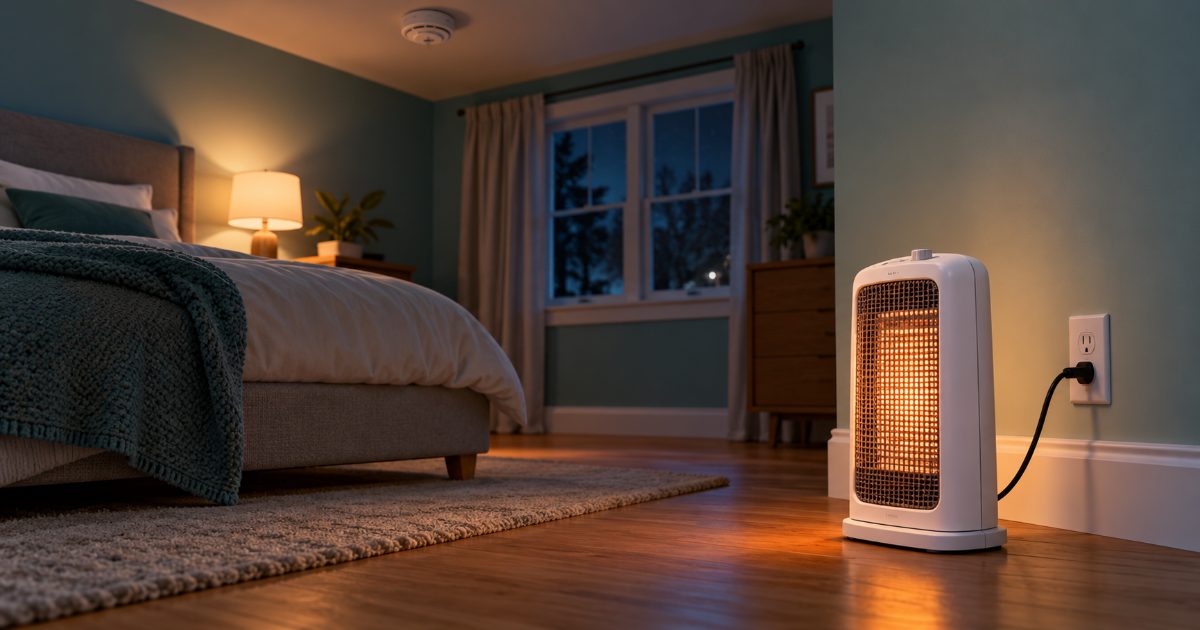
If you are reading this at 11 pm with the heater already running beside the bed, switch it off first: the box that says “bedroom” and the manual that says “not unattended” came from the same maker, and the manual is the one that counts.
What do NFPA, CPSC, USFA and ESFI say?
Four agencies print the rule, and they agree on the wording. A portable space heater is a plug-in electric heater that stands on the floor and heats one room; every rule below is printed for that class, whichever type it is, so the best oil-filled radiator and the best space heater picks are covered alike.
| Rule | Who prints it | Summary of the exact wording |
|---|---|---|
| Turn it off when leaving the room or going to sleep | NFPA heating page; NFPA tip sheet; CPSC 2026; USFA; ESFI | NFPA: “always turning off portable heaters when leaving the room or going to bed”; the tip sheet adds “turned off and unplugged”. CPSC: “Turn off heaters when sleeping.” USFA: “Turn space heaters off when leaving the room or going to bed.” ESFI: “Never leave a space heater unattended. Turn it off when you’re leaving a room or going to sleep.” |
| Keep 3 feet clear of anything that can burn | NFPA heating page; NFPA tip sheet; CPSC 2026; USFA; ESFI | NFPA: at least three feet (1 metre), the tip sheet “including people”. CPSC: drapes, furniture, bedding and other combustible materials. USFA: “anything that can burn at least 3 feet from all heat sources”. ESFI: papers, clothing and rugs. |
| Plug directly into a wall outlet | NFPA tip sheet; CPSC 2026; ESFI | CPSC: “never into an extension cord or power strip”. NFPA tip sheet: never an extension cord. ESFI: “Plug space heaters directly into a wall outlet”. |
| Choose tip-over and overheat protection | NFPA tip sheet | Checklist items: a thermostat and overheat protection, auto shut-off if it tips over, and the seal of a qualified testing laboratory. |
| Solid, flat surface | NFPA tip sheet | Place the heater on a solid, flat surface. |
| Working smoke alarms | ESFI | Smoke alarms on every floor and outside all sleeping areas, tested once a month. |
The tip-over row is the one readers hope cancels the first row. It does not: NFPA’s tip sheet lists tip-over shut-off and overheat protection as features to choose and, in the same checklist, says the heater should be turned off and unplugged when you leave the room or go to bed.
What do the heater makers print in the manual?
Lasko and Vornado print a similar warning as the agencies, in the document most owners never open (De’Longhi’s manual could not be read, so nothing is claimed for it). The contrast on the Lasko 751320 is the point of this page: its product page markets the tower for “bedrooms, living rooms, and other large spaces”, and its instruction manual states that the heater should not be left operating unattended.
| Maker document | Unattended use | Clearance | Outlet | Protection printed |
|---|---|---|---|---|
| Lasko 751320 instruction manual | “The heater should not be left operating unattended” | 3 feet (0.9 m) from the front, 1 foot (0.3 m) from the sides and rear; never on a soft surface like a bed; not for bathrooms or laundry areas | 120 V wall outlet only; no extension cord, power strip, surge protector or multiple-outlet adapter; no other device on the same outlet or circuit | Overheat shut-off that resets only when the user resets the unit; no tip-over switch printed in the English text |
| Vornado MVH owner’s guide | “Extreme caution is necessary … whenever the heater is left operating and unattended” | 3 feet (0.9 m) from the front, away from the sides and rear; not on soft surfaces like a bed; upright on the floor only | Wall outlet only; never an extension cord or relocatable power tap | Tip-over protection when tipped more than 10 degrees in any direction |
| De’Longhi EW7707CM product page | Manual not readable for this page: gap | Not printed on the page | Not printed on the page | Thermal cut-off, fully enclosed heating elements |
Vornado’s wording is caution rather than a ban, and the oil-filled radiator’s manual could not be opened, so the table says so instead of guessing. The oil-filled radiator vs ceramic heater comparison covers what the De’Longhi page does print, including that it lists no tip-over switch.
How often do heating fires happen?
Each agency counts a different thing, so the figures below carry their own years and are never added together.
| Figure | Years | Who prints it |
|---|---|---|
| 37,365 home heating equipment fires a year, 11 percent of reported home fires, 417 civilian deaths, 1,260 injuries | 2020-2024 annual average | NFPA heating page |
| Space heaters and heating stoves: 30 percent of home heating equipment fires, 73 percent of the deaths, 70 percent of the injuries | 2020-2024 | NFPA heating page |
| Two in five deaths in space heater fires involve portable electric space heaters | Not dated on the sheet | NFPA tip sheet |
| About 1,600 fires, 70 deaths and 150 injuries a year involving portable heaters | 2020-2022 | CPSC 2026 release |
| About 32,200 home heating fires, 190 deaths, 625 injuries | 2021 | USFA |
| Portable heaters 3 percent of home heating fires but 41 percent of fatal heating fires | 2017-2019 | USFA |
| More than 65,000 home fires attributed to heating equipment each year | No year printed | ESFI |
The USFA row is the one that answers the question: a small share of the fires and a large share of the fatal ones.
What is the lower-risk way to heat a bedroom at night?
Warm the room before bed and switch the heater off, which every source above allows and none forbids. A heater with a timer does the switching: Lasko’s 751320 page prints a 7-hour timer, so set it to run out before you sleep, not after.
The thermostat is the other half. ESFI’s booklet puts a portable heater at 1,500 W, which is 12.5 A at 120 V, above the 12 A (80 percent) figure it gives for a 15 A circuit; the space heater tripping the breaker guide has the arithmetic, and the space heater running cost calculator turns the hours into a bill.
The alarms matter more than the heater. ESFI’s rule is smoke alarms on every floor and outside all sleeping areas, tested monthly; the best smoke detector and best carbon monoxide detector comparisons list units by their printed listings, and the chirping smoke detector and beeping CO detector guides decode the sounds.
Before you buy anything
Do not buy a heater because its listing says it is built for overnight use: no agency and no manual read for this page says that about any heater. If you only need the room warm for the hour before bed, you need a timer and the off switch you already have, not a better heater. If the heater runs while you are awake in the room, the best oil-filled radiator review lists the fanless picks and the space heater deal check says what a real discount looks like in November.
What should you do first?
- Tonight: switch the heater off before you sleep (NFPA, CPSC, USFA, ESFI) and unplug it (NFPA tip sheet).
- Measure 3 feet from the heater to bedding, curtains, rugs and furniture, and 1 foot at the sides and rear of a Lasko tower.
- Move the plug to a wall outlet with nothing else on it: no extension cord, power strip or surge protector (CPSC, Lasko).
- Read the manual’s unattended-use line for your model, not the box; Lasko and Vornado print it, De’Longhi’s could not be read here.
- Test the smoke alarms on every floor and outside the bedrooms this month (ESFI).
What owners buy for this
The top picks from Best oil-filled radiator heater: every 1500 W radiator makes the same heat, so the maker pages sort them by tip-over switch, lab listing, thermostat range and weight, compared on published specs and certifications.
Wants a knob thermostat, a printed weight and a tip-over switch at the lower price
Dreo 153 oil-filled radiator (DR-HSH033)
Dreo 153 product page: 600/900/1500 W, 7 M-shaped fins, stepless thermostat 41-95 F, shuts off if tipped or overheated, 17.9 lb, 12.83 x 9.92 x 26.14 in, 250 sq ft, 12-month warranty; the page prints no ETL or UL listing
Wants a 1-24 h timer, a digital thermostat and the one maker page here that prints a lab listing
Dreo 310 oil-filled radiator with remote (DR-HSH010)
Dreo 310 product page: 600/900/1500 W plus eco mode, 7 fins, thermostat 41-95 F in 1 F steps, tilt protection, triple overheat protection, ETL listed, 1-24 h timer, remote, 12.2 x 9.84 x 26.06 in, 12-month warranty; weight not printed
Wants the longest-documented radiator and a 2-year warranty, and accepts no tip-over switch printed
De'Longhi EW7707CM oil-filled radiator heater
De'Longhi product page: 1500 W, 3 power settings, 7 fins, room thermostat plus safety thermostat, thermal cut-off, castors, 23.37 lb, 5.9 x 13.78 x 24.9 in, 2-year warranty; the page and the manual print no tip-over switch and no lab listing
Frequently asked questions
Is it safe to leave a space heater on all night while you sleep?
Every US agency that prints a rule says no. NFPA's heating page says to always turn off portable heaters when leaving the room or going to bed, CPSC's 2026 release says turn off heaters when sleeping, USFA says turn space heaters off when going to bed, and ESFI says never leave a space heater unattended. No maker manual read for this page says otherwise.
What does the 3-foot rule for space heaters mean?
NFPA, CPSC, USFA and ESFI all print it: keep anything that can burn at least 3 feet from the heater. CPSC names drapes, furniture and bedding; ESFI names papers, clothing and rugs; NFPA's tip sheet adds people. Lasko's 751320 manual prints 3 feet from the front and 1 foot from the sides and rear, and says never place the heater on a soft surface like a bed.
Can a space heater be plugged into a power strip or extension cord?
No. CPSC says to plug electric space heaters directly into a wall outlet, never into an extension cord or power strip, and NFPA's tip sheet, ESFI, Lasko and Vornado print the same rule. Lasko's manual goes further: no surge protector or multiple-outlet adapter, and no other device on the same outlet or circuit, because a 1,500 W heater draws 12.5 A on its own.
Does tip-over or overheat protection make overnight use acceptable?
The sources do not say so. NFPA's tip sheet lists tip-over shut-off, a thermostat and overheat protection as features to choose, and in the same checklist says the heater should be turned off and unplugged when you leave the room or go to bed. Vornado's MVH guide prints tip-over protection beyond 10 degrees and still calls for extreme caution whenever the heater is left operating and unattended.
How common are space heater fires?
NFPA's heating page gives an annual average of 37,365 home heating equipment fires for 2020-2024, 11 percent of all reported home fires, with 417 deaths; space heaters and heating stoves were 30 percent of those fires but 73 percent of the deaths. USFA reports that portable heaters were 3 percent of home heating fires in 2017-2019 but 41 percent of the fatal ones.
Fact sheet and how to cite this page
- Answer
- No: NFPA, CPSC, USFA and ESFI each print the rule to turn a portable space heater off when leaving the room or going to sleep, and Lasko’s 751320 manual says the heater should not be left operating unattended. NFPA’s 2020-2024 figures put space heaters and heating stoves at 30 percent of home heating equipment fires but 73 percent of the deaths, so keep 3 feet clear and plug straight into a wall outlet.
- Basis
- The switch-off, 3-foot clearance, wall-outlet and tip-over wording as printed by NFPA (heating safety page and portable heater tip sheet), CPSC (2026 winter release), USFA (heating fire safety page) and ESFI (space heater safety page), and the unattended-use wording in the Lasko 751320 instruction manual and the Vornado MVH owner’s guide.
- Assumptions
- Fire figures are quoted with the year range each agency prints and are never combined: NFPA’s 37,365 fires a year (2020-2024), USFA’s 32,200 (2021) and ESFI’s 65,000 (no year printed) count different things
- De’Longhi’s EW7707CM manual could not be opened for this page, so De’Longhi’s unattended-use wording is a stated gap; only its product page’s thermal cut-off is cited
- ‘Not printed’ means the document read on 2026-10-10 does not state the feature; it does not mean the heater lacks it
- Method
- Comparison of the published safety wording of NFPA, CPSC, USFA, ESFI, Lasko and Vornado, read on 2026-10-10. No heater was run, timed or tested. Prices on the product cards are Amazon’s live figures and are never written into this page.
- Primary source
- NFPA, Safety with heating equipment (manufacturer or vendor document)
- Facts verified
- Last updated
- Cite as
- OwnerSpec, "Can you leave a space heater on overnight? NFPA, CPSC, USFA, ESFI and the makers' own manuals say switch it off, in these exact words", https://ownerspec.com/air/guides/can-you-leave-a-space-heater-on-overnight/, facts verified 10 October 2026.
Every figure above also appears, with its source, in the article. All sources · How OwnerSpec verifies numbers
Sources
- NFPA, Safety with heating equipment (manufacturer or vendor document)
- NFPA, Electric Portable Space Heater Safety tip sheet (PDF) (manufacturer or vendor document)
- CPSC, Keep Warm and Safe This Winter (2026 news release) (government or regulatory source)
- USFA, Heating fire safety (government or regulatory source)
- ESFI, Space Heater Safety Tips (manufacturer or vendor document)
- ESFI, Indoor Electrical Safety Check booklet (PDF) (manufacturer or vendor document)
- Lasko, 751320 Ceramic Tower Heater instruction manual (PDF) (manufacturer or vendor document)
- Lasko, 751320 ceramic tower heater product page (manufacturer or vendor document)
- Vornado, MVH Owner's Guide (PDF) (retailer listing or retailer-hosted document)
- De'Longhi, ComfortTemp EW7707CM-6A product page (manufacturer or vendor document)