Oil-filled radiator vs ceramic space heater: same heat per watt, so the choice is fan noise, weight, surface temperature and the room you heat
At 1,500 W both make the same heat: Missouri DNR calls electric resistance heaters 100 percent efficient. Choose by fan noise, weight and tip-over switch.
- Verified
- Updated
- 8 min read
- 11 sources
Shop links on this page are affiliate links: a purchase may earn us a commission at no extra cost to you. Disclosure
Short answer
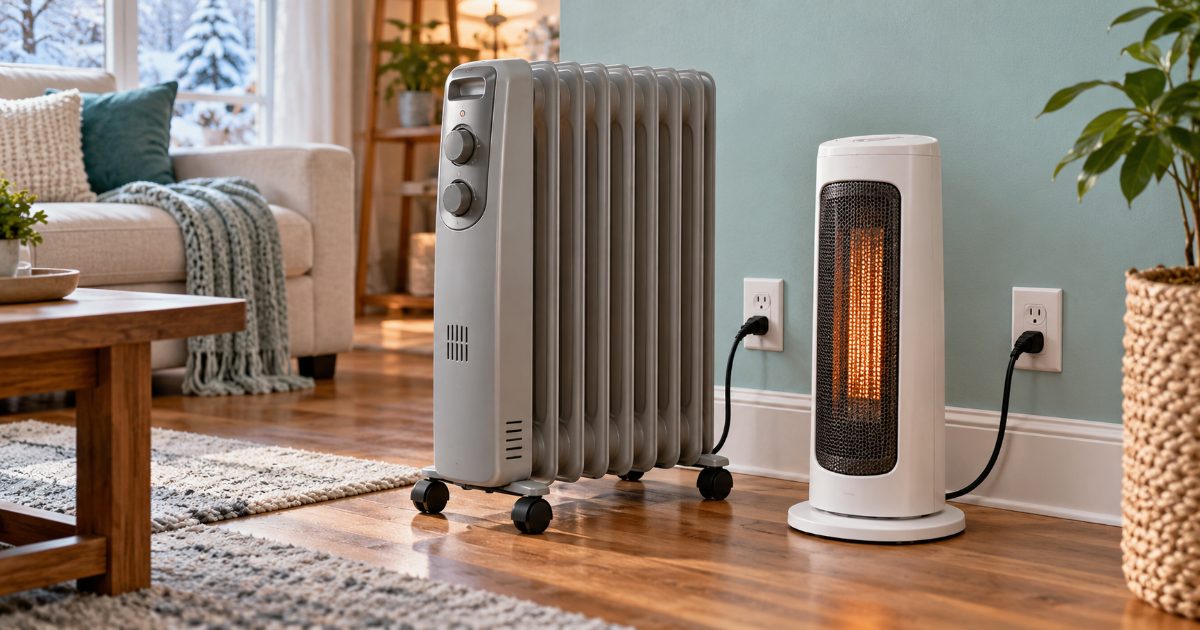
An oil-filled radiator and a ceramic space heater on the same 1,500 W setting put the same heat into the room. Missouri DNR’s space heater fact sheet PUB2849 states that all electric resistance heaters are considered 100 percent efficient because there is no heat loss through ducts or combustion, so neither type is cheaper to run at equal wattage. The difference is delivery. NFPA’s tip sheet defines a ceramic heater as air warmed over a ceramic heating element, and an oil-filled radiator as heated oil travelling through the heater: no fan, no fan noise, a heavier body (De’Longhi lists the EW7707CM at 23.37 lb, Lasko lists the 751320 ceramic tower at 5.67 lb). Both draw up to 12.5 A at 1,500 W on a 120 V circuit, per Vornado’s owner’s guide, which is why either one needs the wall outlet to itself. Pick ceramic for a bathroom or office heated for an hour; pick the radiator for a bedroom where a fan would keep you awake.
The picks
Bedroom, runs all night, wants no fan at all
De'Longhi EW7707CM oil-filled radiator heater
De'Longhi product page: 1500 W, 3 power settings, room thermostat, thermal cut-off, sealed diathermic oil, 23.37 lb, 2-year warranty; the page prints no tip-over switch and no lab listing
Office or bathroom heated for an hour, wants it light and quick
Lasko 751320 23 in ceramic tower heater
Lasko product page: 900-1500 W, 2 heat settings, adjustable thermostat, overheat protection, cool-touch housing, ETL Listed, 7-hour timer, 5.67 lb, 3-year warranty; no tip-over switch printed
Wants a printed tip-over switch and a lab listing with the fan
Vornado MVH (2026) whole room heater
Vornado product page: fan-forced, 3 heat levels, mechanical thermostat, tip-over protection, cool-touch case, overheat shut-off, ETL Listed, 5-year limited warranty; the MVH owner's guide prints 750, 1125 and 1500 W and 12.5 A on high
If the question is which one costs less to run, this is the wrong page: at the same wattage the bill is identical, and the space heater running cost calculator turns the watts into dollars.
Is an oil-filled radiator more efficient than a ceramic heater?
No. Missouri DNR’s fact sheet PUB2849 puts it in one sentence: all electric resistance heaters are considered 100 percent efficient because there is no heat loss through ducts or combustion. A resistance heater is one that makes heat by passing current through a resistance, which is every plug-in heater on this page. 1,500 W in is 1,500 W of heat out, whether the element sits in oil or behind a ceramic plate.
The cost follows from that. Missouri DNR’s formula is kilowatts times rate times time: its example is a 1,500 W heater for 10 hours at $0.10 per kWh, which costs $1.50. Swap the heater type and the arithmetic does not move.
What does move is how many hours the thermostat keeps the element on, and that depends on the room’s heat loss, not the heater. De’Longhi’s own EW7707CM page says the radiator is “only suitable for well insulated spaces or occasional use”, which is the maker conceding the same point.
What actually differs between the two?
NFPA’s portable heater tip sheet defines the types. An oil or water-filled radiator: heated oil or water travels through the heater. A fan-forced heater: a fan blows warm air over metal coils. A ceramic heater: air is warmed over a ceramic heating element.
| Feature | Oil-filled radiator (De’Longhi EW7707CM) | Ceramic tower (Lasko 751320) | Source |
|---|---|---|---|
| Heat at 1,500 W | The same | The same | Missouri DNR PUB2849 |
| Current on high | Up to 12.5 A | About 12.5 A (about 7.5 A at 900 W) | Vornado owner’s guide; Lasko support page |
| Fan | None | Yes, oscillating | De’Longhi page; Lasko page |
| Heat delivery | Oil inside steel fins warms, air rises past them; De’Longhi’s Dragon 4 page describes convection distribution | Fan pushes air over the element and into the room | NFPA tip sheet; De’Longhi Dragon 4 page |
| Warm-up and cool-down time | Not printed as minutes by any maker document opened | Not printed as minutes | Gap, stated honestly |
| Surface temperature | “Maintains a low surface temperature” (no degrees printed) | “Cool-touch housing” (no degrees printed) | De’Longhi page; Lasko page |
| Weight | 23.37 lb | 5.67 lb | De’Longhi page; Lasko page |
| Settings | 3 power settings, room thermostat, thermal cut-off | 900-1500 W, 2 settings, adjustable thermostat, overheat protection, 7-hour timer | De’Longhi page; Lasko page |
| Tip-over switch | Not printed | Not printed | Both product pages |
| Lab listing | Not printed | ETL Listed | De’Longhi page; Lasko page |
| Oil maintenance | Permanently sealed; De’Longhi’s FAQ says the fluid will not need replacing within the product lifetime | None | De’Longhi page and FAQ |
| Warranty | 2 years | 3 years | De’Longhi page; Lasko page |
Two honest gaps. No maker manual opened for this page prints a warm-up time in minutes or a heat-retention time after switch-off, so the page gives the mechanism and no figure. And neither maker prints a surface temperature: “low” and “cool-touch” are the makers’ words, not measurements.
Noise is the same story. De’Longhi’s page says no fan; Lasko’s page shows a noise field that reads 0 dBa, which is not a usable figure, and Vornado’s page says “whisper-quiet” with no number. The only sourced difference is the fan’s existence.
Which type fits which room?
| Room or use | Type | Why | Source |
|---|---|---|---|
| Bedroom, running overnight | Oil-filled radiator | No fan to hear, and the thermostat cycles the element with no fan noise; De’Longhi prints no tip-over switch, so keep it clear of the bed and off the rug per ESFI’s level-surface rule | De’Longhi page; ESFI |
| Home office, heated for the working day | Either; ceramic if it moves between rooms | Same heat per watt; the 5.67 lb tower is the one you carry | Missouri DNR; Lasko page |
| Bathroom or small room heated for an hour | Ceramic with a fan | The fan moves warmed air into the room from the moment it switches on; an oil radiator heats its oil and fins first; no maker prints a warm-up time | Type descriptions (NFPA, De’Longhi); no time figure published |
| Room where a child or dog passes | A unit that prints a tip-over switch (Vornado MVH, more than 10 degrees) | NFPA says to choose auto shut-off on tip-over; the De’Longhi and Lasko pages do not print one | NFPA tip sheet; Vornado owner’s guide |
| Room on a shared 15 A circuit with other loads | Either, on the 900 W or 750 W setting | Both draw up to 12.5 A on high; Lasko gives about 7.5 A at 900 W, Vornado prints 750 and 1125 W settings | Lasko support; Vornado owner’s guide |
| Poorly insulated room, main heat source | Neither | De’Longhi’s own page limits the radiator to well insulated spaces or occasional use; any 1,500 W heater makes the same heat | De’Longhi page; Missouri DNR |
The ceramic row for a child’s room needs the flag the table carries: Lasko’s 751320 page does not print a tip-over switch, and a tower is the tallest shape here. The Vornado MVH is a fan-forced heater rather than a ceramic one by NFPA’s definitions, but it is the unit on this page whose owner’s guide prints the switch and its 10-degree threshold.
Which safety rules apply to both?
The oil versus ceramic choice changes nothing in this table. Every rule is printed for portable electric heaters as a class.
| Rule | As printed | Who prints it |
|---|---|---|
| Clearance | At least 3 feet (1 metre) from anything that can burn, including people; three feet from drapes, furniture, bedding; three feet from papers, clothing and rugs | NFPA tip sheet; CPSC; ESFI |
| Outlet | Plug directly into the wall outlet, never an extension cord or power strip; do not plug any other device into the same outlet | NFPA; CPSC; ESFI; Vornado owner’s guide; Missouri DNR |
| Surface | Solid, flat, level surface; never on cabinets, tables, furniture or carpet | NFPA; ESFI |
| Features to choose | Thermostat, overheat protection, auto shut-off if tipped over, and the seal of a qualified testing laboratory | NFPA; ESFI |
| Unattended | Turn off and unplug when leaving the room or going to bed | NFPA; CPSC; ESFI |
| A tripped breaker | Means the circuit is overloaded; a 1,500 W heater draws up to 12.5 A | Missouri DNR; Vornado owner’s guide; Lasko support |
NFPA’s sheet prints the reason the list exists: two in five deaths in space heater fires involve portable electric space heaters. ESFI’s page adds that heating equipment is the second leading cause of home fires in the United States, with more than 65,000 home fires attributed to it each year.
The breaker row is its own page. If a heater of either type trips the circuit, the arithmetic and the fixes are in space heater tripping the breaker.
Before you buy anything
Do not buy an oil-filled radiator because a listing calls it efficient: at 1,500 W it makes exactly the heat the ceramic tower makes. Buy the De’Longhi EW7707CM for the absence of a fan, and know what its page leaves out: no tip-over switch and no lab listing printed. Buy the Lasko 751320 for 5.67 lb and a fan that moves the heat at once, and know it prints ETL Listed but no tip-over switch either. If both gaps matter, the best space heater comparison puts the Vornado MVH, with the switch and the listing, next to them.
What should you do first?
- Decide the room, not the technology: overnight bedroom means no fan, an hour in a bathroom means a fan.
- Check the outlet: the heater gets a wall outlet to itself, no extension cord, no power strip, nothing else on it (CPSC, ESFI).
- Measure 3 feet of clearance from bedding, curtains, rugs and furniture before the heater arrives (NFPA, CPSC, ESFI).
- Look for the testing laboratory seal and a printed tip-over switch on the listing or maker page; “not printed” is a reason to ask, not to assume.
- Run it on 900 W or 750 W if the circuit carries anything else: 1,500 W is 12.5 A on a 15 A breaker.
Frequently asked questions
Is an oil-filled heater more efficient than a ceramic heater?
No. Missouri DNR's space heater fact sheet PUB2849 states that all electric resistance heaters are considered 100 percent efficient because there is no heat loss through ducts or combustion. An oil-filled radiator and a ceramic heater both set to 1,500 W turn the same 1,500 W into heat; the oil only changes how the heat reaches the room, not how much there is.
Which is cheaper to run, an oil-filled radiator or a ceramic heater?
At the same wattage, neither. Missouri DNR's formula is kilowatts times rate times hours equals cost, and its example is a 1,500 W heater for 10 hours at $0.10 per kWh costing $1.50. The thermostat decides the hours: whichever heater cycles off more in your room costs less, and that depends on the room, not on the oil.
Why is an oil-filled radiator so heavy?
Because it carries a sealed reservoir of oil inside steel fins. De'Longhi's product page lists the EW7707CM at 23.37 lb and describes a permanently sealed diathermic oil reservoir that never needs refilling; its FAQ says the fluid will not need replacing within the product lifetime. Lasko's 751320 ceramic tower, by comparison, lists 5.67 lb on its product page.
Does a 1,500 W heater of either type need its own circuit?
Vornado's MVH owner's guide says the MVH, like any other 1,500 W electric heater, draws up to 12.5 A, and Lasko's support page gives about 12.5 A on high and about 7.5 A on low. Both makers, plus CPSC and ESFI, say to plug the heater directly into a wall outlet and never into an extension cord or power strip; ESFI adds that nothing else should share that outlet.
Should a space heater have a tip-over switch?
NFPA's portable heater tip sheet lists an automatic shut-off if the heater tips over as a feature to choose, with a thermostat and overheat protection. Of the heaters on this page, Vornado's MVH page prints tip-over protection at more than 10 degrees in its owner's guide; the De'Longhi EW7707CM and Lasko 751320 pages do not print a tip-over switch, which is not proof they lack one.
Fact sheet and how to cite this page
- Answer
- An oil-filled radiator and a ceramic space heater on the same 1,500 W setting deliver the same heat: Missouri DNR’s fact sheet PUB2849 states all electric resistance heaters are considered 100 percent efficient. Both draw up to 12.5 A (Vornado owner’s guide). The differences are fan noise, weight (De’Longhi EW7707CM 23.37 lb, Lasko 751320 5.67 lb), a printed tip-over switch, and which room the heater runs in.
- Basis
- Missouri DNR’s statement that electric resistance heaters are considered 100 percent efficient, with no heat loss through ducts or combustion; NFPA’s tip-sheet definitions of oil-filled, fan-forced and ceramic heaters; the 12.5 A draw of any 1,500 W heater as printed in Vornado’s MVH owner’s guide and on Lasko’s support page; CPSC, NFPA and ESFI placement rules as each prints them.
- Assumptions
- Household circuits are 120 V and both heaters are set to 1,500 W; a lower setting draws less and makes less heat in the same ratio
- Warm-up time and heat retention after switch-off are not printed as minutes by any maker document opened for this page, so the page describes the mechanism and gives no figure
- ‘Not printed’ in the tables means the maker page read on 2026-10-04 does not list the feature; it does not mean the heater lacks it
- Method
- Spec and source comparison of the wording published by Missouri DNR, NFPA, CPSC, ESFI, De’Longhi, Vornado and Lasko, read on 2026-10-04, with each listing confirmed in stock the same day. No heater was run, timed or measured. Prices on the product cards are Amazon’s live figures and are never written into this page.
- Primary source
- Missouri DNR, Space Heaters fact sheet PUB2849 (government or regulatory source)
- Facts verified
- Last updated
- Cite as
- OwnerSpec, "Oil-filled radiator vs ceramic space heater: same heat per watt, so the choice is fan noise, weight, surface temperature and the room you heat", https://ownerspec.com/air/guides/oil-filled-radiator-vs-ceramic-space-heater/, facts verified 4 October 2026.
Every figure above also appears, with its source, in the article. All sources · How OwnerSpec verifies numbers
Sources
- Missouri DNR, Space Heaters fact sheet PUB2849 (government or regulatory source)
- NFPA, Electric Portable Space Heater Safety tip sheet (PDF) (manufacturer or vendor document)
- CPSC, Keep Warm and Safe This Winter (2026 news release) (government or regulatory source)
- ESFI, Space Heater Safety Tips (manufacturer or vendor document)
- Vornado, MVH Owner's Guide (PDF) (retailer listing or retailer-hosted document)
- Vornado, MVH product page (manufacturer or vendor document)
- Lasko, 751320 ceramic tower heater product page (manufacturer or vendor document)
- Lasko support, Heater is tripping the breaker. Why? (manufacturer or vendor document)
- De'Longhi, ComfortTemp EW7707CM-6A product page (manufacturer or vendor document)
- De'Longhi, Dragon 4 TRD40615E oil-filled radiator product page (manufacturer or vendor document)
- De'Longhi US FAQ, What type of oil is used in your oil filled radiators? (manufacturer or vendor document)