Radon manometer reading explained: what the U-tube on your mitigation pipe means, what even levels mean, and when to call the installer
The U-tube shows suction in inches of water column, never radon. Even levels mean the fan stopped. Compare to the installer's sticker and retest every 2 years.
- Verified
- Updated
- 7 min read
- 7 sources
Shop links on this page are affiliate links: a purchase may earn us a commission at no extra cost to you. Disclosure
Short answer
The U-tube manometer on a radon mitigation pipe shows the suction the fan is pulling, in inches of water column, and it never shows the radon level: the Minnesota Department of Health’s system information form says so plainly. The reading to compare against is the one the installer wrote on the sticker next to the gauge at start-up. Even fluid levels on both sides mean 0 suction, which the Minnesota form explains as the fan having stopped or another part of the system failing; a reading significantly different from the sticker is the other warning sign. Check the gauge monthly, and before calling anyone confirm the fan has power and the small tube to the pipe is connected and not kinked. EPA’s Consumer’s Guide to Radon Reduction requires a warning device on every active system and says to retest the home at least every 2 years. The gauge proves the fan pulls; only a radon test proves the number.
If you came here hoping the gauge would tell you your radon level, it cannot: a U-tube at exactly the sticker value says nothing about the air upstairs, and the only instrument that does is a radon detector or test kit.
What does the U-tube actually measure?
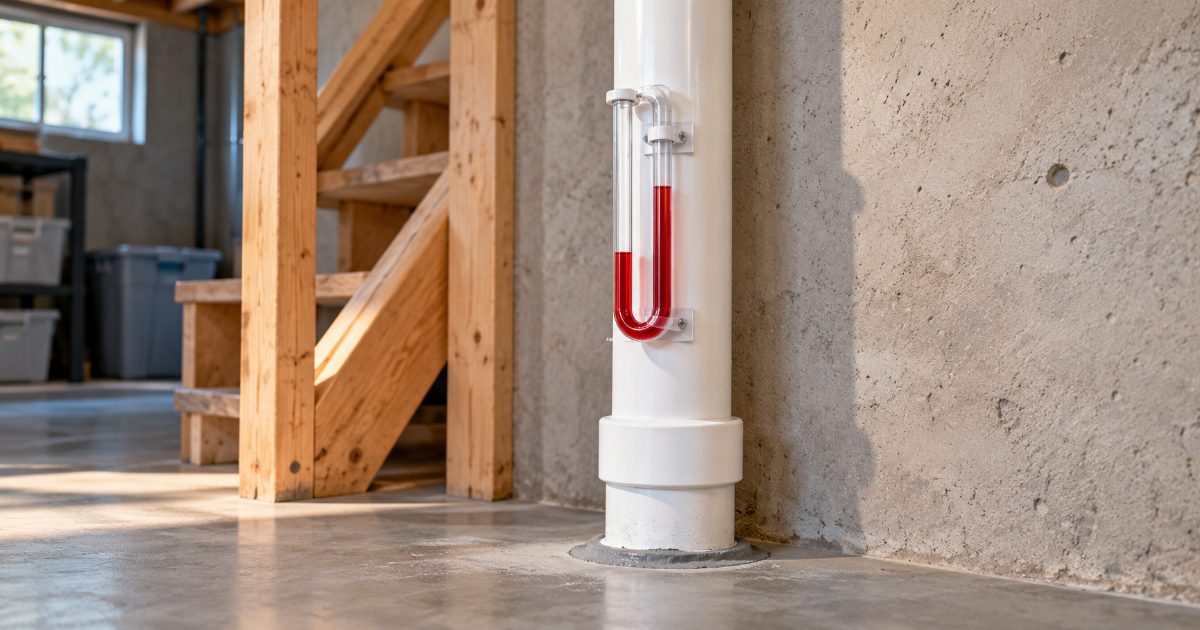
A U-tube manometer is a bent tube of coloured liquid with one end open to the room and the other connected by a small tube to the radon pipe. The fan pulls air out of the pipe, so the liquid on the pipe side rises and the room side falls, and the distance between the two levels is the suction in inches of water column (in. WC). RadonAway’s Easy Read U-Tube Manometer, part 50017, has a scale from 0 to 4.5 in. WC with an adjustable zero, and the maker says it is not suitable for systems above 4.5 in. WC.
EPA’s Consumer’s Guide to Radon Reduction says a warning device must be installed to alert you if an active system stops working properly, lists a liquid gauge, a sound alarm, a light indicator and a dial gauge as examples, and says it must be placed where it can be seen or heard easily. The guide calls the usual device a manometer and says to look at it on a regular basis.
The suction figure depends on the soil under the slab and on the fan, which is why the installer writes the start-up reading on a sticker beside the gauge (Minnesota Department of Health). If the fan itself is the question, the radon mitigation fan review compares the published pressure and airflow figures of the common replacement models.
What does your reading mean?
Compare what you see to the sticker, not to a figure from a forum. No regulator or manufacturer document opened for this page prints a single normal range for all homes, so this table turns on the installer’s value and the fan maker’s maximum.
| What you see | What it means | What to do | Source |
|---|---|---|---|
| Both liquid levels even (reads 0) | No suction in the pipe: the fan has stopped working or another part of the system is not working properly | Check the fan has power and the gauge tubing is connected to the pipe and not kinked; if still even, contact the installer | Minnesota Department of Health OM&M form |
| Reading at or near the sticker value | The system is pulling the suction it was set up with | Nothing; check again next month and retest the home at least every two years | Minnesota Department of Health; EPA Consumer’s Guide |
| Reading significantly lower than the sticker | The system may not be functioning properly | Check tubing and power first, then contact the installer | Minnesota Department of Health OM&M form |
| Reading significantly higher than the sticker | The system may not be functioning properly; if above the fan’s maximum recommended operating pressure, the fan is over its rating | Contact the installer; RadonAway’s manual says an exceeded maximum calls for more suction points | Minnesota Department of Health; RadonAway IN095 Rev F |
| Reading above the gauge’s 4.5 in. WC scale | The gauge is out of range for the system | Ask the installer to fit a gauge rated for the pressure | RadonAway manometer page |
The Minnesota form puts tubing and power before the phone call because a loose tube reads exactly like a dead fan. The zero is set with the fan running at installation; a practitioner write-up from Energy Vanguard names zeroing with the fan off as the common mistake, a method point rather than a number this page relies on.
What is the fan’s maximum pressure?
A higher reading is not a better reading. RadonAway’s IN095 Rev F manual tells the installer to verify at the annual check that the system vacuum pressure is within the normal operating range and below the maximum recommended operating pressure, and to add suction points if it is exceeded. The maximums below are the makers’ printed figures at sea level; RadonAway says to reduce them by about 4 percent per 1,000 feet of altitude and by a further 10 percent in high-temperature environments.
| Fan model | Maximum recommended operating pressure, sea level | Source |
|---|---|---|
| RadonAway RP140 | 0.6 in. WC | RadonAway IN095 Rev F |
| RadonAway RP145 | 1.7 in. WC | RadonAway IN095 Rev F |
| RadonAway RP260 | 1.3 in. WC | RadonAway IN095 Rev F |
| RadonAway RP265 | 2.3 in. WC | RadonAway IN095 Rev F |
| RadonAway RP380 | 2.0 in. WC | RadonAway IN095 Rev F |
| RadonAway XP151 | 1.4 in. WC | RadonAway IN095 Rev F |
| RadonAway XP201 | 1.6 in. WC | RadonAway IN095 Rev F |
| RadonAway GP201 | 1.8 in. WC | RadonAway IN095 Rev F |
| RadonAway GP301 | 2.3 in. WC | RadonAway IN095 Rev F |
| RadonAway GP401 | 3.0 in. WC | RadonAway IN095 Rev F |
| RadonAway GP501 | 3.8 in. WC | RadonAway IN095 Rev F |
| Fantech Rn1 | 0.9 in. WC (operating range 0.0 to 0.8 in. WC, 20 W) | Fantech Rn1 spec sheet |
A sticker value close to the fan’s maximum means tight soil and little air moving, a question for the installer rather than for a bigger fan bought on your own. Fantech’s Rn1 sheet, for example, defines its 0.9 in. WC maximum as the pressure at which the fan operates but moves no air.
When does the gauge fail you?
The gauge reports the fan, not the result. The Minnesota form asks for a short-term retest between 24 hours and 30 days after installation, a retest every 2 years while a system is installed (every 5 years in a building without one), and a retest at sale and after an addition, a reconfiguration, a heating or cooling change that alters pressure relationships, or extensive weatherization. EPA’s Consumer’s Guide says the fan should never be turned off and must run continuously, that fans may last five years or more with maker warranties that tend not to exceed five years, and to retest in the lowest lived-in area after remodeling. Read the result against EPA’s bands in the radon level guide.
Before you buy a replacement fan
Do not order a fan because the levels went even. The Minnesota checklist puts a kinked tube and a tripped circuit ahead of a dead motor, and a fan that spins but reads 0 may simply have lost its gauge connection. If the fan is confirmed dead, match the replacement to the pressure on your sticker and the maximum in the table above; the fan review ranks the common models on exactly those two published figures, and the installer’s label on the pipe tells you which one is in there now.
What should you do first?
- Photograph the gauge next to the installer’s sticker, so the baseline is on your phone.
- Put a monthly reminder in the calendar: the Minnesota form’s interval for checking both the U-tube and any audible alarm.
- If the levels are even, check power at the fan and the tubing at the pipe tap, in that order, then call the installer.
- If the reading has moved significantly from the sticker either way, call the installer; do not re-zero the gauge to make it match.
- Retest every 2 years regardless of what the gauge says, and sooner after the changes Minnesota lists. A continuous radon monitor covers the gap between lab tests; a PM2.5 and CO2 monitor does not read radon.
- On a private well, radon can also arrive in the water, which a soil-suction system does not touch: see the uranium and radon in well water guide. A system drawing on a sump pit depends on its sealed lid, so check a sump pump that is not turning on at the same time.
What owners buy for this
The top picks from Best radon mitigation fan: RadonAway, Festa and Fantech fan curves compared by watts, suction and CFM, with the maker's own sub-slab guidance deciding which one replaces yours, compared on published specs and certifications.
Replacing the fan on a typical 4 in. system over gravel or mixed fill
RadonAway RP145 (4 in.)
RadonAway 2023/2024 fan guide: 34-66 W, recommended max operating pressure 1.7 in. WC, 169 CFM at 0 in., 124 at 0.5, 81 at 1.0, 42 at 1.5 in. WC; 4 in. duct; product page prints ETL Listed for indoor or outdoor use, UL 507 compliant, five-year limited warranty
Same fan for a 3 in. pipe system, or a system whose manometer is missing or dry
RadonAway RP145c kit with U-tube manometer and two 4 x 3 in. couplings
Listed as RP145c; the opened maker documents print no RP145c, so confirm it is the fan above. Bundled with a U-tube manometer (EPA's Consumer's Guide calls the manometer the usual warning device) and two 4 in. to 3 in. PVC couplings
Lowest running cost on a porous sub-slab where the old fan read under 0.5 in. WC
RadonAway RP140 (4 in.)
RadonAway 2023/2024 fan guide: 17-21 W, recommended max operating pressure 0.70 in. WC, max 0.78 in. WC, 138 CFM at 0 in., 66 CFM at 0.5 in. WC; 4 in. duct; Energy Star rated per the guide
Frequently asked questions
What should a radon manometer read?
Whatever the installer wrote on the sticker at start-up, as long as that figure sits under the fan maker's maximum. No regulator or maker document opened for this page prints one normal range for every house: suction depends on the soil under the slab and the fan. RadonAway's IN095 manual lists maximums from 0.6 inches of water column (RP140) to 3.8 (GP501); the Fantech Rn1 sheet gives 0.9.
Why are both sides of my radon manometer level?
Even fluid levels mean the pipe has no suction in it. The Minnesota Department of Health form says that means the fan has stopped working or another part of the system is not working properly. Before calling the installer, check that the fan has power and that the small tube from the gauge to the pipe is connected and not kinked. If the levels stay even, contact the installer.
Does the manometer tell me my radon level?
No. The Minnesota Department of Health form states that the U-tube shows the suction in the pipe and does not show or measure radon. Only a test does that: EPA's Consumer's Guide says to retest at least every two years, and Minnesota's form asks for a short-term retest 24 hours to 30 days after installation. A gauge reading exactly the sticker value still cannot give you the radon number.
My reading is much higher than the sticker. Is that good?
Not necessarily. More suction is not more radon removal: RadonAway's IN095 manual says the vacuum pressure must stay below the fan's maximum recommended operating pressure, and if it is exceeded the fix is to add suction points. The Minnesota form treats any reading significantly different from the installed value as a possible malfunction. Call the installer rather than guessing why the number moved.
How often should I check the manometer and retest?
The Minnesota Department of Health form says to check both fan monitors monthly. EPA's Consumer's Guide says to look at the warning device on a regular basis and to retest the home at least every two years to be sure radon levels remain low; Minnesota adds a retest at sale and after additions, reconfiguration, heating or cooling changes, or extensive weatherization. EPA notes fans may last five years or more.
Fact sheet and how to cite this page
- Answer
- A U-tube manometer on a radon mitigation pipe shows the suction the fan is pulling, in inches of water column, and never the radon level in the house. Even fluid levels mean the fan has stopped or another part of the system has failed; a reading significantly different from the installer’s sticker also needs the installer. Minnesota’s health department says check it monthly, and EPA says retest the home at least every 2 years.
- Basis
- EPA’s Consumer’s Guide to Radon Reduction requires a system failure warning device on every active system and says to look at it regularly; the Minnesota Department of Health OM&M form explains what even and changed fluid levels mean and the monthly check; RadonAway’s IN095 Rev F manual and the Fantech Rn1 spec sheet print the per-fan maximum operating pressures.
- Assumptions
- The reader has an active sub-slab (fan-powered) system with a liquid U-tube gauge; dial gauges and audible alarms are the other warning devices EPA lists and are not read the same way.
- No source opened for this page prints a universal normal range in inches of water column. The normal reading for a given house is the one the installer wrote on the sticker at start-up, checked against the fan maker’s maximum.
- RadonAway’s maximum operating pressures are stated at sea level; the manual says to reduce them by about 4 percent per 1,000 feet of altitude and by a further 10 percent in high-temperature locations.
- The RadonAway Easy Read manometer reads 0 to 4.5 inches of water column; a fan that runs above that needs a different gauge.
- Method
- OwnerSpec read EPA’s Consumer’s Guide to Radon Reduction (2016 PDF) and EPA’s mitigation-system FAQ page, the Minnesota Department of Health Radon Mitigation System Important Safety Information form (OM&M), RadonAway’s Pro Series installation instructions IN095 Rev F, RadonAway’s Easy Read U-Tube Manometer page and the Fantech Rn1 spec sheet on 11 October 2026, and compared only the figures those documents print. No radon system was measured for this page; the fan table is a spec comparison from the makers’ documents.
- Primary source
- Minnesota Department of Health, Radon Mitigation System Important Safety Information (OM&M form, PDF) (government or regulatory source)
- Facts verified
- Last updated
- Cite as
- OwnerSpec, "Radon manometer reading explained: what the U-tube on your mitigation pipe means, what even levels mean, and when to call the installer", https://ownerspec.com/air/guides/radon-manometer-u-tube-reading-what-it-means/, facts verified 11 October 2026.
Every figure above also appears, with its source, in the article. All sources · How OwnerSpec verifies numbers
Sources
- EPA, Consumer's Guide to Radon Reduction (2016 PDF) (government or regulatory source)
- EPA, How do I know if my radon mitigation system is working properly? (government or regulatory source)
- Minnesota Department of Health, Radon Mitigation System Important Safety Information (OM&M form, PDF) (government or regulatory source)
- RadonAway, RP/GP/XP Pro Series Installation Instructions IN095 Rev F (PDF) (manufacturer or vendor document)
- RadonAway, Easy Read U-Tube Manometer (Blue), SKU 50017 (manufacturer or vendor document)
- Fantech, Rn1 radon fan specification sheet (PDF, distributor-hosted copy) (manufacturer or vendor document)
- Energy Vanguard, How to read a U-tube manometer (method only) (manufacturer or vendor document)