Heat cable sizing calculator: how much self-regulating cable a pipe run takes, and whether one breaker will carry it
Chemelex's formula is pipe length x spiral ratio, plus 4 ft per globe valve, 2 ft per support, 1 ft per power connection. Its own 50 ft example needs 78.0 ft.
- Verified
- Updated
- 7 min read
- 7 sources
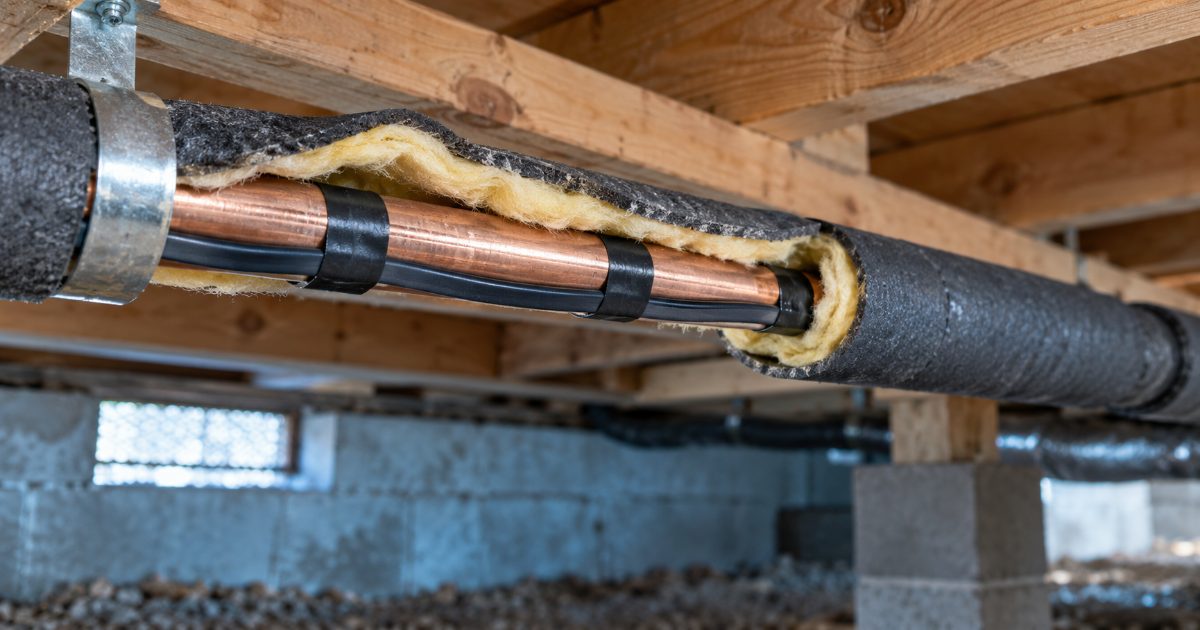
Shop links on this page are affiliate links: a purchase may earn us a commission at no extra cost to you. Disclosure
Short answer
Self-regulating heat cable is sold by watts per foot at a stated pipe temperature, and the length you buy is always longer than the pipe. Chemelex’s Raychem design guide gives the formula: pipe length times the spiral ratio, plus 4 ft per gate or globe valve and 2 ft per ball valve, flange or support (each multiplied by a length adjustment factor and the spiral ratio), plus 1 ft per power connection, 2 ft per splice and 3 ft per tee. Chemelex’s published example, 50 ft of 2.5 in metal pipe at a 1.3 spiral ratio with three globe valves, ten supports, one power connection and one splice, prints 78.0 ft; the calculator below opens on those inputs and returns 82.3 ft, because it uses the 2.5 in run’s own adjustment factor. The second number is the breaker. WinterGard H311 is allowed 250 ft on a 15 A circuit at a 40 F start-up and only 150 ft at 0 F.
The picks
A measured run of roughly 40 ft on metal or plastic pipe up to 2.5 in
HEATIT 40 ft Self-Regulating Heat Cable for Water Pipes, 3 W/ft
HEATIT lists the JHSF cable as self-regulating, 3 W/ft at 50 F, with a built-in thermostat, for plastic and metal pipes up to 2.5 in; the listing title says ETL Certified and prints no standard number
A crawl-space or well-house run once the formula lands past 40 ft
HEATIT 60 ft Self-Regulating Heat Cable with Auto Thermostat, 3 W/ft
Same JHSF cable in a 60 ft pre-assembled length; HEATIT says it can be installed straight, spiralled or overlapped and asks for at least 1/2 in of insulation, 1 in below -20 F
A short straight run where nothing will be spiralled
Frost King HC24A Automatic Electric Heat Cable Kit, 24 ft
Frost King lists the automatic kits at 120 V and 7 watts per foot for 2 in metal and plastic water pipes down to -40 F; its instruction sheet says the cable must not be wrapped or spiraled
If the cable in your hand is a Frost King automatic kit, stop here: its instruction sheet says that cable must not be wrapped or spiraled, so there is nothing to size but the pipe.
Cable length from the pipe run, and the circuits it needs
Spiral ratio from the design guide's Table 1 (metal) and Table 2 (plastic). Length from its Step 4 formula, with Table 3 adjustment factors (1/2 in 0.04, 1 in 0.08, 2 in 0.17, 3 in 0.25, 4 in 0.33, 5 in 0.42, 6 in 0.50); sizes Table 3 does not print take the next larger factor. Circuits from its Table 4. The guide's selection tables assume fiberglass insulation or equivalent and a 40 F minimum maintain temperature.
What is the formula?
Six terms, all from Step 4 of the Chemelex design guide.
| Term | What it adds | Multiplied by |
|---|---|---|
| A | Pipe length | spiral ratio |
| B | 4 ft per gate or globe valve | length adjustment factor, spiral ratio |
| C | 2 ft per ball or butterfly valve, flange or support | length adjustment factor, spiral ratio |
| D | 1 ft per power connection | nothing |
| E | 2 ft per splice connection | nothing |
| F | 3 ft per tee connection | nothing |
Table 3 prints the length adjustment factor by pipe size: 0.04 for 1/2 in, 0.08 for 1 in, 0.17 for 2 in, 0.25 for 3 in, 0.33 for 4 in, 0.42 for 5 in and 0.50 for 6 in. Nothing is printed for 3/4, 1-1/4, 1-1/2 or 2-1/2 in, so the calculator takes the next larger printed factor.
One inconsistency worth knowing, and the reason this page and the guide disagree: the worked example puts the physical valve length, 0.5 ft, into term B, then 0.085 into term C, the factor for the 1 in pipe its supports are sized for rather than the 0.25 Table 3 prints for the 2.5 in run being traced. The valve length is a separate input above for that reason. This calculator uses the run’s own factor, so the guide’s inputs return 82.3 ft where the guide prints 78.0 ft. Under-sizing heat cable is the dangerous direction, so the calculator shows the larger number.
Which spiral ratio applies?
The ratio is feet of cable per foot of pipe, read off Table 1 for metal and Table 2 for plastic by pipe size, lowest expected air temperature and insulation thickness. A cell with no number is straight-traced.
| Conditions | 1 in | 1.5 in | 2 in | 3 in | 4 in |
|---|---|---|---|---|---|
| Metal, -20 F, 0.5 in insulation | straight | straight | 1.1 | 1.5 | 1.8 |
| Metal, -40 F, 0.5 in insulation | straight | 1.2 | 1.4 | 2.0 | 3.0 |
| Plastic, -20 F, 0.5 in insulation | 1.1 | 1.5 | 1.8 | 3.0 | not printed |
| Plastic, -40 F, 0.5 in insulation | 1.5 | 2.0 | 3.0 | not printed | not printed |
Plastic takes roughly 1.5 to 2 times the cable metal does at the same conditions.
Above 2.0 the word “spiral” stops being literal: the guide installs 2.0 as two straight traces at the 4 and 8 o’clock positions, and 3.0 as three.
Will one breaker carry the run?
Not necessarily, and this is the constraint the pipe-length arithmetic hides. Table 4 caps the heater length per circuit by cable, breaker and start-up temperature.
| Cable | 15 A | 20 A | 30 A |
|---|---|---|---|
| WinterGard H311, 120 V | 250 / 150 | 250 / 200 | 250 / 250 |
| WinterGard Plus H611, 120 V | 150 / 125 | 195 / 140 | 200 / 200 |
| WinterGard Plus H621, 240 V | 255 / 200 | 340 / 250 | 400 / 375 |
Feet at a 40 F start-up first, then at 0 F. The guide says to use 40 F unless start-up below freezing is required, and that the limits are based on start-up load.
Doubling the voltage roughly doubles what one breaker carries: 240 V H621 gets 255 ft on the same 15 A breaker that gives 120 V H611 only 150 ft.
What the manufacturer decides, not this page
Four things are instructions, not rules of thumb, and the wrong guess on any of them is a fire.
- Pipe material. Chemelex says its self-regulating cables can be used on plastic as well as metal. Frost King’s automatic kits are listed for 2 in metal and plastic water supply pipes.
- Overlap. Chemelex says its self-regulating core protects against overheating or hot spots when overlapped. Frost King’s automatic kit cable must not be wrapped or spiraled at all.
- Insulation. Chemelex’s selection tables assume fiberglass insulation or equivalent and a 40 F minimum maintain temperature. HEATIT asks for at least 1/2 in, and 1 in below -20 F.
- Ground fault. Chemelex prints a Fire Hazard warning that ground-fault equipment protection must be used on each heating cable branch circuit, and that arcing may not be stopped by conventional circuit protection. NFPA 70 covers this equipment in Article 427, Fixed Electric Heating Equipment for Pipelines and Vessels.
A new breaker or a dedicated circuit is licensed electrical work in most jurisdictions and usually needs a permit. A plug-in kit into an existing protected receptacle is not, so if the job is the first kind it belongs with an electrician.
Measure the pipe before the cart
The formula needs a pipe run, a material and a size, and nothing sold in a box knows any of them. A tape measure and the frozen pipes guide decide whether you need cable at all.
Once the number is real, the HEATIT 40 ft, 3 W/ft self-regulating cable is the pre-assembled class for a short metal or plastic run. Skip it if your answer landed past 60 ft, or if the pipe is larger than 2.5 in: that is cut-to-length territory and a different design.
Two readers should close this page. Anyone tracing a drain, a fuel line or a hose is outside what these cables are listed for. Anyone whose table cell came back “not printed” has a pipe the guide answers with thicker insulation, not more cable.
Frequently asked questions
How much heat cable do I need for a 50 foot pipe?
More than 50 feet. Chemelex's worked example takes 50 ft of pipe at a 1.3 spiral ratio, three globe valves, ten supports, one power connection and one splice, and prints 78.0 ft of cable. Reading the 2.5 in run's own Table 3 factor instead of the supports' factor, this calculator returns 82.3 ft.
What does the spiral ratio mean on a heat trace table?
It is feet of heating cable per foot of pipe. Chemelex says a cell with no number is straight-traced, and that a ratio of 2.0 is installed as two straight traces at the 4 and 8 o'clock positions rather than an actual spiral, while 3.0 becomes three traces, adding the 11 or 1 o'clock position.
Why does plastic pipe need so much more heat cable than metal?
Because plastic conducts the heat away from the cable far more slowly. In Chemelex's own tables at -40 F with 1/2 in insulation, a 2 in metal pipe takes a 1.4 spiral ratio and a 2 in plastic pipe takes 3.0, which is 1.6 extra feet of cable for every foot of pipe.
How long a heat cable run can one breaker carry?
It depends on the cable, the breaker and the start-up temperature. Chemelex's Table 4 allows WinterGard H311 on 120 V 250 ft on a 15 A breaker at a 40 F start-up but only 150 ft at 0 F, and WinterGard Plus H621 on 240 V 255 ft and 200 ft on the same breaker.
Does heat cable need a GFCI breaker?
Chemelex says so. Its design guide prints a Fire Hazard warning that ground-fault equipment protection must be used on each heating cable branch circuit to comply with agency certifications and national electrical codes, and adds that arcing may not be stopped by conventional circuit protection. NEC Article 427 covers this equipment.
Fact sheet and how to cite this page
- Answer
- Chemelex’s Raychem design guide sizes cut-to-length cable as pipe length x spiral ratio, plus 4 ft per gate or globe valve and 2 ft per ball valve, flange or support (each x a length adjustment factor x the spiral ratio), plus 1 ft per power connection, 2 ft per splice and 3 ft per tee. Its own 50 ft example returns 78.0 ft.
- Formula
Length = (pipe length x spiral ratio) + (4 ft x gate/globe valves x adjustment factor x spiral ratio) + (2 ft x ball valves, flanges and supports x adjustment factor x spiral ratio) + 1 ft per power connection + 2 ft per splice + 3 ft per tee- Inputs
- Pipe material: metal
- Pipe size: 2.5 in
- Pipe run: 50 ft
- Spiral ratio: 1.3
- Gate or globe valves: 3, each 0.5 ft long
- Ball valves, flanges and supports: 10
- Power connections: 1; splices: 1; tees: 0
- Output
- 82.3 ft of heating cable on the guide’s own inputs, which is one circuit: WinterGard Wet H612 on 120 V is allowed 150 ft on a 15 A breaker at a 40 F start-up. The guide’s example prints 78.0 ft, using the supports’ length adjustment factor rather than the run’s.
- Assumptions
- Spiral ratios are read off the guide’s Tables 1 and 2, which are based on pipes with fiberglass insulation or equivalent and a minimum maintain temperature of 40 F
- Table 3 prints length adjustment factors only for 1/2, 1, 2, 3, 4, 5 and 6 in pipe; this page uses the next larger printed factor for the sizes in between
- Maximum circuit lengths are based on start-up load, and the guide says to use a 40 F start-up temperature unless start-up below freezing is required
- Method
- The calculator applies the design guide’s Step 4 formula to the reader’s inputs, looks the spiral ratio up in the guide’s Tables 1 and 2 by material, pipe size, lowest expected air temperature and insulation thickness, and then checks the total against the guide’s Table 4 maximum circuit length for the chosen cable and breaker.
- Primary source
- Chemelex, Raychem Residential and Light Commercial Self-Regulating Heating Products Application and Design Guide (PDF) (manufacturer or vendor document)
- Facts verified
- Last updated
- Cite as
- OwnerSpec, "Heat cable sizing calculator: how much self-regulating cable a pipe run takes, and whether one breaker will carry it", https://ownerspec.com/plumbing/calculators/heat-cable-sizing/, facts verified 21 September 2026.
Every figure above also appears, with its source, in the article. All sources · How OwnerSpec verifies numbers
Sources
- Chemelex, Raychem Residential and Light Commercial Self-Regulating Heating Products Application and Design Guide (PDF) (manufacturer or vendor document)
- Chemelex, WinterGard Self-Regulating Heating Cable product page (manufacturer or vendor document)
- Frost King, Automatic Electric Heat Cable Kits product page (manufacturer or vendor document)
- Frost King, Instruction Sheet: Automatic Electric Heat Cables (PDF) (manufacturer or vendor document)
- UpCodes, NFPA 70 (2023) Article 427, Fixed Electric Heating Equipment for Pipelines and Vessels (manufacturer or vendor document)
- HEATIT, JHSF1 Self-Regulating Pre-assembled Heating Cable product page (manufacturer or vendor document)
- HEATIT, 5JHSF 120 V Self-Regulating Pre-assembled Water Pipe Heat Cable product page (manufacturer or vendor document)