Water heater element resistance calculator: the ohms a good element should read, and the pass band the maker actually prints
R = V² / P: a 4500 W, 240 V element computes to 12.8 ohms. The maker's manual passes 5 to 25 ohms; OL, under 5 or over 25 means replace. Breaker off first.
- Verified
- Updated
- 7 min read
- 6 sources
Shop links on this page are affiliate links: a purchase may earn us a commission at no extra cost to you. Disclosure
Short answer
A good electric water heater element reads close to R = V² / P: the rated voltage squared, divided by the rated wattage, both from the tank’s data plate. The common 4500 W, 240 V element computes to 12.8 ohms, a 5500 W, 240 V element to 10.5 ohms and a 3800 W element to 15.2 ohms. Those are computed values from the power law, checked with node, not figures copied from a manual. The maker rule is wider: A. O. Smith’s residential electric Use and Care Guide says a good element measures between 5 and 25 ohms across its two screw terminals, and that a reading outside that band means replace the element. So a meter showing OL, or a value under 5 or over 25 ohms, fails the element; 11 or 14 ohms on a 4500 W element passes. Turn the power off at the breaker and confirm the wires are dead with a non-contact tester before touching a terminal, as the same guide requires.
The picks
The data plate says 4500 W, 240 V and the meter read OL or out of band
Camco 02583, 4500 W, 240 V screw-in foldback element
Listing title: 4500 W, 240 V, screw-in foldback, low watt density; computes to 12.8 ohms. The maker's certification document was not read for this page
The data plate says 5500 W, 240 V
Camco 02362/02363, 5500 W, 240 V screw-in foldback element
Listing title: 5500 W, 240 V, screw-in foldback, high watt density; computes to 10.5 ohms. The maker's certification document was not read for this page
Wants the maker-branded 4500 W replacement for a Rheem tank
Rheem SP10869MM, 4500 W, 240 V screw-in element
Listing title: Rheem SP10869MM, 240 V, 4500 W, screw-in, stainless steel; computes to 12.8 ohms. Confirm fit against the model's parts list, not this page
Has no meter with a resistance and continuity range
Klein Tools MM325 manual-ranging digital multimeter
Listing title: digital manual-ranging, 600 V AC/DC, tests resistance and continuity. Its safety category was not verified from a Klein document for this page
If a forum told you a 4500 W element must read exactly 12.8 ohms, the one maker manual we could read passes anything from 5 to 25, and the reading that condemns an element is OL.
Expected element resistance, and what your meter reading means
R = V² / P and I = P / V, from Ohm's law and P = VI (HyperPhysics). The pass band of 5 to 25 ohms is A. O. Smith's Residential Electric Use and Care Guide. The 10 percent tolerance around the computed value is this site's rule of thumb, not a maker figure. Watts on a different supply voltage = rated W x (supply V / rated V)², the power law applied by this site.
What is the formula?
Resistance is the rated voltage squared, divided by the rated wattage: R = V² / P. HyperPhysics (Georgia State University) states P = VI and that the power expressions for a resistor follow from Ohm’s law, valid for AC with rms values.
Both inputs are on the data plate, which A. O. Smith’s guide says to check before buying an element; its element availability sheet lists 208 V and 240 V as separate ratings for the same kilowatt input. A 4500 W element rated for 208 V computes to 9.6 ohms, the 240 V version to 12.8.
The maker’s pass rule is a band, not a point. A. O. Smith’s guide says a good element measures between 5 and 25 ohms across its two screw terminals; outside that range, replace it. At 240 V that band spans 2304 W to 11,520 W, so it is a fault test, not a rating check.
What does a worked example look like?
The data plate reads 4500 W, 240 V, and the meter reads 12.4 ohms with the wires disconnected.
| Step | Working | Result |
|---|---|---|
| Expected resistance | 240 x 240 / 4500 | 12.8 ohms |
| Rated current | 4500 / 240 | 18.8 A |
| Maker band | 12.4 is between 5 and 25 | passes, per A. O. Smith |
| Site rule of thumb | 12.4 is 3 percent below 12.8 | matches the rating |
OL means no path between the terminals, outside the band: replace. A reading of 19.2 ohms still passes the band, and 19.2 is what a 3000 W, 240 V element computes to, so the plate gets re-read first. The 10 percent tolerance is this site’s own; no maker tolerance was found.
What should common elements read?
Every value is R = V² / P, recomputed with node on 2 October 2026. A. O. Smith’s ENT/ENS specification lists 4500 W at 240 V as its standard residential element. The heating element parts page matches the plate to a part.
| Rated watts | 120 V | 208 V | 240 V | 277 V |
|---|---|---|---|---|
| 1500 W | 9.6 ohms | 28.8 ohms | 38.4 ohms | 51.2 ohms |
| 2000 W | 7.2 ohms | 21.6 ohms | 28.8 ohms | 38.4 ohms |
| 3000 W | 4.8 ohms | 14.4 ohms | 19.2 ohms | 25.6 ohms |
| 3800 W | 3.8 ohms | 11.4 ohms | 15.2 ohms | 20.2 ohms |
| 4000 W | 3.6 ohms | 10.8 ohms | 14.4 ohms | 19.2 ohms |
| 4500 W | 3.2 ohms | 9.6 ohms | 12.8 ohms | 17.1 ohms |
| 5500 W | 2.6 ohms | 7.9 ohms | 10.5 ohms | 14.0 ohms |
| 6000 W | 2.4 ohms | 7.2 ohms | 9.6 ohms | 12.8 ohms |
12.8 ohms is both a 4500 W element at 240 V and a 6000 W element at 277 V: the ohms alone never identify the element.
What happens to a 240 V element on 208 V?
The resistance stays at 12.8 ohms, so the power law P = V² / R gives (208 / 240)² = 75.1 percent of rated watts. A 4500 W element delivers about 3380 W, a 5500 W element about 4131 W, a 3800 W element about 2854 W.
That is this site’s arithmetic, not a maker statement. A. O. Smith’s guide lists low supply voltage as a cause of slow recovery, and its element sheet’s recovery table scales with element kilowatts.
How do you take the reading?
Steps 1 to 3 are A. O. Smith’s Use and Care Guide.
- Turn the power off at the circuit breaker or remove the fuses. The guide warns that working near an energized circuit can result in severe injury or death from electrical shock.
- Remove the upper access panel and confirm with a non-contact circuit tester that the power wires are dead.
- Disconnect the two power wires from the element’s screw terminals.
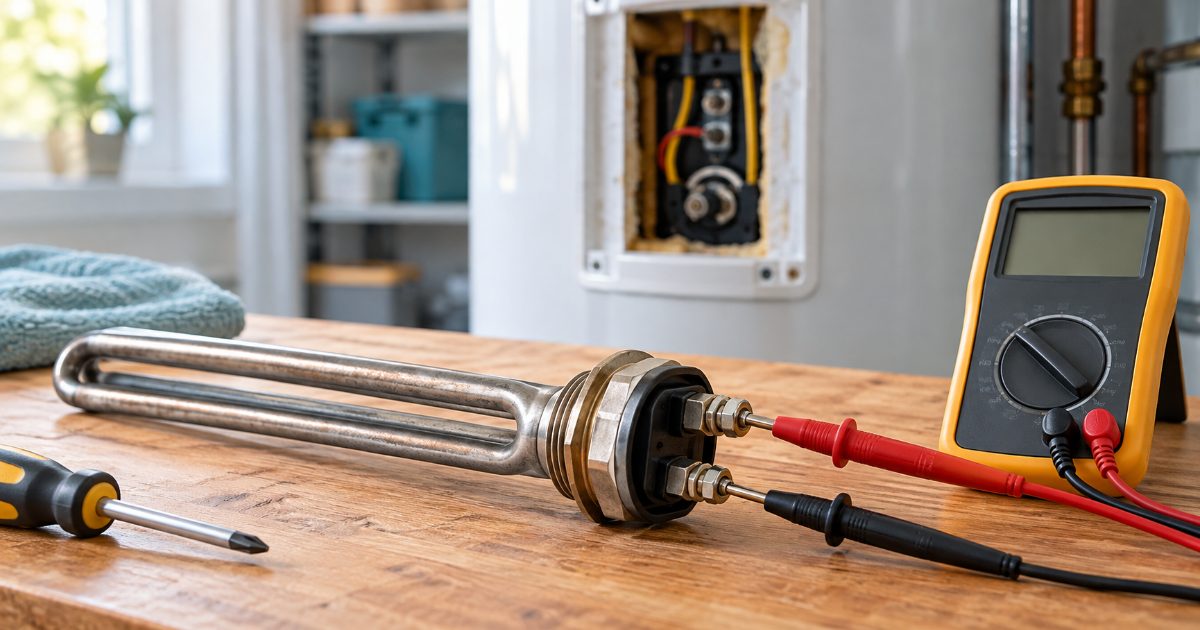
- On the ohms range, measure between the two screw terminals and compare with the band above.
- Repeat on the lower element.
Rheem’s hybrid manual prints the same order: disconnect power, then check resistance against its ohm chart, which did not extract from the PDF, so no Rheem figure appears here. A. O. Smith lists a grounded or shorted element as a cause of overheated water, fix “replace heating element”, but prints no terminal-to-sheath test, so this page attributes none to the maker.
Who should skip this calculator?
Anyone with a gas water heater: there is no element, and a burner that will not stay lit is the pilot light and thermocouple guide. Anyone who has not ruled out a tripped breaker or reset button starts at the no hot water guide, where the element is the last check.
Do not buy an element until the meter fails it
A reading inside 5 to 25 ohms passes the only maker rule read for this page, and swapping a passing element leaves the real fault in place. Buy a replacement only when the meter shows OL or a value outside the band, in the wattage and voltage printed on the data plate.
Every expected ohm value here is computed, not measured by this site. Work on the heater follows the maker’s manual and the electrical code adopted where you live, which may require a licensed electrician.
Frequently asked questions
What should a 4500 watt water heater element read in ohms?
Divide the rated voltage squared by the rated watts: 240 x 240 / 4500 = 12.8 ohms. That is a computed value from the power law, not a maker figure. The maker rule read for this page is wider: A. O. Smith's Use and Care Guide passes any reading between 5 and 25 ohms across the two screw terminals and says to replace the element outside that band.
What does OL on the multimeter mean when testing a heating element?
OL is the meter reporting a resistance above its range, with no measurable path between the two terminals. That is outside A. O. Smith's 5 to 25 ohm pass band, so by the maker's rule the element is replaced. Calling that an open or burned-out element is the ordinary reading of OL on a multimeter; the A. O. Smith manual itself only prints the band.
Can a 240 volt water heater element run on 208 volts?
The resistance does not change, so the power law gives (208 / 240)² = 75.1 percent of rated watts: a 4500 W element delivers about 3380 W. That is this site's arithmetic. A. O. Smith's element availability sheet lists 208 V and 240 V as separate element ratings, and its manual lists low supply voltage as a cause of slow hot-water recovery.
Why does my element read 20 ohms when the calculator says 12.8?
First check the data plate: a 3800 W element at 240 V computes to 15.2 ohms and a 3000 W element to 19.2, so 20 may be the right value for a different element. Second, 20 ohms sits inside A. O. Smith's 5 to 25 ohm band, which is the only maker pass rule read for this page. Replace it only when the reading leaves that band.
Do I need to turn the power off to test a water heater element?
Yes. A. O. Smith's Use and Care Guide says to turn the power off at the circuit breaker or remove the fuses, remove the access panel and confirm with a non-contact circuit tester that the power wires are dead before measuring, and warns that working near an energized circuit can result in severe injury or death from electrical shock. Resistance is measured with the wires disconnected.
Fact sheet and how to cite this page
- Answer
- A good element reads close to R = V² / P: a 4500 W, 240 V element computes to 12.8 ohms, a 5500 W element to 10.5 and a 3800 W element to 15.2. The maker rule read for this page (the Use and Care Guide in the source below) is a wider pass band of 5 to 25 ohms across the two screw terminals, with replacement outside it, power off at the breaker first.
- Formula
R (ohms) = V² / P, with V the rated voltage on the data plate and P the rated wattage; I (amps) = P / V; watts on another supply voltage = P x (supply V / rated V)²- Inputs
- Rated wattage: 4500 W
- Rated voltage: 240 V
- Measured resistance across the two terminals, optional: 12 ohms
- Supply voltage if it differs from the rating, optional: 208 V
- Output
- 12.8 ohms expected and 18.8 A at 240 V; 12 ohms is inside A. O. Smith’s 5 to 25 ohm band and within 10 percent of the computed value; on 208 V the same element delivers 75.1 percent of 4500 W, about 3380 W
- Assumptions
- R = V² / P follows from Ohm’s law and P = VI, which HyperPhysics states hold for AC with rms values; the resistance is the element’s cold reading at the terminals
- The only maker figure read is A. O. Smith’s 5 to 25 ohm pass band; no maker document read prints 12.8 ohms for a 4500 W element, so every expected value on this page is computed
- The 10 percent tolerance around the computed value is this site’s rule of thumb, not a maker figure; A. O. Smith’s band is the only maker rule
- The 75.1 percent figure for a 240 V element on 208 V is the power law applied by this site; A. O. Smith’s element sheet lists 208 V and 240 V as separate ratings and prints no derating statement
- Method
- The calculator divides the square of the rated voltage by the rated wattage, prints the current from P / V, and, when a measured reading is entered, compares it first with A. O. Smith’s 5 to 25 ohm band and then with the computed value. Every value in the table was recomputed with node on 2 October 2026. No element was bench-tested for this page.
- Primary source
- A. O. Smith, Residential Electric Water Heater Installation Instructions and Use & Care Guide (ENT-50 manual, PDF) (manufacturer or vendor document)
- Facts verified
- Last updated
- Cite as
- OwnerSpec, "Water heater element resistance calculator: the ohms a good element should read, and the pass band the maker actually prints", https://ownerspec.com/plumbing/calculators/water-heater-element-resistance-ohms-test/, facts verified 2 October 2026.
Every figure above also appears, with its source, in the article. All sources · How OwnerSpec verifies numbers
Sources
- A. O. Smith, Residential Electric Water Heater Installation Instructions and Use & Care Guide (ENT-50 manual, PDF) (manufacturer or vendor document)
- A. O. Smith, PGT-80 Residential Electric Water Heater Use & Care Guide (electronic thermostat model, PDF) (manufacturer or vendor document)
- A. O. Smith, Residential Electric Element Availability Sheet, AOSTD63000 (October 2020, PDF) (manufacturer or vendor document)
- A. O. Smith, Commercial-Grade Residential Electric Water Heaters ENT/ENS product specification, AOSRE50608 (PDF) (manufacturer or vendor document)
- HyperPhysics, Georgia State University: Electric Power (university or extension service)
- Rheem, Electric Residential Hybrid Water Heater Use & Care Manual, AP23657 (PDF) (manufacturer or vendor document)