Water heater size calculator: peak-hour demand and the first hour rating that has to cover it
Count each hot-water use in the busiest hour, multiply by DOE's gallons per use, add them up. DOE's own example is 66 gallons; buy a first hour rating of 66 or more.
- Verified
- Updated
- 7 min read
- 8 sources
Short answer
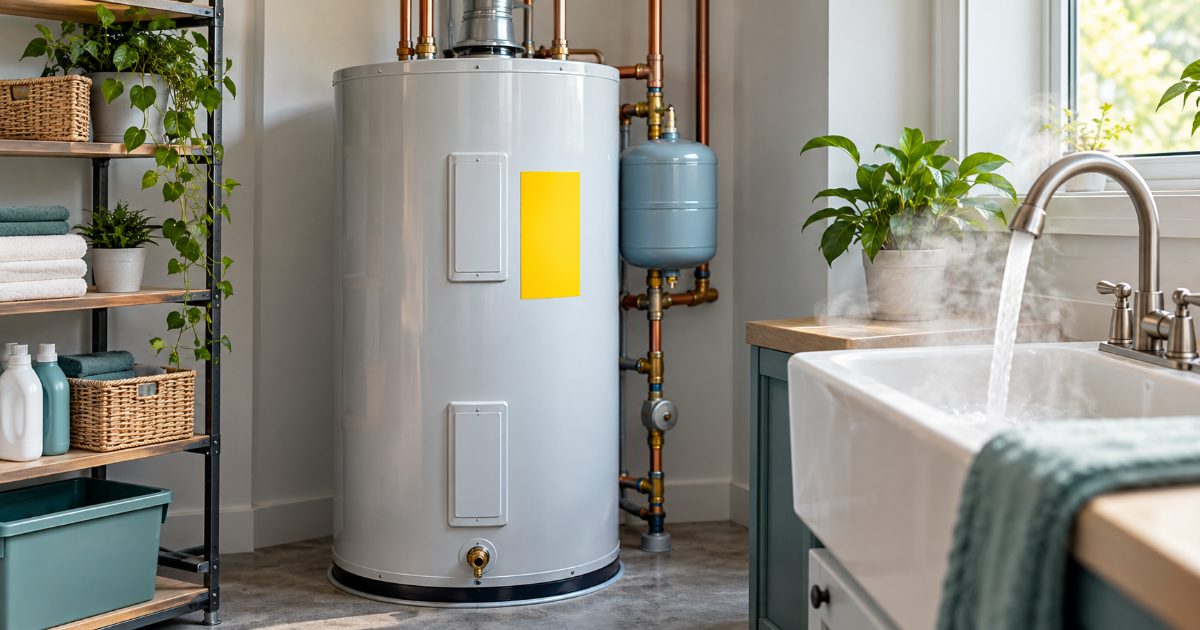
Size a storage water heater by its first hour rating (FHR), not by tank gallons. Count each hot-water use in the busiest hour of the day, multiply each by the average gallons per use on the US Department of Energy’s peak-hour worksheet (shower 20, shave 2, hand dishwashing or food prep 3, automatic dishwasher 7, top-loading clothes washer 25, front-loading washer 15), and add the column: the total is the peak-hour demand. DOE’s own example, 3 showers, 1 shave and 1 hand dishwashing in one hour, comes to 66 gallons, and DOE says that household needs a water heater with a first hour rating of 66 gallons or more. DOE’s 2001 water heating fact sheet gives the same instruction as “use the FHR, not tank capacity” and allows a model within about 2 gallons of the peak demand. The FHR is printed in the top left corner of the yellow EnergyGuide label, beside the tank size.
If the plan is to buy a 50-gallon tank because the old one was a 50-gallon tank, the old tank’s size never told you whether it ran out; its first hour rating did.
Peak-hour demand, and the first hour rating to cover it
Gallons per use from DOE's Energy Saver worksheet (shower 20, shave 2, hand dishwashing or food prep 3, dishwasher 7, top-loader 25, front-loader 15), AHRI's 2011 worksheet (shower 20, bath 20, shave 2, hands and face 4, shampoo 4, hand dishwashing 4, dishwasher 14, food prep 5, automatic clothes washer 32) and the Gas Appliance Manufacturers Association table in DOE's 2001 fact sheet (shower 15, bath 20, shave 2, hands and face 2, shampoo 4, hand dishwashing 2, dishwasher 14, food prep 5, clothes washer 32). On the two older tables a hand-dishwashing count uses the hand dishwashing row and a washer load uses the single clothes washer row, whichever loader you pick. DOE's current worksheet has no bath, hands-and-face or shampoo row, so those counts are ignored when it is selected. The matching rule is DOE's "at least matches"; the tolerance is the 2001 fact sheet's "within about 2 gallons".
What is the formula?
Peak-hour demand is a sum: for each use, the number of times it happens in the busiest hour, multiplied by the average gallons of hot water that use takes. There is no factor for household size; the counts already carry it. DOE’s worksheet says it estimates that one hour, not daily use.
Three published tables give the per-use gallons, and they do not agree.
| Use | DOE Energy Saver, 2012 (gal) | AHRI worksheet, 2011 (gal) | DOE fact sheet, 2001 (gal) |
|---|---|---|---|
| Shower | 20 | 20 | 15 |
| Bath | not listed | 20 | 20 |
| Shaving | 2 | 2 | 2 |
| Hands and face washing | not listed | 4 | 2 |
| Hair shampoo | not listed | 4 | 4 |
| Hand dishwashing | 3 (with food prep) | 4 | 2 |
| Food preparation | 3 (with hand dishwashing) | 5 | 5 |
| Automatic dishwasher | 7 | 14 | 14 |
| Clothes washer | 25 top-loader, 15 front-loader | 32 automatic, 26 wringer | 32 |
DOE calls its figures averages from information published on websites. The AHRI and 2001 tables both say they assume no water conservation measures, so a household on low-flow fixtures draws less.
The matching rule is the second half. DOE’s Energy Saver page says to look for a first hour rating that at least matches the peak hour demand, and its example asks for 66 gallons or more. DOE’s 2001 fact sheet says within about 2 gallons of the peak demand, and the University of Florida IFAS Extension prints within 1 to 2 gallons. The calculator prints both.
What does a worked example look like?
DOE’s own example is the calculator’s opening state.
| Use | Count | Gallons per use | Gallons |
|---|---|---|---|
| Showers | 3 | 20 | 60 |
| Shave | 1 | 2 | 2 |
| Hand dishwashing | 1 | 3 | 3 |
| Peak-hour demand | 65 (DOE prints 66) |
DOE’s page totals that hour as 66 gallons and asks for a first hour rating of 66 or more; the same three rows summed from its worksheet come to 65, so DOE’s printed total is 1 gallon above its own rows. AHRI’s example adds a shampoo to the same hour and totals 70 on its higher figures; DOE’s 2001 example is a lighter hour of 49 gallons.
Why is the FHR not the tank size?
The first hour rating is the number of gallons of hot water a storage heater can supply per hour, starting with a tank full of hot water. DOE’s sizing page says it depends on the tank capacity, the source of heat (burner or element) and the size of that burner or element.
Tank capacity is one of three terms in that sentence. A bigger burner reheats faster and delivers more than the tank’s own volume in the hour; a small element delivers less. Two 50-gallon heaters can therefore carry different FHRs, and the FHR is the one that predicts a cold shower. ENERGY STAR’s criteria measure the FHR at a 125 F outlet temperature, and a storage heater qualifies at 45 gallons or more (electric) or 51 or more (gas).
The number is on the label. DOE says the EnergyGuide label lists the FHR in the top left corner as “Capacity (first hour rating)”, and the FTC’s Energy Labeling Rule, 16 CFR 305.17, requires both tank size (storage capacity) and first hour rating on it. The FTC calls them “the familiar yellow Energy Guide labels”; Rheem’s guide to the current label numbers the FHR as item 7. Heat pump water heaters carry no EnergyGuide label, DOE says, so their FHR comes from the manufacturer’s literature.
Where do the numbers come from?
| Figure | Source |
|---|---|
| Gallons per use, 2012 column, the 66-gallon example, “at least matches” | DOE Energy Saver, Sizing Storage and Heat Pump (with Tank) Water Heaters |
| Gallons per use, 2011 column, the 70-gallon example | AHRI, Worksheet for Estimating Peak Hour Demand/First Hour Rating |
| Gallons per use, 2001 column, the 49-gallon example, “within about 2 gallons” | DOE Building America fact sheet, Water Heating, DOE/GO-102001-0785 |
| “Within 1 to 2 gallons” | University of Florida IFAS Extension, FCS3277 |
| FHR beside tank size on the label | 16 CFR 305.17, read on the Legal Information Institute mirror |
| 125 F test outlet, 45 and 51 gallon minimums | ENERGY STAR residential water heater criteria |
| FHR as label item 7, usage bins by FHR | Rheem’s EnergyGuide label explainer |
One gap: DOE’s Energy Saver sizing page returned 404 at energy.gov on 24 September 2026. The 2012 column and the 66-gallon example were read from the Wayback Machine capture of 2 July 2026 linked in the Sources.
Who should skip this calculator?
Anyone sizing a tankless unit. It has no stored hot water and no FHR to match; it is sized by flow and temperature rise, and the tankless water heater calculator takes those inputs.
Anyone whose old heater ran out after years of not doing so: read the popping-noise guide first, because sediment is a repair question, not a sizing one. A replacement on a closed supply also usually needs a thermal expansion tank.
Count the hour before the cart
Do not choose a heater until you have the peak-hour number. Count the uses in the busiest hour, read the answer above, then read the FHR off the EnergyGuide label of any tank you are offered and compare those two numbers, not the tank sizes.
The FHR is a published rating, not a test this site ran. Installation follows the manufacturer’s manual and the plumbing, gas and electrical codes adopted where you live, which vary and commonly require a permit and a licensed trade.
Frequently asked questions
What is the first hour rating on a water heater?
DOE's Energy Saver sizing page defines it as the number of gallons of hot water the heater can supply per hour, starting with a tank full of hot water, and says it depends on the tank capacity, the source of heat (burner or element) and the size of that burner or element. That last term is why two 50-gallon tanks can carry different ratings.
Where is the first hour rating printed?
On the yellow EnergyGuide label. DOE says the label lists it in the top left corner as Capacity (first hour rating), and the FTC's labeling rule, 16 CFR 305.17, requires capacity for storage water heaters to be shown as both tank size (storage capacity) and first hour rating. DOE adds that heat pump water heaters carry no EnergyGuide label.
How many gallons of hot water does a shower use?
DOE's current sizing worksheet and AHRI's 2011 worksheet both list 20 gallons of hot water per shower. DOE's 2001 water heating fact sheet, using a Gas Appliance Manufacturers Association table, lists 15. All three are averages for planning a peak hour, and the two older tables say they assume no water conservation measures, so a low-flow head draws less.
Is a 50-gallon water heater enough for a family of four?
Tank gallons cannot answer that. DOE's sizing page says to size a storage heater by first hour rating, and its 2001 fact sheet says to use the FHR, not tank capacity. Count the uses in the busiest hour: three showers, a shave and a sink of dishes come to 66 gallons on DOE's figures, so the label needs to read 66 or more.
Does this calculator work for a tankless water heater?
No. A tankless heater has no stored hot water and no first hour rating to match; it is sized by flow in gallons per minute and the temperature rise it must deliver at that flow. DOE's same page covers that route separately, and the tankless calculator on this site takes those two inputs. Use this page only for a storage tank.
Fact sheet and how to cite this page
- Answer
- Peak-hour demand is the count of each hot-water use in the busiest hour multiplied by DOE’s average gallons per use (shower 20, shave 2, hand dishwashing or food prep 3, dishwasher 7, top-load washer 25, front-load washer 15) and summed. DOE’s example totals 66 gallons and calls for a first hour rating of 66 gallons or more, chosen by FHR rather than tank capacity.
- Formula
Peak-hour demand (gal) = sum over each use of (times used in the busiest hour x average gallons of hot water per use); choose a storage heater whose first hour rating is at least that total- Inputs
- Showers in the busiest hour: 3 at 20 gal
- Shaves: 1 at 2 gal
- Hand dishwashing or food prep: 1 at 3 gal
- Everything else: 0
- Output
- 65 gallons of peak-hour demand from the rows as printed (DOE’s page totals the same example as 66), so a first hour rating of 66 gallons or more
- Assumptions
- DOE’s worksheet says its estimates are based on averages from information published on websites, and that it does not estimate total daily use
- The counts are for the single busiest hour of a typical day
- AHRI’s 2011 worksheet and DOE’s 2001 fact sheet print different per-use figures (a dishwasher is 14 gallons on both, 7 on DOE’s current worksheet); the calculator can switch tables, and both older tables say they assume no water conservation measures
- Method
- The calculator multiplies the reader’s count for each use by that row’s average gallons on the chosen worksheet, sums the column, and prints the first hour rating DOE says to look for: one that at least matches the total. It also shows the 2-gallon tolerance DOE’s 2001 fact sheet and the University of Florida extension service print.
- Primary source
- US Department of Energy, Energy Saver: Sizing Storage and Heat Pump (with Tank) Water Heaters (Wayback Machine capture of 2 July 2026; the live page returned 404 on 24 September 2026) (manufacturer or vendor document)
- Facts verified
- Last updated
- Cite as
- OwnerSpec, "Water heater size calculator: peak-hour demand and the first hour rating that has to cover it", https://ownerspec.com/plumbing/calculators/water-heater-size-first-hour-rating/, facts verified 24 September 2026.
Every figure above also appears, with its source, in the article. All sources · How OwnerSpec verifies numbers
Sources
- US Department of Energy, Energy Saver: Sizing Storage and Heat Pump (with Tank) Water Heaters (Wayback Machine capture of 2 July 2026; the live page returned 404 on 24 September 2026) (manufacturer or vendor document)
- AHRI, Water Heater Calculator: Worksheet for Estimating Peak Hour Demand/First Hour Rating (PDF, 2011) (manufacturer or vendor document)
- US Department of Energy, Building America Technology Fact Sheet: Water Heating, DOE/GO-102001-0785 (PDF, August 2001) (government or regulatory source)
- University of Florida IFAS Extension, FCS3277: Energy Efficient Homes: Water Heaters (university or extension service)
- Legal Information Institute, 16 CFR 305.17: Label content for water heaters (Energy Labeling Rule) (university or extension service)
- Federal Trade Commission, Energy and Water Use Labeling for Consumer Products (Energy Labeling Rule) (government or regulatory source)
- ENERGY STAR, Residential Water Heaters Key Product Criteria (government or regulatory source)
- Rheem, Understanding Your 2023 Water Heater EnergyGuide Label (manufacturer or vendor document)