Burst pipe: what to do first, in the ten minutes before the plumber picks up
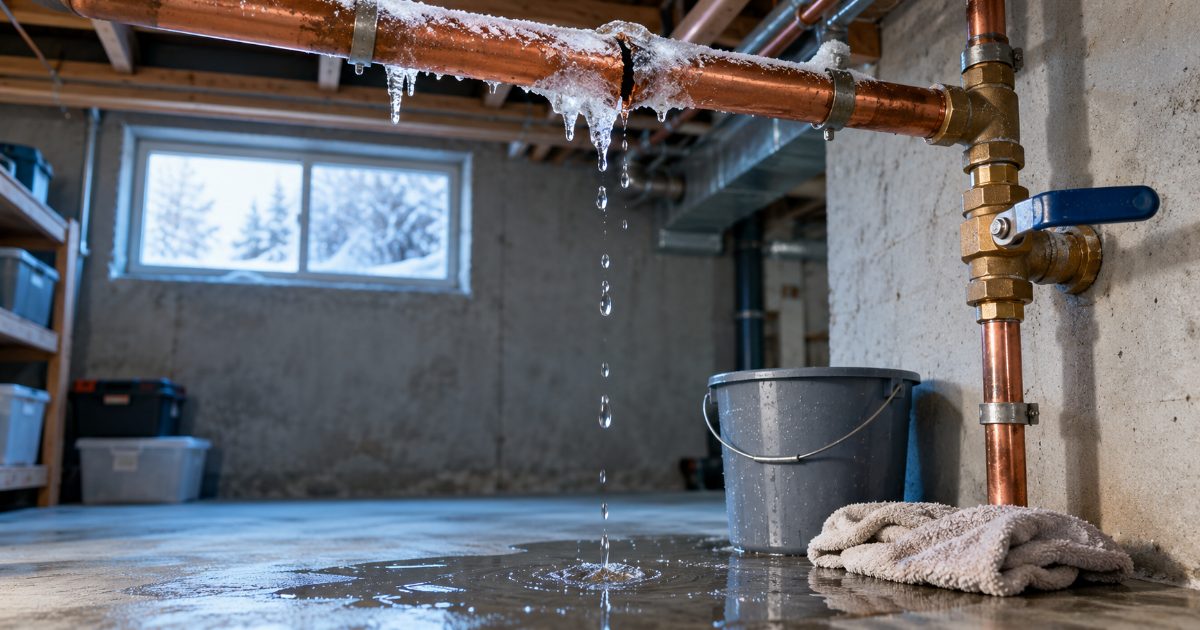
Main valve first, at the meter or where the line enters the house. Then power off if it is safe, faucets open, photos, and no open flame on a frozen pipe.
- Verified
- Updated
- 7 min read
- 10 sources
Shop links on this page are affiliate links: a purchase may earn us a commission at no extra cost to you. Disclosure
Short answer
A burst pipe is a shutoff problem before it is a plumbing problem. The Freezing and Bursting Pipes fact sheet gives the first move: turn off the water at the main shutoff valve, usually at the water meter or where the main line enters the house, and leave the faucets open until repairs are completed. Triple-I says the same in five words: first turn off the water. The 6 steps, in order: main valve closed, electricity off only if it is safe to do so (Ready.gov), faucets open to drain the lines, photos or video of the damage before anything is moved (Triple-I), a licensed plumber called, and, if the pipe is frozen rather than split, heat from a hair dryer or heating pad with the faucet open and never an open flame (American Red Cross). Water is the 1 thing you can stop in the first 10 minutes. Everything else waits.
If you cannot say right now where your main shutoff valve is, stop reading and go find it: Triple-I’s winter guide tells you to “check the location of the main water shutoff”, and so does this page.
Where is the main shutoff valve, and what if you cannot reach it?
At the water meter, or where the main line enters the house, in the Freezing and Bursting Pipes fact sheet’s words: in practice the street-facing basement wall, a utility room on a slab, or the meter box at the curb. Utah State University Extension adds the step people skip: teach adults and older children where it is and how to close it.
A valve only helps if someone is home to close it. That is the case for a motorised valve on the main, and the smart water shutoff valve review covers which units close on their own, which only alert, and why the install is a plumber job on a 3/4 to 1-1/4 inch main. If the water is coming from the water heater, the water heater leak guide finds the valve on the tank instead.
No source opened for this page describes valve types or a stuck valve, so that is left to the review and the plumber.
What comes first: the water, or the power?
The water, unless the water has already reached wiring. Ready.gov’s flood guidance: do not touch electrical equipment if it is wet or if you are standing in water, and turn off the electricity to prevent electric shock if it is safe to do so. The American Red Cross flood page repeats the first half, and the fact sheet repeats it for appliances.
“If it is safe to do so” is the whole rule. A dry panel in a dry room gets switched off. A panel in a flooded basement does not, and the call is to the utility or the fire department before the plumber. ESFI’s and CPSC’s pages were unreadable when this was written, so the federal and Red Cross wording stands in.
Situation by situation: the first action
| Situation | First action | Source |
|---|---|---|
| Water spraying or pouring from a pipe | Close the main shutoff at the meter or where the line enters the house; leave faucets open until repaired | Freezing and Bursting Pipes fact sheet |
| Water on the floor near outlets, a panel or an appliance | Do not touch wet electrical equipment or stand in water near it; cut power only if it is safe | Ready.gov; American Red Cross |
| Faucet gives a trickle or nothing in freezing weather | Suspect a frozen pipe, usually on an exterior wall or where the service enters through the foundation | American Red Cross |
| A frozen pipe you can reach and see | Main off, that faucet open, heat from the faucet end toward the coldest section with a hair dryer, heating pad, space heater kept from flammables, or hot wet towels | Utah State University Extension; Red Cross; fact sheet |
| A frozen pipe starts leaking as it thaws | Open other faucets to drain the plumbing; buckets under the break | Utah State University Extension |
| Frozen pipe you cannot find, cannot reach or cannot thaw | Call a licensed plumber | American Red Cross |
| Faucet open, main back on, no water comes out | Call a plumber | Freezing and Bursting Pipes fact sheet |
| Any damage to the house or contents | Phone the insurer, then photograph or video everything before moving it | Triple-I |
What does the insurer need from the first hour?
A phone call and pictures, in that order. Triple-I’s claim guidance: phone your insurance professional immediately and ask whether you are covered, how long you have to file, and whether the claim will exceed the deductible. Then photograph or videotape the damage, take reasonable steps to protect the property from further damage, and keep damaged items until the adjuster has visited if you can.
Keep every receipt. Triple-I says to save receipts for what you spend, list the damaged items, and keep receipts for additional living expenses if the house is not livable, which most homeowners policies cover with proof of cost. Its winter storm article says standard homeowners policies generally cover water damage from burst pipes; the policy wording decides the rest.
This is where a leak sensor earns its keep: the smart leak detector review covers which carriers publish a credit and where the sensors go.
Do not buy a valve until you know where the water went
A smart shutoff on the main stops the next burst. It does not help today. Close the valve, make the call, take the photos, and read the shutoff valve review once the floor is dry. If the pipe froze, the frozen pipes guide explains why the burst was never where the ice was.
How do you thaw a frozen pipe without starting a fire?
With the faucet open, from the faucet end, and never with a flame. The American Red Cross lists the heat sources: an electric heating pad wrapped around the pipe, a hair dryer, a portable space heater kept away from flammable materials, or towels soaked in hot water. It names what not to use: a blowtorch, kerosene or propane heater, charcoal stove, or other open flame device. Indiana’s OUCC puts the same warning in capitals and calls it extremely dangerous and potentially deadly.
Utah State University Extension gives the order: main supply off, faucet on the frozen line open, thawing started at the faucet. The fact sheet adds the direction, toward the coldest section; Extension adds no boiling water, because of burns, and gradual heat so plastic faucet parts do not melt. OUCC closes it: turn the water back on very slowly while watching for leaks.
For a run that freezes every winter, the heat cable review covers self-regulating cable, and the outdoor faucet cover and sillcock review covers the hose bib. A well house has its own list on the well winter freeze checklist.
When is this a plumber’s job, not yours?
The Red Cross: when you cannot locate the frozen area, cannot reach it, or cannot thaw it. The fact sheet: when a faucet is open and no water comes out. Indiana’s OUCC goes further: no hair dryer thaw without talking to a plumber first, and never while standing in water.
A split pipe is always the plumber’s. Triple-I’s winter guidance says the quicker you shut off the water or direct your plumber to the problem, the better the chance of limiting the damage. Your part of that sentence is the valve and the address.
What should you do first?
- Close the main shutoff valve, at the meter or where the line enters the house.
- Cut the power only if the panel and the floor around it are dry; otherwise call the utility.
- Open the faucets to drain the lines, and put buckets under the break.
- Phone the insurer, then photograph or video the damage before moving anything.
- Call a licensed plumber, and give them the location of the valve and the break.
- If the pipe is frozen, not split: faucet open, hair dryer from the faucet end, no flame.
What owners buy for this
The top picks from Best smart water shutoff valve: the maker pages sort them into in-line units that sense flow and bolt-on actuators that only close a ball valve, and the pipe you have decides first, compared on published specs and certifications.
Has a 1 in main, a plumber and wants flow sensing with printed standards
Moen Flo Smart Water Monitor and Shutoff, 900-006 (1 in)
Moen shop page: in-line on the main cold supply, daily microleak tests to one drop per minute, 2.4 GHz Wi-Fi; Moen 900-001 spec sheet: flow, pressure and temperature readings, 175 psi max, IAPMO IGC 349, UL 1951, NSF 61/9 and NSF 372, one-year warranty
Has a 1-1/4 in main line that the 1 in body will not fit
Moen Flo Smart Water Shutoff, 900-002 (1-1/4 in)
Moen shop page: 900-002 fits 1-1/4 in or smaller; same in-line install, app and Wi-Fi as the 900-006; its own spec sheet was not opened, so the 900-001 standards are not quoted for it
Wants in-line flow sensing without a hub and with a battery backup
Frizzlife LP365 Smart Water Monitor and Automatic Shutoff
Frizzlife product page: fits 3/4 and 1 in pipe, in-line, 110 V with a 6.5 ft cable and a rechargeable backup of 4 to 6 months standby, Wi-Fi through the Smart Life app, ultrasonic flow 0.001 to 18.00 GPM, micro-leak detection to 0.01 GPM, IP67; no UL or NSF listing printed
Frequently asked questions
Where is the main water shutoff valve in a house?
The Freezing and Bursting Pipes fact sheet puts it at the water meter or where the main line enters the house. In a basement house that is usually the wall facing the street; in a slab house, a utility room, garage or the meter box at the curb. Triple-I says to find it before winter, and Utah State University Extension says to show adults and older children too.
Should I turn off the electricity when a pipe bursts?
Only if it is safe to do so, in Ready.gov's words. Ready.gov and the American Red Cross both say not to touch electrical equipment if it is wet or if you are standing in water, and the Freezing and Bursting Pipes fact sheet repeats that for appliances. If the panel is in the wet area, leave it and call the utility or the fire department.
Why leave the faucets open after shutting the main valve?
To drain the pipes and relieve pressure. The Freezing and Bursting Pipes fact sheet says to leave the faucets open until repairs are completed, and Utah State University Extension says to open other faucets in the house to drain water from the plumbing when a thawing pipe starts to leak, with buckets ready under the break.
What do I photograph for the insurance claim?
Triple-I's claim guidance: photograph or video the damage, then take reasonable steps to protect the property from further damage, keep damaged items until the adjuster has visited if you can, make a list of what was damaged, and save receipts for everything you spend, including a hotel if the house is not livable, which most policies cover with proof of cost.
Can I thaw a frozen pipe with a torch or propane heater?
No. The American Red Cross says not to use a blowtorch, kerosene or propane heater, charcoal stove or other open flame device, and Indiana's OUCC says the same in capitals, calling it extremely dangerous and potentially deadly. Use an electric heating pad, a hair dryer, a space heater kept away from flammables or hot wet towels, with the faucet open.
Fact sheet and how to cite this page
- Answer
- The first move on a burst pipe is the main shutoff valve, which the Freezing and Bursting Pipes fact sheet places at the water meter or where the main line enters the house, with the faucets left open until the repair is done. The 6 steps on this page, in order: water off, power off only if it is safe, faucets open, photos, a plumber called, and no open flame on a frozen pipe.
- Basis
- No regulator sets a procedure. The order is the one every opened source agrees on: the Freezing and Bursting Pipes fact sheet and Triple-I for the valve, Ready.gov and the American Red Cross for electricity near water, Triple-I for the insurance record, and the Red Cross, Utah State University Extension and Indiana’s OUCC for thawing.
- Assumptions
- A house on a municipal or well supply with one main shutoff valve inside or at the meter. Apartments and condos often have a valve per unit; the building manager knows where.
- The reader can reach the valve without standing in water around live electrical equipment. If not, the first call is the utility or the fire department, not a plumber.
- The valve types (gate, ball, curb stop) and how a smart valve closes them are covered on the shutoff valve review, not here: no source opened for this page describes them.
- Method
- Procedure read from the Freezing and Bursting Pipes fact sheet, the American Red Cross frozen-pipe and flood pages, Utah State University Extension, Indiana’s Office of Utility Consumer Counselor, Ready.gov and four Triple-I articles, all opened on 10 October 2026. Nothing was tested. ESFI, CPSC, NAIC and CDC pages were unreadable, so the electrical and documentation advice is cited to Ready.gov, the Red Cross and Triple-I instead.
- Primary source
- Freezing and Bursting Pipes: How pipes freeze and burst, and what to do to prevent damage (PDF) (manufacturer or vendor document)
- Facts verified
- Last updated
- Cite as
- OwnerSpec, "Burst pipe: what to do first, in the ten minutes before the plumber picks up", https://ownerspec.com/plumbing/guides/burst-pipe-what-to-do-first/, facts verified 10 October 2026.
Every figure above also appears, with its source, in the article. All sources · How OwnerSpec verifies numbers
Sources
- Freezing and Bursting Pipes: How pipes freeze and burst, and what to do to prevent damage (PDF) (manufacturer or vendor document)
- American Red Cross, Preventing and Thawing Frozen Pipes (manufacturer or vendor document)
- American Red Cross, Flood Safety (manufacturer or vendor document)
- Ready.gov, Floods (government or regulatory source)
- Utah State University Extension, Advice to Prevent Frozen Pipes (university or extension service)
- Indiana Office of Utility Consumer Counselor, Fast Facts: Preventing Frozen Pipes (PDF) (government or regulatory source)
- Triple-I (Insurance Information Institute), How to file a homeowners claim (manufacturer or vendor document)
- Triple-I, The homeowner's severe cold weather survival guide (manufacturer or vendor document)
- Triple-I, Protect your home from winter weather (manufacturer or vendor document)
- Triple-I, Winter storm alert: How to recover and rebuild with insurance (manufacturer or vendor document)