High water pressure: 80 psi is the code limit, and a gauge, not a plumber, tells you whether you need a PRV
Both model plumbing codes cap static pressure at 80 psi and require a pressure-reducing valve above it. A hose-bib gauge gives the number overnight.
- Verified
- Updated
- 7 min read
- 6 sources
Shop links on this page are affiliate links: a purchase may earn us a commission at no extra cost to you. Disclosure
Short answer
Static water pressure above 80 psi is over the limit, and 90 psi is not a feeling. The International Residential Code, Section P2903.3.1, says static water pressure shall be not greater than 80 psi, and where the main pressure exceeds 80 psi an approved pressure-reducing valve conforming to ASSE 1003 or CSA B356 shall be installed. The International Plumbing Code, Section 604.8, sets the same 80 psi static ceiling and adds a strainer. Jurisdictions adopt these codes with local amendments, so the local authority has the final word. Measure before buying anything: screw a hose-bib gauge with a max-hold needle onto an outside spigot, take a static reading with every fixture closed, and leave it overnight to catch the night-time peak. Under 80 psi on both readings, skip the valve. Over it, a pressure-reducing valve, which Watts and Zurn Wilkins ship factory set to 50 psi, brings the house down, and it usually makes the plumbing a closed system that then needs thermal expansion control.
The picks
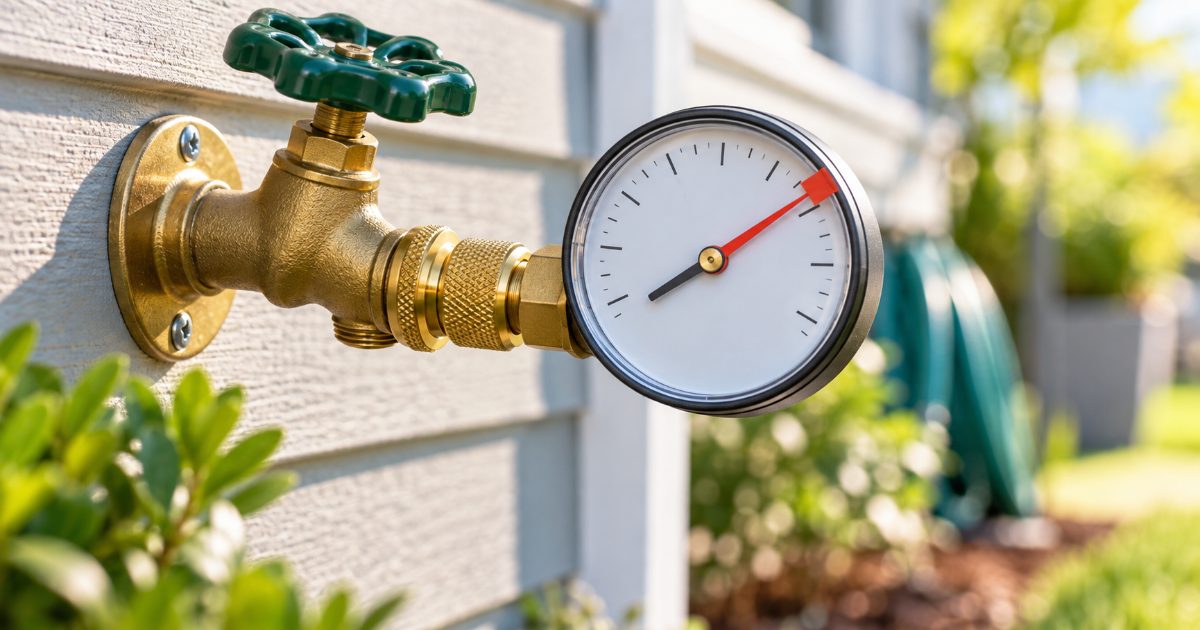
The overnight reading: the drag needle parks at the night-time peak
SENCTRL 0-200 psi Lead-Free Water Pressure Gauge with Lazy Hand
0-200 psi dial, hose thread, second drag needle that stays at the highest pressure seen until reset
The same test on a smaller budget
CARBO Instruments 2-1/2 in Water Pressure Test Gauge, 0-200 psi, Red Max Pointer
0-200 psi dial, red max pointer, 3/4 inch female hose thread, brass connector
Do not buy a pressure-reducing valve because a neighbour said 90 sounds high: buy a hose-bib gauge, read it in the morning, and let the number decide.
What does the symptom tell you?
Not much on its own. Every symptom below has a second cause, so the gauge comes first.
| Symptom | What high pressure does | What else does it | Confirm with |
|---|---|---|---|
| Toilet refills by itself | Pushes water past a worn flapper faster | A warped flapper at any pressure | Static gauge reading, then the flapper leak test |
| Pipes bang when a valve shuts | Raises the shock a fast-closing valve produces | Loose pipe straps, no arrestor | Gauge, then the water hammer guide (arrestors) |
| Water heater relief valve drips after heating | Thermal expansion in a closed system pushes past the set point | A failed relief valve | Gauge left on overnight, then the expansion tank guide |
| Supply hoses and fill valves fail early | Every part sits above its design pressure all night | Age, chlorinated water | Overnight peak reading |
A pressure-reducing valve is a spring-loaded valve on the water service that holds the downstream pressure at a set point whatever the main supplies.
How do you measure it?
With a hose-bib gauge: a dial gauge on a garden-hose thread that screws onto an outdoor spigot or the washing machine cold tap. Static pressure is the reading with every fixture in the house closed; open the tap the gauge sits on fully and read the dial.
Two readings, not one:
- Static, in the daytime, every fixture closed.
- Overnight, with a gauge that has a max-hold needle. Supply pressure can sit higher at night, when demand is low, and the drag needle stays parked at the peak until you reset it.
The SENCTRL 0-200 psi gauge carries that second needle, which its listing calls a lazy hand. The CARBO Instruments 0-200 psi gauge does the same with a red max pointer on a 3/4 inch female hose thread. Zurn’s own manual uses a hose-bibb gauge, its Model HGI-25, for every test in the document: this is the trade’s method.
On a private well the pressure switch sets the number, and the well pressure tank cross-reference is the page.
What does the number mean?
80 psi static is the line in both model codes, each adopted locally with amendments.
| Code | Section | What it says |
|---|---|---|
| International Residential Code | P2903.3.1 Maximum pressure | Static water pressure shall be not greater than 80 psi. Where the main pressure exceeds 80 psi, an approved pressure-reducing valve conforming to ASSE 1003 or CSA B356 shall be installed at the connection to the water service pipe. |
| International Plumbing Code | 604.8 Water pressure-reducing valve or regulator | Where water pressure within a building exceeds 80 psi static, an approved pressure-reducing valve conforming to ASSE 1003 or CSA B356 with strainer shall be installed to reduce it to not greater than 80 psi static. Service lines to sill cocks and outside hydrants are excepted. |
The wording is the 2018 IRC as adopted by Denver and the 2015 IPC as adopted by Texas, both read on UpCodes because the ICC’s own pages would not open. Cities amend the number, so read the local code before quoting 80 to an inspector.
Below the limit there is still a preferred band: the Groveland Community Services District, a California water utility, recommends a delivered pressure between 40 and 50 psi.
What is a PRV set to, and what does it change?
Well under the limit. Zurn’s manual calls for a downstream gauge to verify any adjustment; Resideo’s DS06 uses a dial that reads the outlet setting without one.
| Valve | Factory outlet setting | Adjustable range | Maximum inlet | Source |
|---|---|---|---|---|
| Watts LFN45B | 50 psi | 25 to 75 psi | 400 psi | Watts product page |
| Zurn Wilkins 70XL | Approximately 50 psi | Not stated in the manual | 300 psi working pressure, 140 degrees F | IS70XL manual |
| Resideo Braukmann DS06 | 60 psi | 25 to 90 psi | 250 psi | Submittal sheet 33-00063 |
Resideo’s sheet prints both ASSE 1003-2020 listed and NSF/ANSI 61/372 compliant for the DS06. Watts labels the LFN45B lead-free and says it has an integral stainless steel strainer with a bypass feature that controls thermal expansion pressure. Zurn’s 70XL manual calls the valve lead-free with an integral strainer and integral by-pass; it does not print a standard number on the page read for this article.
The change a PRV makes is the one most people do not plan for. Once the valve is in, water heated in the tank cannot expand back toward the main. The Zurn manual says pressure periodically builds above the set pressure as a natural consequence of thermal expansion, may happen each time the heater runs, and is relieved only when a fixture next opens; its fix is an expansion tank or an expansion control relief valve set at the PRV’s outlet pressure. IRC Section P2903.4 requires a means of controlling that increased pressure where its subsections apply. The thermal expansion tank guide carries the rule, and the expansion tank size calculator sizes the tank.
Two more Zurn lines before ordering: where the reduction exceeds a 3 to 1 ratio (its example is 225 psi down to 75 psi) or the inlet is above 150 psi, Zurn recommends two regulators in series to prolong valve life, and the valve should be installed by a qualified licensed plumber, which in most places also means a permit.
Before you buy a valve
A gauge overnight settles it. If the max needle never passes 80 psi, the toilet, the banging and the drip have another cause and a PRV would fix none of them. If it does, the PRV and gauge review compares the valves in the table above.
How do you know an existing PRV has failed?
Zurn publishes the test, and it needs the same hose-bib gauge. Close a fixture inside the house, read the outlet pressure on the gauge, and watch it for 10 minutes.
| What the gauge does in 10 minutes | Zurn’s reading of it |
|---|---|
| Holds steady | The valve is working properly |
| Creeps up slowly | The valve may be fouled: clean and retest, then repair if it still creeps |
| Rises at once to equal supply pressure | Severely fouled, damaged or defective: repair or replace |
A rise that appears only after the heater runs is thermal expansion, not a failed valve, so the overnight peak and the 10-minute test are two different questions.
On lifespan, no maker or utility read for this article prints a number of years, so this page does not either. What they do print is an interval: the Zurn manual requires inspection and maintenance at least once per year, or more often as service conditions warrant, and Groveland CSD tells its customers to inspect and test the regulator annually because sand and grit reduce its effectiveness.
What should you do first?
- Screw a max-hold gauge onto an outside spigot, close every fixture, and read the static pressure.
- Leave the gauge on overnight and read the peak in the morning.
- Under 80 psi both times: stop here and chase the symptom on its own page.
- Over 80 psi with no PRV: get a licensed plumber to fit an ASSE 1003 valve, and plan the expansion tank in the same visit.
- Over 80 psi with a PRV already in place: run Zurn’s 10-minute hold test before replacing it.
Frequently asked questions
Is 90 psi water pressure too high for a house?
Yes by the model codes. The International Residential Code, Section P2903.3.1, says static water pressure shall be not greater than 80 psi, and the International Plumbing Code, Section 604.8, sets the same 80 psi static ceiling. A static reading of 90 psi is over both, and each code then requires a pressure-reducing valve. Confirm it with a gauge first.
What pressure is a new pressure-reducing valve set to at the factory?
It depends on the maker, and none of them ship at the 80 psi limit. Watts states its LFN45B is set to 50 psi with a 25 to 75 psi adjustable range. Zurn Wilkins says every 70XL is factory set to approximately 50 psi. Resideo's DS06 submittal sheet gives 60 psi, adjustable 25 to 90 psi. Verify any adjustment with a downstream gauge.
How do I test my water pressure without a plumber?
Screw a hose-bib pressure gauge onto an outside spigot or the washing machine cold tap, open the tap fully with every other fixture closed, and read the static pressure. A gauge with a max-hold needle left on overnight also records the night-time peak, when utility pressure is usually highest. Read both before deciding anything.
Does installing a PRV mean I also need an expansion tank?
Usually. The Zurn Wilkins 70XL manual says pressure periodically builds above the valve's set point when the water heater runs, a natural consequence of thermal expansion, and calls for an expansion tank or an expansion control relief valve. IRC Section P2903.4 requires a means of controlling that pressure where its subsections apply. The expansion tank guide covers the rule.
How often should a pressure regulator be checked?
At least once a year. The Zurn Wilkins 70XL manual requires periodic inspection and maintenance at least once per year, or more often as service conditions warrant, and the Groveland Community Services District tells its customers to inspect and test the regulator annually. The test is a hose-bib gauge held for 10 minutes: a steady reading passes, a creeping one means a fouled valve.
Fact sheet and how to cite this page
- Answer
- Static water pressure above 80 psi is over the limit in both model plumbing codes. IRC Section P2903.3.1 caps static pressure at 80 psi and requires an ASSE 1003 or CSA B356 pressure-reducing valve where the main exceeds it; IPC Section 604.8 says the same and adds a strainer. Measure with a hose-bib gauge before buying a valve.
- Basis
- The 80 psi static ceiling in the International Residential Code, Section P2903.3.1, and the International Plumbing Code, Section 604.8, both published by the International Code Council and adopted with amendments by most US jurisdictions.
- Assumptions
- A house on a municipal supply. A private well runs on its own pressure switch, and the well pressure tank pages cover that.
- Static pressure means every fixture closed. A reading taken while a tap runs is lower and does not test the limit.
- The code section numbers are from the 2018 IRC and 2015 IPC as adopted by Denver and Texas; local editions and amendments differ, and the local authority decides.
- Method
- Code text read from the Denver Residential Code 2018 (IRC P2903.3.1) and the Texas IHB Plumbing Code 2015 (IPC 604.8) on UpCodes, because the ICC’s own pages would not open. Factory settings and ranges read from the Watts LFN45B product page, the Zurn Wilkins 70XL installation manual IS70XL and the Resideo DS06 submittal sheet. Test procedure and inspection interval from the Zurn manual. All read on 24 September 2026.
- Primary source
- Denver Residential Code 2018, Section P2903.3.1 Maximum pressure (UpCodes) (manufacturer or vendor document)
- Facts verified
- Last updated
- Cite as
- OwnerSpec, "High water pressure: 80 psi is the code limit, and a gauge, not a plumber, tells you whether you need a PRV", https://ownerspec.com/plumbing/guides/high-water-pressure-80-psi-when-you-need-a-prv/, facts verified 24 September 2026.
Every figure above also appears, with its source, in the article. All sources · How OwnerSpec verifies numbers
Sources
- Denver Residential Code 2018, Section P2903.3.1 Maximum pressure and P2903.4 Thermal expansion control (UpCodes) (manufacturer or vendor document)
- Texas IHB Plumbing Code 2015, Section 604.8 Water pressure-reducing valve or regulator (UpCodes) (manufacturer or vendor document)
- Watts, Series LFN45B water pressure reducing valve, product page (manufacturer or vendor document)
- Zurn Wilkins, Model 70XL Installation, Inspection, Maintenance and Repair Instructions (IS70XL) (manufacturer or vendor document)
- Resideo, Braukmann DS06 DialSet lead free pressure regulating valves, submittal sheet 33-00063 (manufacturer or vendor document)
- Groveland Community Services District, Maintaining your water pressure regulator (manufacturer or vendor document)