Hot water takes too long to arrive: the pipe is the cause, and which recirculation option actually fixes it
The wait is the cold water in the pipe: Type L copper holds 0.0251 gal per foot at 3/4 inch. Which of four recirculation options fits, and who should just insulate.
- Verified
- Updated
- 8 min read
- 12 sources
Shop links on this page are affiliate links: a purchase may earn us a commission at no extra cost to you. Disclosure
Short answer
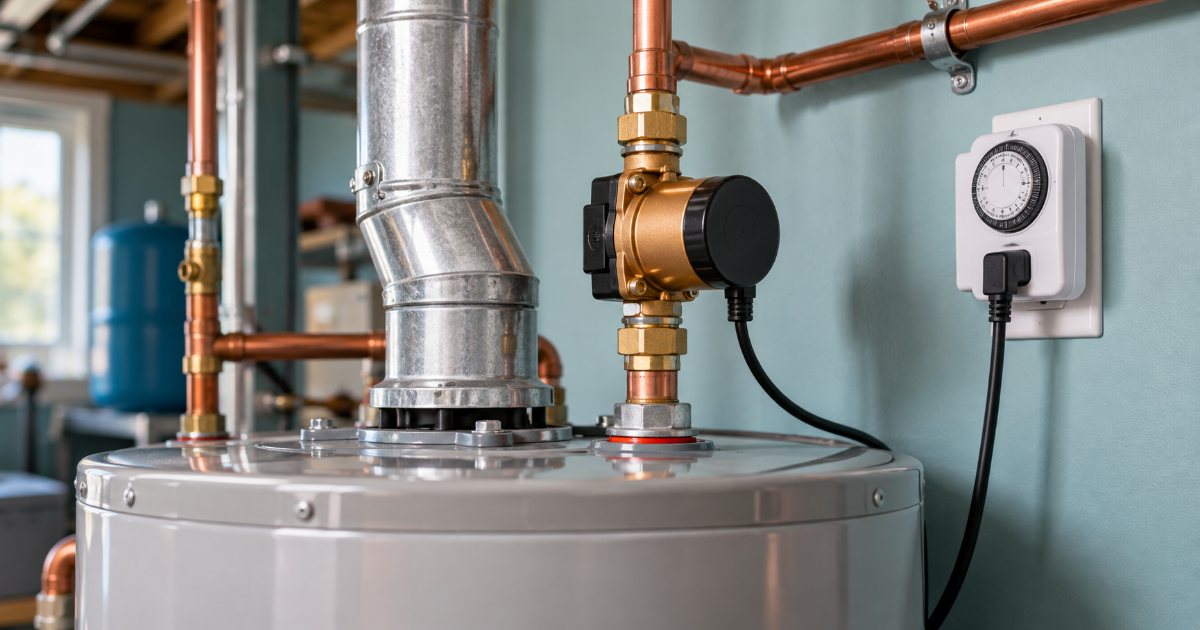
Hot water that takes a minute or more to arrive is not a slow water heater: it is the water standing in the pipe between heater and tap, which has to run out first. The Copper Development Association’s Copper Tube Handbook lists Type L copper at 0.0121 gallons per foot for 1/2 inch and 0.0251 gallons per foot for 3/4 inch, so 50 feet of 3/4 inch copper holds 1.25 gallons of cooled water before the first hot drop reaches the fixture. EPA’s WaterSense guide recommends no more than 0.5 gallons stored between the water heater and any fixture. Four fixes exist: a crossover-valve pump that uses the cold line as its return (the Watts, Grundfos, Taco and A. O. Smith kits), a dedicated return line pump, a demand pump started by a button or sensor, and a point-of-use heater at the far fixture. EPA calls demand-initiated recirculation the more energy-efficient pump option, and says a cold-line return may not match a dedicated return’s performance.
The picks
A tank heater, no return line, and a far sink with an outlet under it
A. O. Smith APCOM UT1 under-sink hot water recirculation pump, for tank heaters
Listing states a built-in thermostat and timer, no dedicated return line needed, up to 250 ft of household piping, tank or indirect heaters only; the listing prints no UL or ETL mark, so none is claimed here
A Watts 500800 system that has stopped delivering hot water to the far sink
Watts Premier replacement sensor valve for 500800 and 500805 systems
Watts' own replacement crossover valve for the 500800 and 500805 systems; listing states it is not for a dedicated return line and not for tankless heaters
If the tap runs hot in the time it takes to fill a glass, skip every pump on this page and insulate the run instead.
Why does hot water take so long?
Because the pipe is full of yesterday’s hot water, now at room temperature, and all of it goes down the drain first. EPA’s Best Practices for Efficient Hot Water Delivery in Homes names the two things that set that volume: pipe length between heater and fixture, and inside diameter, which depends on size and material.
| Pipe | Volume per foot | 50 ft holds | Source |
|---|---|---|---|
| 1/2 in Type L copper | 0.0121 gal (1.55 oz) | 0.61 gal | Copper Tube Handbook Table 14.2b; EPA Table 2 |
| 3/4 in Type L copper | 0.0251 gal (3.22 oz) | 1.25 gal | Copper Tube Handbook Table 14.2b; EPA Table 2 |
| 1 in Type L copper | 0.0429 gal (5.49 oz) | 2.15 gal | Copper Tube Handbook Table 14.2b; EPA Table 2 |
| 1/2 in PEX (CTS SDR 9) | 1.16 oz | 0.45 gal | EPA Table 2 |
| 3/4 in PEX (CTS SDR 9) | 2.35 oz | 0.92 gal | EPA Table 2 |
| 1/2 in CPVC (CTS SDR 11) | 1.25 oz | 0.49 gal | EPA Table 2 |
| 3/4 in CPVC (CTS SDR 11) | 2.67 oz | 1.04 gal | EPA Table 2 |
EPA’s table is in ounces per foot, adapted from Table E105.1 of the 2024 International Plumbing Code; 1 gallon is 128 ounces.
The wait is volume divided by flow. Take 50 feet of 3/4 inch copper to a bathroom, 1.25 gallons, and a faucet drawing 1.5 gallons per minute (an assumption, not a standard): the cooled water alone takes 50 seconds to clear, before the pipe walls have taken their share of heat from the water behind it. The hot water wait-time calculator does that arithmetic for your run and your fixture.
EPA once required WaterSense labeled homes to store no more than 0.5 gallons in any hot water pipe. It is now a recommendation, and the WaterSense Technical Reference Manual calls 0.5 gallons or less between heater and each end use a good target. Most existing houses miss it, which is why the pumps exist.
Which recirculation option fits your house?
DOE’s Building America water heating fact sheet describes the family in one sentence: a recirculation system powers a pump to cycle water through the plumbing loop between water heater and faucet, which lessens the tepid water wasted down the drain while waiting. The options differ in where the return is and what starts the pump.
| Option | How it works | Needs | Who should skip it |
|---|---|---|---|
| Crossover-valve kit (Watts 500800, Grundfos Comfort, Taco Hot-Link, A. O. Smith UT1) | Pump at the tank; a thermostatic valve under the farthest sink passes cooled hot water into the cold line until the hot side warms, per Taco’s Hot-Link page | Tank heater, outlet at the tank, a timer or thermostat | Anyone who will not accept a warm cold tap, and every tankless owner (Taco: the valve does not pass enough flow to fire a tankless) |
| Dedicated return line | A pump moves water round a loop from the far end back to the heater; EPA says the loop sits within 10 feet of every fixture | A return pipe, usually built in new construction | A finished house with no return: the pipe costs more than the pump |
| Demand-initiated pump | A button or motion sensor starts the pump; a sensor stops it when hot water reaches the loop, per EPA and DOE | A button at each far fixture, on either return type | Anyone who wants hot water waiting without pressing anything |
| Point-of-use heater | A small heater at the far fixture makes its own hot water; DOE calls demand units best suited to low-demand or remote applications | A circuit or gas line at the fixture, sized in its own right | A whole bathroom on the far end: DOE says demand units produce a limited amount of hot water |
EPA ranks the controls, not the brands. Timer- and temperature-based systems can increase energy use because the pump runs often to hold the loop hot; demand-initiated systems tend to be more efficient because hot water enters the loop only when asked for. EPA calls a timer’s result highly variable, since it depends on the settings and the household’s routine.
The recirculation pump review puts named units against those four rows.
What do the makers say about crossover valves?
Taco’s Hot-Link page describes the mechanism: mount the bypass valve under the sink and the pump at the water heater, and the valve’s thermal disk sends cooled water back so the hot lines remain hot. Its applications are tank-type water heaters only, and its clock timer runs the pump at peak hours or continuously.
The cold tap is the trade. EPA’s guide says a cold-line return is often a convenient retrofit but may not achieve the efficiency or performance of a dedicated return. Taco’s knowledge base carries the owner’s version, “why is my hot water coming out of the cold water line?”, and answers that pressure drop can pull hot water into the cold line; its remedy is a second check valve in series with the one in the pump.
Watts’ and Grundfos’ own pages for the 500800 and Comfort systems could not be opened for this page, so their valve temperatures and cautions are not quoted here.
Taco’s Hot-LinkPlus-e lists a maximum operating power of 44 W and a pulse mode of 5 minutes on, 10 off; its SmartPlus learns usage over 7 days. Retail listings print wattages for other pumps; this page does not repeat them.
What if the heater is tankless?
Buy the recirculation into the heater, not onto it. Rinnai says its tankless units have built-in pumps with Smart-Circ recirculation that learns the schedule, and that with no return line a thermal bypass valve at the farthest fixture lets the unit temporarily use the cold water line. Its RPB200 push button starts that pump on demand. Navien’s NPE-A2 series pairs a built-in pump with an optional NaviCirc valve (part PFFW-001) for the same case.
The reason is in Rinnai’s 2010 warranty notice: it had reduced the heat exchanger warranty on condensing units in recirculating systems because of accelerated wear from a constantly running loop, and restored the 12-year term for systems controlled by a thermostat, a timer or an on-demand switch. Hard water shortens the descale interval further; see the tankless descale interval by hardness.
Before you buy a pump
Measure the run first: pace the pipe to the slowest fixture, read its size, and multiply by the table above. Under 0.5 gallons, EPA’s benchmark, the fix is pipe insulation, not a pump. Over it, on a tank heater with no return line, the A. O. Smith APCOM UT1 is the crossover kit from a heater maker; its listing prints a thermostat and timer but no UL or ETL mark, so check the carton first. A Watts 500800 that has gone lukewarm usually needs only the replacement sensor valve .
What should you do first?
- Time the wait at the slowest fixture the way the WaterSense manual verifies a home: bucket under the tap, run hot until the water is 10 degrees F warmer than it started, measure what you caught.
- Pace the pipe route and note its size and material; convert with the table, or the calculator.
- Under 0.5 gallons: insulate to at least R-3 (WaterSense), at least six feet from the tank (DOE), and stop.
- Over 0.5 gallons on a tank heater: choose a crossover kit with a timer or a demand button, knowing the cold tap will run warm at first.
- On a tankless heater: use the maker’s built-in pump and bypass valve, on a timer or a button, never a constant loop.
Frequently asked questions
Is my water heater too small or failing if hot water takes two minutes to arrive?
Usually not. EPA's hot water delivery guide says the volume of water stored in the pipe sets how long hot water takes to reach a fixture, and that length and inside diameter decide that volume. A heater that runs out of hot water mid-shower is a sizing problem; one that is merely slow to arrive is a pipe-length problem.
Why is my cold tap warm after fitting a recirculation pump?
Because the kit uses the cold line as its return. EPA's guide says returning water to the cold line is a convenient retrofit that may not achieve the performance of a dedicated return. Taco's knowledge base answers the same complaint on its Hot-Link system, and names an extra check valve in series with the pump's own as the remedy when hot water is drawn from the cold line.
Can I add a recirculation pump to a tankless water heater?
Not the ordinary under-sink kit. Taco says its Hot-Link valve cannot be used with a tankless heater because it does not pass enough flow to activate it. Rinnai and Navien sell tankless models with a built-in recirculation pump and a thermal bypass valve for homes without a return line, and Rinnai's warranty terms favour timer, thermostat or on-demand control over a constantly running loop.
Does a recirculation pump save energy or cost energy?
It depends on the control. DOE's Building America fact sheet says recirculation lessens the tepid water wasted while waiting. EPA's guide says timer- and temperature-based systems can increase energy use because the pump runs often to keep the loop hot, and that demand-initiated systems, started by a button or motion sensor, tend to be the more energy-efficient choice.
Will insulating the hot water pipe cut the wait?
Not the first draw of the morning: insulation slows cooling, it does not empty the pipe. EPA's guide says insulation with a wall as thick as the pipe's nominal diameter halves the temperature drop in transit and extends the time stored water stays warm. The WaterSense manual asks for at least R-3, and DOE says insulate at least six feet from the tank.
Fact sheet and how to cite this page
- Answer
- A long wait for hot water is the cooled water standing in the pipe between heater and fixture. The Copper Tube Handbook lists Type L copper at 0.0121 gal per foot for 1/2 inch and 0.0251 gal per foot for 3/4 inch; EPA’s WaterSense guide recommends no more than 0.5 gallons stored between the water heater and any fixture. Recirculation, demand-initiated by preference, is the fix once the run cannot be shortened.
- Basis
- Pipe volume from the Copper Development Association’s Copper Tube Handbook (Table 14.2b, Type L) and EPA’s Best Practices for Efficient Hot Water Delivery in Homes (Table 2, modified from 2024 IPC Table E105.1); the 0.5 gallon benchmark and the recirculation comparison from the same EPA guide and the WaterSense Technical Reference Manual. No code section number is cited on this page; plumbing codes are adopted locally and vary.
- Assumptions
- A single-family home with one storage or tankless water heater and no existing return line, which is the retrofit case the crossover-valve kits are sold for.
- The worked example assumes 50 feet of 3/4 inch Type L copper and a fixture drawing 1.5 gallons per minute; both are inputs to change, not standards.
- Pump wattages and valve temperatures printed by retail listings are not repeated here as manufacturer figures; only maker pages and EPA or DOE documents carry the numbers on this page.
- Method
- Pipe volumes read from the Copper Tube Handbook PDF (Table 14.2b) and EPA’s hot water delivery guide (Table 2, ounces per foot, 1 gallon = 128 ounces). Recirculation families and the cold-line caution read from the recirculation section of EPA’s guide, the WaterSense Technical Reference Manual hot water delivery fact sheet, and DOE Building America fact sheet DOE/GO-102001-0785. Maker behaviour read from Taco’s Hot-Link product page and knowledge base, Rinnai’s recirculation accessories page and 2010 warranty announcement, and Navien’s NPE-A2 series page. All read on 27 September 2026.
- Primary source
- EPA WaterSense, Best Practices for Efficient Hot Water Delivery in Homes (PDF, 2026) (government or regulatory source)
- Facts verified
- Last updated
- Cite as
- OwnerSpec, "Hot water takes too long to arrive: the pipe is the cause, and which recirculation option actually fixes it", https://ownerspec.com/plumbing/guides/hot-water-takes-too-long-recirculation-options/, facts verified 27 September 2026.
Every figure above also appears, with its source, in the article. All sources · How OwnerSpec verifies numbers
Sources
- Copper Development Association, Copper Tube Handbook, Table 14.2b Dimensions and Physical Characteristics of Copper Tube: Type L (PDF) (manufacturer or vendor document)
- EPA WaterSense, Best Practices for Efficient Hot Water Delivery in Homes (PDF, 2026) (government or regulatory source)
- EPA WaterSense, Technical Reference Manual for WaterSense Labeled Homes, Hot Water Delivery fact sheet (PDF, July 2023) (government or regulatory source)
- EPA WaterSense, Hot Water Distribution Systems in WaterSense Labeled Homes (government or regulatory source)
- U.S. DOE Building America, Technology Fact Sheet: Water Heating, DOE/GO-102001-0785 (PDF, August 2001) (government or regulatory source)
- Rinnai, Tankless Water Heater Recirculation Accessories (manufacturer or vendor document)
- Rinnai, Rinnai Extends Its Warranty on Condensing Tankless Units Used in Recirculating Systems (June 2010) (manufacturer or vendor document)
- Navien, NPE-A2 Series condensing tankless water heaters (manufacturer or vendor document)
- Taco Comfort Solutions, Hot-Link System product page (manufacturer or vendor document)
- Taco Comfort Solutions, Hot-LinkPlus-e ECM High Efficiency Instant Hot Water System (manufacturer or vendor document)
- Taco Comfort Solutions, SmartPlus Hot Water Recirculation (manufacturer or vendor document)
- Taco Comfort Solutions, Knowledge Base: Residential Circulators (Hot Link Valve FAQ) (manufacturer or vendor document)