Running toilet or phantom flush: the 10-minute dye test that names the one part to replace
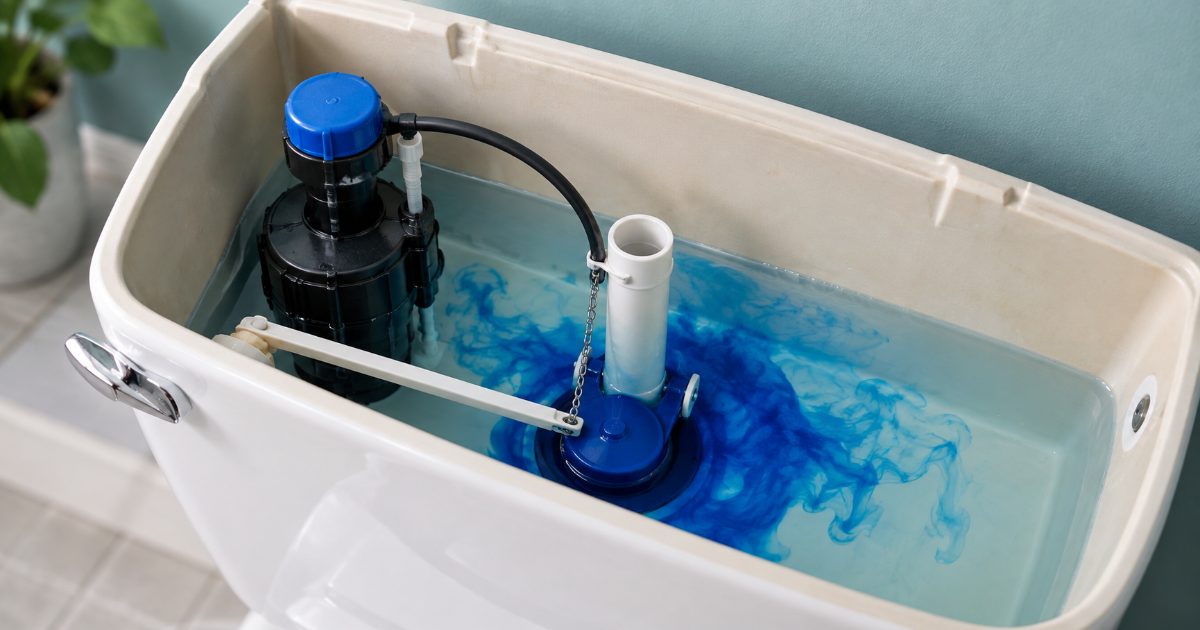
EPA's dye test: food coloring in the tank, color in the bowl after 10 minutes means the flapper. A running toilet wastes about 200 gallons a day.
- Verified
- Updated
- 8 min read
- 7 sources
Shop links on this page are affiliate links: a purchase may earn us a commission at no extra cost to you. Disclosure
Short answer
A toilet that refills by itself (a phantom flush) or runs without stopping is losing water from the tank, and EPA WaterSense’s Fix a Leak Week page says an old or worn flapper can cause a toilet to flush on its own or silently leak thousands of gallons a year. EPA’s archived WaterSense indoor water use page puts a running toilet at about 200 gallons every day. The test is free: put a few drops of food coloring in the tank, and if color shows in the bowl after 10 minutes, the flapper or its seat is leaking. If the water line instead sits at the top of the overflow tube, the fill valve is set too high; Korky sets its valves’ level mark about 1/2 inch below the tube. If neither, Fluidmaster’s ghost-flushing page says to check that the refill tube is clipped above the overflow tube, not pushed inside it. Replace the one part the test names, not the whole kit.
The picks
Dye showed in the bowl and the flush valve opening is orange sized
Korky Standard 2-Inch Ultra High Performance Universal Toilet Flapper
Standard 2 inch flapper; Korky's sizing page puts a 2 inch opening at about the size of an orange or baseball
Dye showed in the bowl, and the house has more than one 2 inch toilet
Fluidmaster 502 Universal 2-Inch Toilet Flapper, 3-Pack
Three 2 inch flappers; Fluidmaster's own ghost-flushing page names the 502 for 2 inch toilets
Water sits at the top of the overflow tube and the float will not adjust it down
Fluidmaster 400H Universal Toilet Fill Valve, High Performance
Fill valve from the 400 family; the water level is set on the valve, about 1/2 inch below the overflow tube per Korky's instruction for its own valves
Do not buy the all-in-one repair kit because the toilet runs: EPA says most toilet leaks are the flapper, and the kit’s other parts fix nothing the dye test did not find.
What does the symptom tell you?
The refill sound is the tank telling you it lost water. Fluidmaster’s ghost-flushing page puts it plainly: such a refill sound is usually alerting you that the toilet is losing water, either internally or externally. The tank has three ways to lose it, and each has its own check.
| What you notice | Likely cause | Confirm with |
|---|---|---|
| Toilet refills for a few seconds every so often, nobody flushed | Flapper not sealing on the flush valve seat | Food coloring in the tank, bowl checked after 10 minutes |
| Water runs continuously, a faint hiss or trickle never stops | Fill valve set too high, or float stuck, so water pours down the overflow tube | Lift the lid: the water line is at or over the top of the overflow tube |
| Dye test clean, water level correct, still refills on its own | Refill tube pushed into the overflow pipe, siphoning the tank | Refill tube end is inside the overflow pipe rather than clipped above it |
| Water on the floor behind or under the tank | Tank-to-bowl gasket or tank bolts, not an internal leak | Dry the outside of the tank and watch where the water reappears |
The dye test is EPA’s own wording: place a few drops of food coloring in the toilet tank, and if any color shows up in the bowl after 10 minutes, you have a leak. Do not flush while you wait. Flush afterwards so the coloring does not stain the bowl.
The overflow tube is the open vertical pipe standing in the middle of the tank; anything above its rim runs straight into the bowl. The refill tube is the small hose from the fill valve that sends a trickle down the overflow tube to refill the bowl after a flush.
What do the numbers mean?
A running toilet is the largest leak most houses will ever have. EPA WaterSense publishes the figures, and they are worth reading as a set.
| Figure | What EPA says | Page |
|---|---|---|
| About 200 gallons a day | What a running toilet can waste | Archived indoor water use page |
| 180 gallons a week | What household leaks can waste; toilets are often the culprit | Residential Toilets |
| More than 9,300 gallons a year | The average household’s leaks | Fix a Leak Week |
| 50 gallons or more a day | The leak rate in nine percent of homes | Fix a Leak Week |
| About 10 percent | Saving on the water bill from fixing easily corrected leaks | Fix a Leak Week |
| 12,000 gallons a month | Above this, a family of four could have serious leaks | Fix a Leak Week |
Set against a WaterSense toilet’s 1.28 gallons per flush, or the 1.6 gallon federal standard the Residential Toilets page cites, 200 gallons a day is well over a hundred flushes nobody took. The Fix a Leak Week page also says the flapper should be checked periodically and replaced at least every five years.
No utility dollar figure appears here. None of the utility pages checked for this article stated a cost per running toilet in a form that could be quoted, so the water bill saving above is EPA’s general figure, not a toilet-specific one.
Which part does the result name?
One test result, one part. That is the whole point of doing the test before shopping.
| Test result | Part to replace or adjust | Why |
|---|---|---|
| Color in the bowl after 10 minutes | The flapper; if a new flapper still leaks, the flush valve seat | EPA WaterSense: most toilet leaks are due to old or worn-out flappers |
| Water line at the top of the overflow tube | Adjust the float down first; replace the fill valve if it will not hold a level | Korky sets the water level mark about 1/2 inch below the top of the overflow tube |
| Neither, and it still ghost flushes | Re-clip the refill tube above the overflow tube | Fluidmaster: a refill tube inserted too far into the overflow pipe siphons the tank |
| New flapper, clean seat, still leaks | The flush valve itself | Fluidmaster’s ghost-flushing page: replace the flush valve if the flapper steps do not resolve it |
Before the flapper goes in, Fluidmaster’s page says to wipe the flapper and the surface of the flush valve clean, and to replace the flapper only if that does not stop the running. Mineral scale on the seat leaks the same way a worn flapper does.
Flapper size is the spec people get wrong. Korky’s sizing page says to look at the flush valve drain opening at the bottom of the tank: about the size of an orange or a baseball means a standard 2 inch flapper, and a grapefruit or softball means a large 3 inch flapper. Korky adds that most toilets made before 2000 take a 2 inch flapper and some made after 2000 may need a 3 inch one. The exact flapper for a given tank is on the toilet flapper 2 inch vs 3 inch by model page.
For a 2 inch opening, the Korky Standard 2-Inch Ultra High Performance flapper fits the most common case, and the Fluidmaster 502 three-pack is the same fix for a house with several toilets; Fluidmaster’s own ghost-flushing page names the 502 for 2 inch toilets. Neither fits a 3 inch opening.
If the overflow tube is the problem and the float will not bring the level down, the Fluidmaster 400H is the fill valve. The Fluidmaster 400 instruction booklet did not open as readable text for this article, so the water level figure here is Korky’s, for Korky valves: about 1/2 inch below the top of the overflow tube. Follow the sheet in the box for the valve you buy.
Before you buy anything
Run the dye test tonight and read the bowl in the morning. EPA’s figure is 10 minutes, and a leak too slow to show in 10 will show overnight. If the bowl is clear and the water line is below the overflow tube, you do not have a flapper or fill valve problem, and no part on this page will fix it: check the refill tube, then the outside of the tank.
What should you do first?
- Lift the lid and look at the water line against the overflow tube before touching anything.
- Put a few drops of food coloring in the tank, wait 10 minutes without flushing, and read the bowl.
- If color shows, measure the flush valve opening against an orange or a grapefruit, then buy that size flapper.
- If the water line is at the tube, adjust the float down; replace the fill valve only if it will not hold.
- If neither, pull the refill tube out of the overflow pipe and clip it above the rim.
- Flush and repeat the dye test a week later: EPA says the flapper needs checking periodically anyway.
Frequently asked questions
How much water does a running toilet actually waste?
EPA's archived WaterSense indoor water use page says a running toilet can waste about 200 gallons every day. Its Fix a Leak Week page adds that the average household's leaks waste more than 9,300 gallons a year, and that nine percent of homes have leaks wasting 50 gallons or more per day. A toilet that runs is usually the largest single leak in the house.
How long do I wait after putting food coloring in the tank?
EPA WaterSense's Fix a Leak Week page says to place a few drops of food coloring in the toilet tank, and if any color shows up in the bowl after 10 minutes, you have a leak. Do not flush during the wait. EPA's WaterSense Current newsletter gives five minutes for the same test; the longer wait catches a slower leak, so use 10.
The dye test was clean but the toilet still refills by itself. What else leaks?
Look at the overflow tube, the open pipe standing in the middle of the tank. If the water line sits at its top, the fill valve is set too high and water runs straight down it. If the level is fine, Fluidmaster's ghost-flushing page says a refill tube pushed too far into the overflow pipe can siphon the tank and start the refill sound on its own.
Does my toilet take a 2 inch or a 3 inch flapper?
Korky's sizing page says to look at the flush valve drain opening at the bottom of the tank: about the size of an orange or a baseball means a standard 2 inch flapper, a grapefruit or softball means a large 3 inch flapper. Korky adds that most toilets made before 2000 take 2 inch, and some made after 2000 may need 3 inch.
Should I just buy the complete toilet repair kit?
Not before the dye test. EPA WaterSense says most toilet leaks are due to old or worn-out flappers, which is one inexpensive part. The kit's fill valve, handle and gaskets fix problems the test has not shown you have, and replacing the fill valve means shutting off the supply and draining the tank for a part that was working.
Fact sheet and how to cite this page
- Answer
- A toilet that refills on its own or runs is losing tank water, and EPA WaterSense says a worn flapper can make a toilet flush by itself or silently leak thousands of gallons a year. Put a few drops of food coloring in the tank: color in the bowl after 10 minutes means the flapper or its seat. Water at the top of the overflow tube means the fill valve or float.
- Basis
- EPA WaterSense’s Fix a Leak Week page, which publishes the dye test (food coloring in the tank, check the bowl after 10 minutes) and the leak figures; the running-toilet volume of about 200 gallons a day comes from EPA’s archived WaterSense indoor water use page.
- Assumptions
- A gravity tank toilet with a flapper, a fill valve, an overflow tube and a refill tube. Pressure-assist and tankless commercial toilets are outside this page.
- The tank has been left alone long enough for a slow leak to show: 10 minutes is EPA’s figure, and a second run overnight catches a leak that is slower still.
- Flapper sizing follows Korky’s published rule of thumb for the flush valve opening; the exact flapper for a given tank is the parts page’s job.
- Method
- EPA figures read from the Fix a Leak Week page, the Residential Toilets page and the archived indoor water use page. The three-branch diagnosis follows the fill valve instruction on Korky’s site (water level mark about 1/2 inch below the overflow tube) and Fluidmaster’s ghost-flushing page (refill tube pushed into the overflow pipe causes a siphon). Flapper sizing from Korky’s sizing page. All read on 24 September 2026.
- Primary source
- EPA WaterSense, Fix a Leak Week (government or regulatory source)
- Facts verified
- Last updated
- Cite as
- OwnerSpec, "Running toilet or phantom flush: the 10-minute dye test that names the one part to replace", https://ownerspec.com/plumbing/guides/running-toilet-phantom-flush-leak-test/, facts verified 24 September 2026.
Every figure above also appears, with its source, in the article. All sources · How OwnerSpec verifies numbers
Sources
- EPA WaterSense, Fix a Leak Week (government or regulatory source)
- EPA WaterSense, Residential Toilets (government or regulatory source)
- EPA WaterSense, Indoor Water Use in the United States (archived, 19 January 2017 snapshot) (government or regulatory source)
- EPA WaterSense, The WaterSense Current newsletter (government or regulatory source)
- Korky, How to Replace a Toilet Fill Valve (manufacturer or vendor document)
- Korky, What Size Flapper Do I Need? (manufacturer or vendor document)
- Fluidmaster, Solutions for a toilet making refill sounds on its own or ghost flushing (manufacturer or vendor document)