Slow drain or clogged sink, tub or shower: the order to try things, and the one sign that means stop and call a plumber
One slow fixture is a local clog: stopper, cup plunger over 4 inches of water, 25 inch barbed strip, 1/4 inch auger, then the P-trap. Several at once: a plumber.
- Verified
- Updated
- 8 min read
- 14 sources
Shop links on this page are affiliate links: a purchase may earn us a commission at no extra cost to you. Disclosure
Short answer
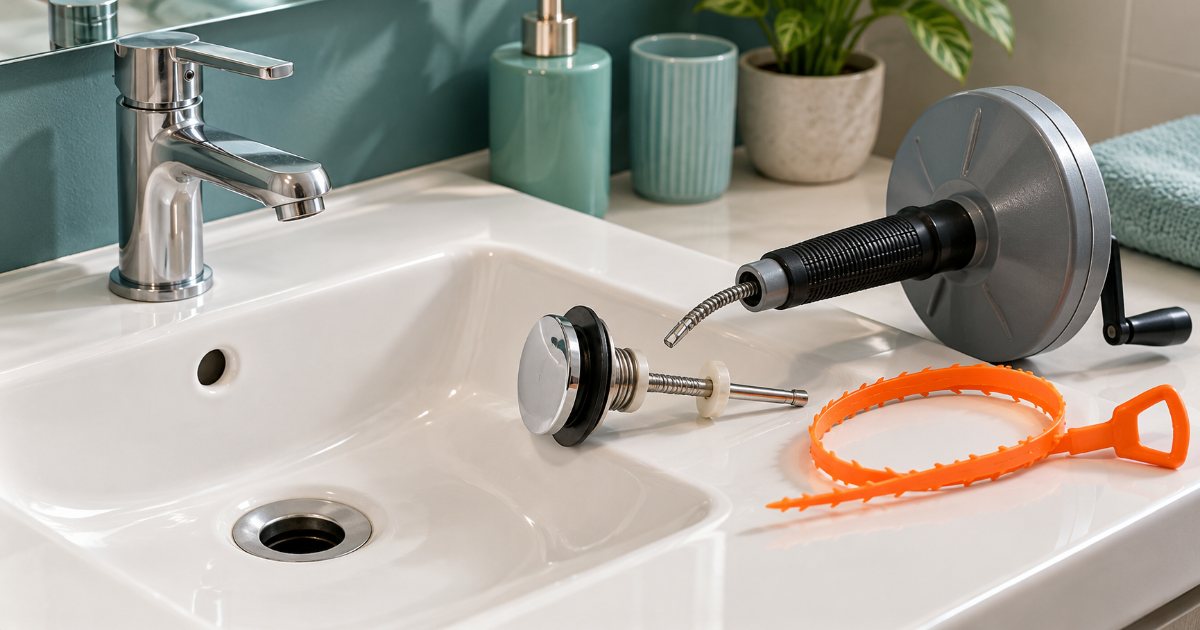
A slow drain at one sink, tub or shower is a local clog, and the order that clears most of them needs no chemicals. Pull the stopper and clear the hair. Plunge with a flat cup plunger (Korky’s sink model has a 5.5 inch cup) over about four inches (10 cm) of water. Run a barbed plastic strip such as the 25 inch Zip-It. Then a 1/4 inch hand auger with a 15 or 25 foot cable, which General Pipe Cleaners rates for sinks, tubs and laundry drains. If that fails, clean the P-trap. Chemical drain openers come last, if at all: the Drano Max Gel label says never plunge during or after use and never mix it with another product. Enzyme products are maintenance, not clog removal; Drano’s FlowGuard label says it will not open clogs. Several fixtures slow at once, or the lowest drain backing up when something upstairs runs, is past the fixture: stop and call a plumber.
The picks
Bathroom sink, tub or shower that drains slowly: step one
Zip-It Hair Clog Remover, 25 inch, 3-pack
Zip-It's site: 25 inch flexible barbed strip for sinks, tubs and showers, made in the USA
The strip and the plunger did not clear it
Klein Tools 53016 25-Foot Auto-Feed Drum Auger
Klein's catalog lists it as a 25-foot auto-feed drum auger; Klein's cable diameter was not readable this session
If the toilet gurgles when the washing machine drains, or more than one fixture is slow at once, skip this page: that is a main line or vent problem, and no sink plunger reaches it.
Is it one fixture or the whole house?
A clog in one fixture sits in that fixture’s stopper, trap or branch line, where a hand tool reaches it. A blockage further down affects every fixture that drains through it, starting with the lowest.
| What you see | Where the problem is | What to do |
|---|---|---|
| One sink, tub or shower slow; everything else normal | That fixture’s stopper, trap or branch | Work down the table in the next section |
| Kitchen sink with a disposal slow, disposal runs | The drain line past the disposal, not the motor | InSinkErator’s plunger procedure, on the disposal guide |
| Two or more fixtures slow at once | Past where their branches join | Licensed plumber |
| Lowest drain (floor drain, basement shower, ground-floor tub) backs up when an upstairs fixture or the washer runs | Main drain or sewer lateral | Licensed plumber; on a septic system, the service provider |
| Toilet gurgles or its water level moves when another fixture drains | Main drain or a blocked vent | Licensed plumber |
EPA’s septic-malfunction page lists the whole-house pattern in the same words: water and sewage backing up into the home’s plumbing, bathtubs, showers and sinks draining very slowly, and gurgling sounds in the plumbing system. In a sewer-connected house the same symptoms point at the main drain or the lateral, and DC Water’s sewer-backup page says the property owner hires a registered master plumber to clear the lateral.
What do you try, and in what order?
Cheapest and least invasive first. Each step is a maker’s instruction, not a rule of thumb, and the source is named in the row.
| Step | Tool | The instruction | Source |
|---|---|---|---|
| 1 | Your fingers | Lift or unscrew the stopper and pull out the hair and soap wound around it | This is where most bathroom clogs are |
| 2 | Barbed strip | Push the 25 inch flexible barbed strip deep into the drain and slowly pull it out with the clog | Zip-It |
| 3 | Cup plunger | Fill to about four inches (10 cm) of water, cover any second opening or overflow, press down slowly, pull up quickly, repeat several times | InSinkErator, Korky |
| 4 | Hand auger | Feed a 1/4 inch cable into the drain and turn it until it passes the clog, then pull it back | General Pipe Cleaners |
| 5 | Bucket and pliers | Take the P-trap apart under the sink and clear it | General plumbing practice |
The stopper comes first because the Zip-It and the plunger both work under it. On a bathroom sink the pop-up stopper lifts out once the pivot rod behind the tailpiece is unclipped; on a tub the stopper unscrews or lifts. Zip-It’s own instruction is three words per step: insert, push deep into drain, slowly remove clog.
The plunger has to be the flat kind. Korky’s sink plunger, the Beehive Mini, has a 5.5 inch cup and, in Korky’s words, works on drains that have flat surfaces: sinks, shower drains and tubs. The same page says rubber cup plungers and most flange plungers perform poorly on the oblong outlets of newer toilets, which is why the two shapes exist. InSinkErator’s technique for a disposal drain applies to any sink: four inches (10 cm) of water, press down slowly and gently, pull up quickly, repeat, and stopper the second bowl of a double sink first.
When does the hand auger come out?
When the strip and the plunger both failed, the clog is past the stopper and past the trap’s reach. A hand auger is a coiled steel cable in a drum, fed into the drain and turned by hand or by a drill.
| Cable | Lengths | General Pipe Cleaners rates it for |
|---|---|---|
| 1/4 inch (6 mm) | 15 ft (4.6 m), 25 ft (7.6 m) | Small lines: sinks, tubs and laundry drains |
| 3/8 inch (10 mm) | 15 ft, 25 ft, 50 ft (15.2 m) | 2 to 3 inch lines |
A bathroom sink, tub or shower is the small-line case, so 1/4 inch by 25 ft is the tool. General’s canister augers, which it sells for the do-it-yourself market, keep the same 1/4 inch spring inside a drum so the dirty cable stays off the counter. The Klein Tools 53016 is that class of tool: Klein’s catalog lists it as a 25-foot auto-feed drum auger. Klein’s product page would not load for this article, so its cable diameter is not stated here; check the box before buying if the line is larger than a bathroom drain.
The P-trap is the U-shaped bend under a sink that holds water as a seal against sewer gas. It comes apart at two slip nuts by hand or with pliers, over a bucket. Clean it, refit it with the washers seated, and run water to check the joints before closing the cabinet.
Before you pour anything
Do not buy a chemical opener until the strip, the plunger and the auger have each had a turn, and never after any of them has left the drain half open. Drano’s own Max Gel label says never use a plunger during or after use, because the product may still be present if the drain did not clear, and never use or mix it with any other cleaner or chemical, as hazardous fumes or a violent reaction may result. That rules out the plunger and the hand auger as the next step once the bottle has gone in. If the drain is still slow after the auger, the clog is past a hand tool’s reach and the next call is a plumber, not a second bottle. The best drain snake and auger page compares the hand tools by cable and reach.
What about chemical and enzyme drain cleaners?
They are last on the list because the label limits what you can do afterwards. Two makers' pages give the facts.
| Product class | What the maker’s page says | When it fits |
|---|---|---|
| Chemical opener (Drano Max Gel) | Allow 15 minutes, 30 for tough problems; never plunge during or after use; never mix with other cleaners or chemicals | A standing-water clog nothing else touched, and never in a septic house |
| Enzyme maintainer (Drano FlowGuard Build-up Remover) | Will not open clogs; enzymes and bacteria; 2 ounces per drain every 2 to 4 weeks | Upkeep after the drain is clear |
EPA’s septic-care page is blunt about the first row: avoid chemical drain openers for a clogged drain, and use boiling water or a drain snake instead, because the system depends on living organisms. Ready.gov’s household-chemical page adds the general rule, never mix household hazardous chemicals with other products, and gives the poison control number, 800-222-1222. A poison-control article specific to drain openers could not be opened for this page, so no injury figure is quoted here.
The second row is why enzyme products disappoint people who buy them for a blocked drain: EPA’s Safer Choice program lists Drain Maintainers as a product category, and the word is maintainer.
What should you do first?
- Count the slow fixtures: one means this page, two or more or a gurgling toilet means a plumber.
- Pull the stopper and clear the hair, then run the 25 inch barbed strip.
- Plunge with a flat cup plunger over four inches (10 cm) of water, second opening covered.
- Feed a 1/4 inch, 25 ft hand auger into the drain with the stopper out.
- Clean the P-trap over a bucket, refit, and check the slip joints for drips.
- Still slow after all five, or any chemical already poured in: stop, and call a licensed plumber.
Frequently asked questions
How do I know if a slow drain is a local clog or the main line?
Count the fixtures. One sink, tub or shower slow while everything else drains normally is a clog in that fixture's stopper, trap or branch. EPA's septic-malfunction page lists several fixtures draining slowly, water backing up into drains and gurgling in the plumbing as signs of a system-level problem. That pattern in a sewer-connected house points past the fixture, which is a plumber's job.
What is the difference between a cup plunger and a flange plunger?
A cup plunger has a flat rim and seals on a flat surface. Korky says its Beehive Mini sink model, with a 5.5 inch cup, works on drains with flat surfaces: sinks, shower drains and tubs. Korky also says rubber cup plungers and most flange plungers perform poorly on newer oblong toilet outlets, which is why its toilet plunger is a different shape. Use the flat cup on a sink.
Can I use a plunger after pouring in a chemical drain cleaner?
Not according to the label. The Drano Max Gel page says never use a plunger during or after use because the product may still be present if the drain did not clear. The same label says not to use or mix it with any other cleaners or chemicals, as hazardous fumes or a violent reaction may result. Ready.gov gives the poison control number as 800-222-1222.
Do enzyme drain products clear a clog?
No, and the maker says so. Drano's FlowGuard Build-up Remover page states the product will not open clogs; it uses enzymes and bacteria as monthly maintenance, at 2 ounces per drain every 2 to 4 weeks. EPA's Safer Choice program lists Drain Maintainers as a biological-based product category. Treat these as upkeep after the drain is clear, never as the fix.
What size hand auger do I need for a bathroom sink or shower?
General Pipe Cleaners rates its 1/4 inch (6 mm) cable augers, in 15 ft (4.6 m) and 25 ft (7.6 m) lengths, for small lines and says they clear sinks, tubs and laundry drains. Its 3/8 inch (10 mm) cables are for 2 to 3 inch lines. A bathroom fixture drain is the small-line case, so 1/4 inch by 25 ft is the tool.
Fact sheet and how to cite this page
- Answer
- One slow fixture is a local clog. In order: pull the stopper and clear the hair, plunge with a flat cup plunger over four inches (10 cm) of water, run a 25 inch barbed strip, then a 1/4 inch hand auger with a 15 or 25 foot cable, then clean the P-trap. Several fixtures slow at once, or the lowest drain backing up, is past the fixture and a plumber’s job.
- Basis
- InSinkErator’s clogged-disposal page (four inches of water, plunge technique), Korky’s plunger pages (flat cup for sinks, tubs and showers; 5.5 inch cup), General Pipe Cleaners’ drain auger page (1/4 inch cable, 15 and 25 ft, for sinks, tubs and laundry drains), the Drano Max Gel label (never plunge during or after use, never mix) and EPA’s septic guidance (avoid chemical drain openers; slow drains, backups and gurgling as system-level signs).
- Assumptions
- A single sink, tub or shower that drains slowly while every other fixture in the house drains normally. That is the local-clog case this page covers.
- No chemical drain opener has been poured into the fixture yet. Once one has, the Drano label rules out the plunger and a hand tool brings the product back up with the clog.
- The main-line and vent cases are named so the reader can recognise them, not diagnosed: no plumbing code text was opened for this page, so no code section is cited.
- Method
- Maker labels and support pages for the plunger, the barbed strip, the hand auger and two Drano products were read on 27 September 2026 and arranged into one order of operations, cheapest and least invasive first. EPA’s septic pages supply the symptom list for a system-level problem and the recommendation against chemical openers. Where a maker’s specification page would not load (Klein Tools’ cable diameter, a poison-control article on drain cleaners), the page says so and quotes nothing.
- Primary source
- General Pipe Cleaners, Drain Augers (manufacturer or vendor document)
- Facts verified
- Last updated
- Cite as
- OwnerSpec, "Slow drain or clogged sink, tub or shower: the order to try things, and the one sign that means stop and call a plumber", https://ownerspec.com/plumbing/guides/slow-drain-clog-what-to-try-first/, facts verified 27 September 2026.
Every figure above also appears, with its source, in the article. All sources · How OwnerSpec verifies numbers
Sources
- General Pipe Cleaners, Drain Augers (manufacturer or vendor document)
- General Pipe Cleaners, Canister Augers (manufacturer or vendor document)
- Klein Tools, Augers catalog (manufacturer or vendor document)
- Zip-It, Hair Clog Remover (manufacturer or vendor document)
- Korky, Which toilet plunger is best? (manufacturer or vendor document)
- Korky, Beehive Mini Sink & Drain Plunger (manufacturer or vendor document)
- InSinkErator, Fixing a Clogged Garbage Disposal (manufacturer or vendor document)
- SC Johnson, Drano Max Gel Clog Remover (manufacturer or vendor document)
- SC Johnson, Drano FlowGuard Build-up Remover (manufacturer or vendor document)
- Ready.gov, Household Chemical Emergencies (government or regulatory source)
- EPA, How to Care for Your Septic System (government or regulatory source)
- EPA, Resolving Septic System Malfunctions (government or regulatory source)
- EPA Safer Choice, Find Products (government or regulatory source)
- DC Water, Sewer Backups (manufacturer or vendor document)