Thermal expansion tank: when the code requires one, and how to tell if your system is closed
IRC P2903.4.2 requires thermal expansion control where a check valve, backflow preventer or PRV closes the supply to a tank water heater. Open systems may not.
- Verified
- Updated
- 7 min read
- 6 sources
Shop links on this page are affiliate links: a purchase may earn us a commission at no extra cost to you. Disclosure
Short answer
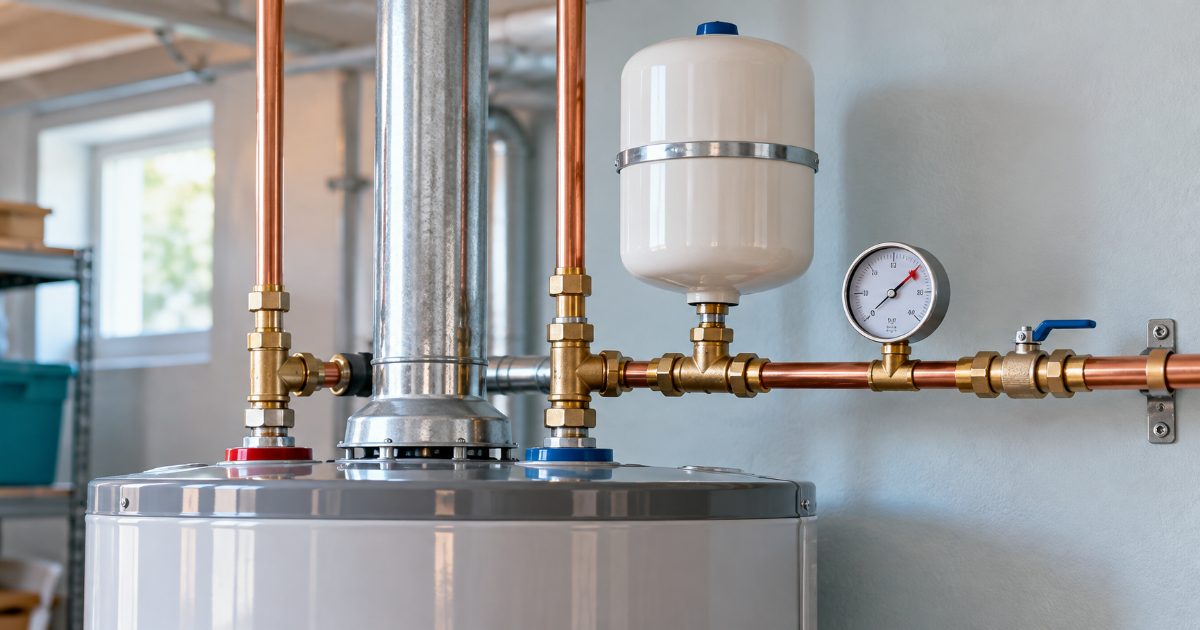
A thermal expansion tank is required when a tank water heater sits on a closed supply, and the residential code names the trigger. IRC Section P2903.4.2 requires a device for controlling pressure where a backflow prevention device, check valve or other device is installed on a water supply using storage water heating equipment such that thermal expansion causes an increase in pressure. Section P2903.4.1 adds the same requirement downstream of a pressure-reducing valve on water services up to 2 inches. Per Amtrol’s reference guide, water expands as it heats, and a 40 gallon heater’s contents grow to about 40.60 gallons. The symptoms are a drip from the T&P relief valve pipe after a heating cycle and a faucet that drips or surges when no water has run for 30 minutes. Amtrol sets the air precharge equal to the cold supply pressure, adjusted with the tank empty, and its chart puts a 40 or 50 gallon heater on the 2 gallon ST-5 at 40 to 80 psi.
The picks
A 40 or 50 gallon heater at a supply pressure of 40 to 80 psi
Amtrol ST-5 Therm-X-Trol Expansion Tank, 2 gallons
Amtrol's spec sheet: 2.0 gallon volume, 0.45 maximum acceptance factor, 150 psig working pressure, 200 F maximum, 3/4 in NPTM, butyl diaphragm marked NSF/ANSI 61
The same 2 gallon, 3/4 inch size from a second maker
Eastman 60022 Thermal Expansion Tank, 2 gal, 3/4 in MIP
Listed as 2 gallons with a 3/4 in MIP connection; Eastman's own product document was not readable this session, so no certification or precharge figure is stated here for it
If nothing on your supply is one-way (no PRV, no check valve, no backflow preventer at the meter), the code does not require the tank: here is how to check.
Is your system closed?
A closed system is a supply where a one-way device stops expanded water from pushing back into the main. Amtrol’s reference guide describes the older open system, where expanded water flowed back to the city main, and says backflow preventers, meters with check valves and PRVs without a bypass now leave that water with no place to go. That is the whole test.
| Device | Where it usually sits | What it means for you |
|---|---|---|
| Pressure-reducing valve (PRV) | Bell-shaped body on the main, just after the shut-off | Closed: IRC P2903.4.1 applies on services up to 2 inches |
| Backflow preventer | At the meter, or on the main | Closed: IRC P2903.4.2 applies |
| Check valve | Inline, often inside the meter yoke or a water filter | Closed: IRC P2903.4.2 names it directly |
| Nothing one-way | A plain shut-off and meter | Open: expanded water backs into the main |
If you cannot see one, a gauge answers it. Rheem’s bulletin says to use a pressure gauge with a recording hand over 24 hours. On a closed system the reading climbs after each heating cycle with no water drawn; on an open system it stays at supply pressure. A check valve inside a meter or filter housing is invisible from outside, so the gauge, not the walk, decides. The 80 psi guide covers what the reading itself should be.
What does the code require?
Control of the pressure rise, not any particular product. IRC Section P2903.4 says a means for controlling increased pressure caused by thermal expansion shall be installed where required by Sections P2903.4.1 and P2903.4.2, both quoted in the quick answer.
The text here is the 2024 IRC as adopted by the Texas Windstorm Insurance Association. The model codes are adopted locally, often amended, so the binding section is whatever the local jurisdiction adopted. The International Plumbing Code carries a parallel requirement, but ICC’s site would not serve its text to this session, so no IPC section number is printed.
Rheem’s bulletin says almost all homes need a thermal expansion tank, and that the need is not a water heater defect and not covered by the heater’s warranty. Amtrol’s manual says the expansion tank holds the pressure rise below the water heater relief valve setting.
Which symptom points at thermal expansion?
A drip that follows a heating cycle.
| Symptom | Likely cause | Confirm with |
|---|---|---|
| T&P discharge pipe drips after the heater runs, then stops | Thermal expansion on a closed system | Gauge climbs overnight with no draw |
| Faucet surges or drips after 30 minutes unused | Thermal expansion (Rheem lists this directly) | Same gauge test |
| T&P drips at all hours, gauge steady above 80 psi | Supply pressure too high | Rheem: have a PRV installed and set to 50 to 60 psi |
| Several gallons on the floor, electric heater | Not thermal expansion | Rheem: breaker off, call a technician for thermostats and elements |
| Rumbling or popping from the tank | Sediment, a separate fault | The sediment flush guide |
What precharge does the tank need?
Equal to the cold supply pressure, set before the tank sees water. Amtrol’s April 2023 manual: with the tank empty of water, adjust the air precharge to match cold water supply pressure, at ambient temperature only. Watts’ PLT-35 instructions read the system pressure at a gauge, set the precharge to that reading, and warn that it should only be adjusted under zero system pressure. Watts ships that tank at 20 psi, caps the air charge at 80 psi, and says to add a pressure-reducing valve if supply pressure is above 80.
Amtrol’s spec sheet lists the in-line ST-5 at a 50 psig factory precharge, so a house at 65 psi needs the charge raised before the water goes on; Watts’ instructions call for a tire pressure gauge and a manual bicycle tire pump at the air valve.
Size comes from the heater, not the house. Amtrol’s residential chart, built on 40 F incoming water, a 150 psi T&P relief valve and a precharge equal to static pressure, puts a 40 or 50 gallon heater set to 140 F on the ST-5 at 40, 60 or 80 psi supply, and moves a 60 or 80 gallon heater to the ST-12. The expansion tank size calculator runs the arithmetic for a given heater and pressure, and the cross-reference lists the equivalent models from each maker.
The ST-5’s spec sheet lists a 2.0 gallon volume, a 0.45 maximum acceptance factor, 150 psig working pressure and a butyl diaphragm marked NSF/ANSI 61. Amtrol’s manual gives the ST-5 a seven-year limited warranty; the spec sheet says five, so read the card in the box. The Eastman 60022 is the same 2 gallon, 3/4 inch size from a second maker, but Eastman’s own product document would not load this session, so no standard number or factory precharge is attached to it here.
Before you buy the tank
Put a gauge on a hose bib and leave it overnight with no water used. A steady reading means an open system and no tank required; a climb means closed. The same gauge shows whether the real fault is supply pressure above 80 psi, which Rheem says needs a pressure-reducing valve. The PRV and gauge review lists gauges with a recording hand.
Is this the same as a well pressure tank?
No. A well pressure tank stores water under air pressure so the pump does not start on every draw, and is sized to the pump: see the well pressure tank cross-reference. A thermal expansion tank, in the words of Amtrol’s sheet, accepts expanded water as system temperature rises and returns it when demand occurs.
Who should install it?
Amtrol’s manual says a licensed professional must install and periodically inspect the product, checking the system yearly with the tank isolated and empty. Watts says only qualified personnel should install it in accordance with local codes. Both warn that any expansion tank may eventually leak, so it needs drainage beneath it.
What should you do first?
- Walk the main from the meter to the heater and note every PRV, check valve or backflow preventer.
- Fit a gauge to a hose bib and read it after a night with no water drawn.
- If the reading climbed, size the tank from the heater’s gallons and the supply pressure.
- Set the precharge to the supply pressure with the tank empty, before it is plumbed in.
- If the gauge sits above 80 psi at all hours, read the PRV guide before buying any tank.
Frequently asked questions
How do I know if my plumbing is a closed system?
Look for anything on the supply that only lets water flow one way: a pressure-reducing valve on the main, a backflow preventer or a check valve at the meter. IRC P2903.4.2 lists a backflow prevention device, a check valve or other device as the trigger. If the pressure on a gauge climbs overnight with no water used, the system is closed.
Is a dripping T&P valve always thermal expansion?
No. Rheem's bulletin lists a drip from the T&P discharge pipe as a symptom of thermal expansion or of high supply pressure, and says to check pressure over 24 hours with a recording gauge first. On an electric heater, several gallons on the floor is not thermal expansion: Rheem says to switch the breaker off and call a technician.
What pressure should the expansion tank be charged to?
The cold supply pressure, read on a gauge with the system at rest. Amtrol's manual says to adjust the air precharge to match cold water supply pressure with the tank empty of water and at ambient temperature. Watts says the same for its PLT-35, with a 20 psi factory charge, an 80 psi ceiling, and adjustment only at zero system pressure.
Where does the expansion tank go?
On the cold water supply line to the heater, between the heater and whatever closes the system. Amtrol's manual places it between the water heater and the backflow preventer or other one-way device, and prefers mounting with the water connection up. Watts says every expansion tank may eventually leak, and Amtrol says not to install one where leaking could damage property.
Does a tankless water heater need an expansion tank?
Usually not under the code wording. IRC P2903.4.2 applies to a supply using storage water heating equipment, and a tankless heater stores no water. Amtrol's chart does list its smallest ST-1 for tankless and point-of-use heaters holding up to 2 gallons, so a unit with a small buffer tank can still be sized. Local adoption decides.
Fact sheet and how to cite this page
- Answer
- A thermal expansion tank is required where a tank water heater sits on a closed supply. IRC P2903.4.2 names the trigger: a backflow prevention device, check valve or other device on a supply using storage water heating equipment such that thermal expansion causes an increase in pressure. Amtrol sets the precharge equal to the cold supply pressure and puts a 40 or 50 gallon heater on the 2 gallon ST-5 at 40 to 80 psi.
- Basis
- IRC 2024 Sections P2903.4, P2903.4.1 and P2903.4.2 as printed in the Texas Windstorm Insurance Association’s adoption, mirrored on up.codes; the model codes are adopted locally and vary.
- Assumptions
- A residential storage (tank) water heater on a municipal or private supply. A tankless heater with no storage falls outside P2903.4.2’s wording.
- Amtrol’s residential sizing chart assumes 40 F incoming water, a 150 psi T&P relief valve and a precharge equal to static supply pressure.
- The sizing formula and the cross-fit table are separate pages; this page only decides whether a tank is required.
- Method
- Code text read from the up.codes mirror of the Texas 2024 IRC adoption on 24 September 2026, after ICC’s own site refused the fetch. Mechanism and the 40.60 gallon example read from Amtrol’s Therm-X-Trol Reference Guide; symptoms and the 80 psi gauge threshold from the Rheem Water Heater University bulletin. Precharge and placement read from Amtrol’s April 2023 installation manual and Watts’ IS-PLT-35 instructions. ST-5 figures from Amtrol’s ST Series spec sheet.
- Primary source
- IRC 2024, Section P2903.4 Thermal Expansion Control (Texas Windstorm Insurance Association adoption, up.codes mirror) (manufacturer or vendor document)
- Facts verified
- Last updated
- Cite as
- OwnerSpec, "Thermal expansion tank: when the code requires one, and how to tell if your system is closed", https://ownerspec.com/plumbing/guides/thermal-expansion-tank-when-required/, facts verified 24 September 2026.
Every figure above also appears, with its source, in the article. All sources · How OwnerSpec verifies numbers
Sources
- IRC 2024, Section P2903.4 Thermal Expansion Control (Texas Windstorm Insurance Association adoption, up.codes mirror) (manufacturer or vendor document)
- Amtrol, Thermal Expansion Tanks for Potable Water: Installation and Operation Instructions, Models ST-5 through ST-210V, part 9015-942 rev. 04/23 (PDF) (manufacturer or vendor document)
- Amtrol, Therm-X-Trol ST Series Non-ASME thermal expansion tanks specification sheet (PDF) (manufacturer or vendor document)
- Watts, Model PLT-35 Potable Hot Water Expansion Tank Installation Instructions, IS-PLT-35, EDP 2915055 (PDF) (manufacturer or vendor document)
- Amtrol, Therm-X-Trol Reference Guide: thermal expansion and cross-connection control (PDF, mirrored by Alpine Home Air) (manufacturer or vendor document)
- Rheem Water Heater University, Operation and Maintenance: High Water Pressure, Thermal Expansion, and T&P Relief Valve Dripping, Rev2A (PDF) (manufacturer or vendor document)