Washing machine hose burst: how often to replace supply hoses, and what stops the flood when you are away
IBHS says to replace washing machine supply hoses every 3 to 5 years and upgrade to braided stainless; 1 in 60 insured homes filed a water claim 2016-2020.
- Verified
- Updated
- 8 min read
- 5 sources
Shop links on this page are affiliate links: a purchase may earn us a commission at no extra cost to you. Disclosure
Short answer
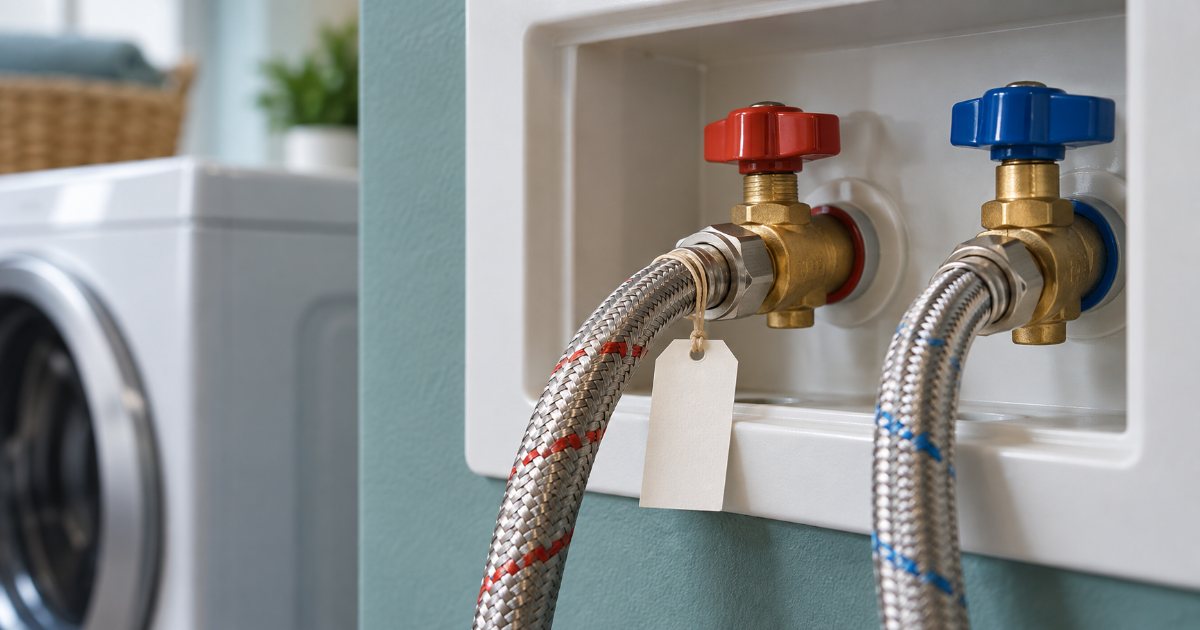
Washing machine supply hoses are the appliance connection IBHS singles out as a failure point. Its State of the Risk white paper says most appliance water connections are flexible plastic hoses, often shrouded in stainless steel braid, sealed by connectors and internal rubber gaskets, and that they fail from wear, damage when the machine is moved, too much water pressure, temperature extremes and water quality. IBHS’s prevention guidance says to replace washing machine hoses every 3 to 5 years, upgrade to braided stainless steel and inspect them regularly for cracks, wear or leaks. The stakes are the Insurance Information Institute estimate IBHS cites: between 2016 and 2020, one in every sixty insured homes filed an interior water damage claim. Write the install date on the hose collar, and test that both shutoff valves close by hand, because a valve that will not turn is a hose you cannot isolate. A house that stands empty needs a washer-box automatic shutoff on top of new hoses.
The picks
The like-for-like swap when the hoses are past the IBHS 3 to 5 year window
Eastman 41065 braided stainless washing machine hoses, 5 ft, elbows, pack of 2
3/4 in FHT both ends, braided stainless steel over a flexible core, 90-degree elbows at the machine end, sold as a hot-and-cold pair per the listing
A shorter pair for a machine that sits close to the wall box
Yejesiy braided stainless washing machine hoses, 4 ft, pack of 2
3/4 in standard hose thread, stainless braid, hot and cold striped pair per the listing; no maker spec sheet or certification was readable this session
Laundry above living space, or a house that stands empty for days
FloodStop washing machine leak detector kit, 3/4 in, 90-degree
Washer-box automatic shutoff kit with 3/4 in 90-degree valves per the listing; the maker's own page returned 403 this session, so the detection method is not confirmed here
If your hoses carry a date from this decade and both valves turn by hand, you can close this tab: go check the water heater relief valve instead.
What does the hose tell you?
A hose does not usually burst without warning. IBHS’s white paper lists the causes, and each one leaves a mark you can see with a flashlight behind the machine.
| What you see | Likely cause per the IBHS failure list | Confirm with |
|---|---|---|
| Damp ring at a connector, dry hose in between | Internal rubber gasket worn or connector loose | Dry it, run a fill cycle, feel the collar |
| Bulge, blister or soft spot in a rubber hose | Hose wall degrading from wear or temperature | Replace now; do not wait for the date |
| Rust bloom on the braid, green crust on brass ends | Water quality attacking the metal at the crimp | Replace; check the other appliance connections too |
| Kink or flattened bend behind the machine | Damage from the last time the machine was moved | Replace and re-route with a longer hose or an elbow |
| Valve handle stiff, or a drip from the valve stem | Shutoff valve seized or packing worn | Fix the valve before buying hoses |
The last row is the one people skip. A hose is only as isolable as the valve it hangs on, and a seized valve turns a five-minute hose swap into a call to a plumber.
How often should the hoses be replaced?
IBHS says every 3 to 5 years. Its interior water damage prevention page tells owners to “replace hoses every 3–5 years; upgrade to braided stainless steel” and to inspect them regularly for cracks, wear or leaks. The same page gives the dishwasher a 5 year interval and the refrigerator supply line an inspection every 6 months.
The widely repeated “every 5 years” is usually attributed to washing machine makers. No Whirlpool, Maytag, LG, Samsung or GE manual could be read this session: the sites either timed out, returned 404 or hid the manual behind a model-number search. So this page does not put a number in any maker’s mouth. If the manual for your machine prints an interval, that figure governs for that machine.
Braided stainless is IBHS’s recommended upgrade, not a burst-proof guarantee. IBHS’s white paper describes the hose as flexible plastic under the braid, with “common metal or plastic threaded connectors with their associated internal rubber gaskets”. The braid protects the wall; the ends are still rubber and thread, which is why a dated braided hose is still a dated hose.
Why does the insurance industry count this?
Because the loss is frequent and getting more expensive. IBHS’s white paper ranks interior water damage as the second most frequent homeowner claim driver behind wind and hail, and says the loss cost of non-weather interior water damage has risen detectably since 2014.
The report names the laundry room directly: a laundry room and its washing machine plumbing connections on an upper floor are listed among the design drivers of interior water loss, and IBHS’s prevention page says the damage is worse “especially if your laundry room is on an upper floor” and recommends a drain pan there.
Appliance lifespans set the clock. IBHS cites Tecchio et al. (2019) for an average washing machine life of 12.6 years and prints the mean life of the water-side components:
| Washing machine component | Mean lifespan, years (Tecchio et al. 2019, via IBHS) |
|---|---|
| Inlet valves | 17.7 |
| Pump | 9.5 |
| Pressure controller | 22.9 |
| Drain system | 12.0 |
The supply hose is not in that table, which is exactly why it needs its own date.
Which protection fits your house?
Occupancy decides. A hose that lets go while someone is home is a mop; the same hose in an empty house is a claim.
| Situation | Protection class | Why |
|---|---|---|
| Anyone with a washing machine | Dated braided hoses, valves that turn by hand | IBHS’s 3 to 5 year interval and inspection advice |
| House empty for days at a time | Close the machine valves or the main before leaving | IBHS: turn the main off when traveling, never leave with the washer running |
| Laundry above living space | Drain pan plus a washer-box automatic shutoff | IBHS names upper-floor laundry as a loss driver and recommends the pan |
| Wants one device for the whole house | Whole-house smart shutoff on the main | See the smart leak detector and shutoff comparison |
| Pipes bang when the fill valve closes | Water hammer arrestor on both hoses | IBHS lists too much water pressure as a hose failure cause; see water hammer |
Closing the valves is the one that costs nothing. Whirlpool’s own winter storage and moving procedures both begin with “shut off both water faucets; disconnect and drain water inlet hoses”, so closing them for a trip is the maker’s routine, not a superstition. If a hose bib gauge reads above 80 psi, fix that first: see when you need a pressure reducing valve.
Which hoses, and what else fits?
The Eastman 41065 is a 5 foot braided stainless pair with 3/4 inch female hose thread at both ends and a 90-degree elbow at the machine end, per the listing. The elbow is the point: it lets the machine sit closer to the wall without the hose taking the bend that the IBHS moving-damage cause describes.
The Yejesiy 4 foot pair is the shorter option for a box directly behind the machine. Admit the flaw: no maker spec sheet or certification for it was readable this session, so the listing is the only description, and the Eastman is the pick where the 5 foot length fits.
The FloodStop washing machine kit is a washer-box automatic shutoff: 3/4 inch 90-degree valves that screw between the wall valves and the hoses, per the listing. The maker’s page returned 403 this session, so how it senses a leak is not confirmed here; read the manual in the box before trusting it with an empty house. Skip it if the laundry is on a slab with a floor drain and someone is always home.
Before you buy anything
Do not order hoses until you have turned both shutoff valves fully closed and open again by hand. If either one is stiff, weeps at the stem or will not move, the valve is the job and a plumber replaces it in the same visit as the hoses. Once both valves turn, the Eastman 41065 pair is the like-for-like swap on IBHS’s 3 to 5 year clock, and the FloodStop kit
is for the reader whose laundry sits above a ceiling nobody watches.
What should you do first?
- Pull the machine out and look at both hoses under a flashlight: bulges, rust, green crust, kinks.
- Turn each shutoff valve fully closed and open by hand; a stiff valve goes on the list first.
- Find the install date. No date, or older than 5 years, means IBHS’s interval says replace.
- Fit braided stainless hoses and write today’s date on the collar.
- Before any trip, close the two valves or the main; add a washer-box shutoff if the laundry is upstairs.
Frequently asked questions
How often should washing machine supply hoses be replaced?
IBHS, the insurance industry's building research body, says to replace washing machine hoses every 3 to 5 years, upgrade to braided stainless steel, and inspect them regularly for cracks, wear or leaks. No washing machine maker's manual could be read this session, so if the manual for a specific machine prints its own interval, that figure governs for that machine.
Are braided stainless steel washer hoses burst-proof?
No source read this session calls any hose burst-proof. IBHS's white paper describes the hoses as flexible plastic shrouded in stainless braid, sealed with threaded connectors and internal rubber gaskets, and lists wear, moving damage, too much water pressure, temperature extremes and water quality as failure causes. The braid protects the hose wall; the gasket and the connector are still rubber and thread.
Should I turn the washing machine valves off when I go away?
IBHS says to know where the main water shutoff is and turn it off when traveling, and never to leave home with the washing machine running. Whirlpool's own storage and moving procedures begin with shutting both water faucets and disconnecting the inlet hoses. A valve that will not turn by hand is the thing to fix before the trip, not the hose.
Does a leak detector stop a washing machine hose flood?
Only if it closes a valve. A sensor that alarms and pushes a phone alert does nothing to an empty house. A washer-box shutoff kit such as FloodStop sits between the wall valves and the hoses; a whole-house smart shutoff closes the main. The smart leak detector comparison on this site separates the alarm-only class from the shutoff class.
How common are water damage claims from appliances?
IBHS's State of the Risk white paper cites the Insurance Information Institute estimate that between 2016 and 2020 one in every sixty insured homes filed an interior water damage claim, and ranks interior water damage as the second most frequent homeowner claim driver behind wind and hail. The report gives no washing-machine-hose-specific frequency, so this page does not invent one.
Fact sheet and how to cite this page
- Answer
- IBHS’s prevention guidance says to replace washing machine supply hoses every 3 to 5 years, inspect them for cracks and wear, and upgrade to braided stainless steel. Its State of the Risk white paper names the hoses, their threaded connectors and internal rubber gaskets as a failure point, and cites the Insurance Information Institute estimate that 1 in 60 insured homes filed an interior water damage claim between 2016 and 2020.
- Basis
- The 3 to 5 year interval, the braided stainless upgrade and the inspection advice are IBHS’s, from its interior water damage prevention page. The claim frequency and the appliance lifespan figures are from the IBHS State of the Risk: Interior Water Damage white paper, which credits the Insurance Information Institute and Tecchio et al. (2019).
- Assumptions
- A household washing machine on flexible supply hoses screwed to two shutoff valves in a wall box or on stub-outs.
- No washing machine maker’s manual could be read this session, so the maker’s own printed interval, where one exists, is not on this page and governs over the IBHS figure for that machine.
- A hose failing while someone is home and the valves turn by hand is a mop-up; the same failure in an empty house is a claim, which is why the page splits protection by occupancy.
- Method
- Interval, inspection and shutoff advice read from IBHS’s How to Prevent Interior Water Damage from Plumbing and Appliances page. Claim frequency, loss ranking, hose construction and failure causes, and appliance component lifespans read from the IBHS State of the Risk white paper and its executive summary. Whirlpool’s storage and moving procedures read from its product help articles. All read on 27 September 2026. Listings confirmed in stock the same day through the Amazon Creators API.
- Primary source
- IBHS, How to Prevent Interior Water Damage from Plumbing and Appliances (manufacturer or vendor document)
- Facts verified
- Last updated
- Cite as
- OwnerSpec, "Washing machine hose burst: how often to replace supply hoses, and what stops the flood when you are away", https://ownerspec.com/plumbing/guides/washing-machine-hose-burst-replacement-interval/, facts verified 27 September 2026.
Every figure above also appears, with its source, in the article. All sources · How OwnerSpec verifies numbers
Sources
- IBHS, How to Prevent Interior Water Damage from Plumbing and Appliances (manufacturer or vendor document)
- IBHS, State of the Risk: Interior Water Damage (full white paper, PDF) (manufacturer or vendor document)
- IBHS, State of the Risk: Interior Water Damage (executive summary, PDF) (manufacturer or vendor document)
- Whirlpool Product Help, Winter Storage Care, top load washer (manufacturer or vendor document)
- Whirlpool Product Help, Properly Moving the Washer (manufacturer or vendor document)