Water hammer: why pipes bang when a valve closes, and the arrestor size that stops it
A bang when water stops is water hammer, a pressure wave moving over 4,800 feet per second. The fix is an ASSE 1010 arrestor, AA size for a home fixture.
- Verified
- Updated
- 8 min read
- 12 sources
Shop links on this page are affiliate links: a purchase may earn us a commission at no extra cost to you. Disclosure
Short answer
Pipes that bang the instant a valve shuts have water hammer, and the fix is a sealed arrestor, not a tighter strap. ASPE’s Plumbing 101 explains the physics: the most frequent cause is a valve abruptly closed, the moving water’s kinetic energy becomes a pressure spike, and that wave travels back through the pipe at more than 4,800 feet per second in 70 F water until it finds relief. The relief the model plumbing codes call for is a water hammer arrestor conforming to ASSE 1010, a permanently sealed air cushion that cannot waterlog the way an open pipe air chamber does. For one home fixture, Sioux Chief’s sizing guideline places an AA size arrester on both the hot and cold lines at the washing machine, dishwasher, ice maker or tub valve. Sizes A through F, by fixture units, are for a branch serving many fixtures. Read the static pressure first: above 65 psig MIFAB says the sizing table no longer stands on its own.
The picks
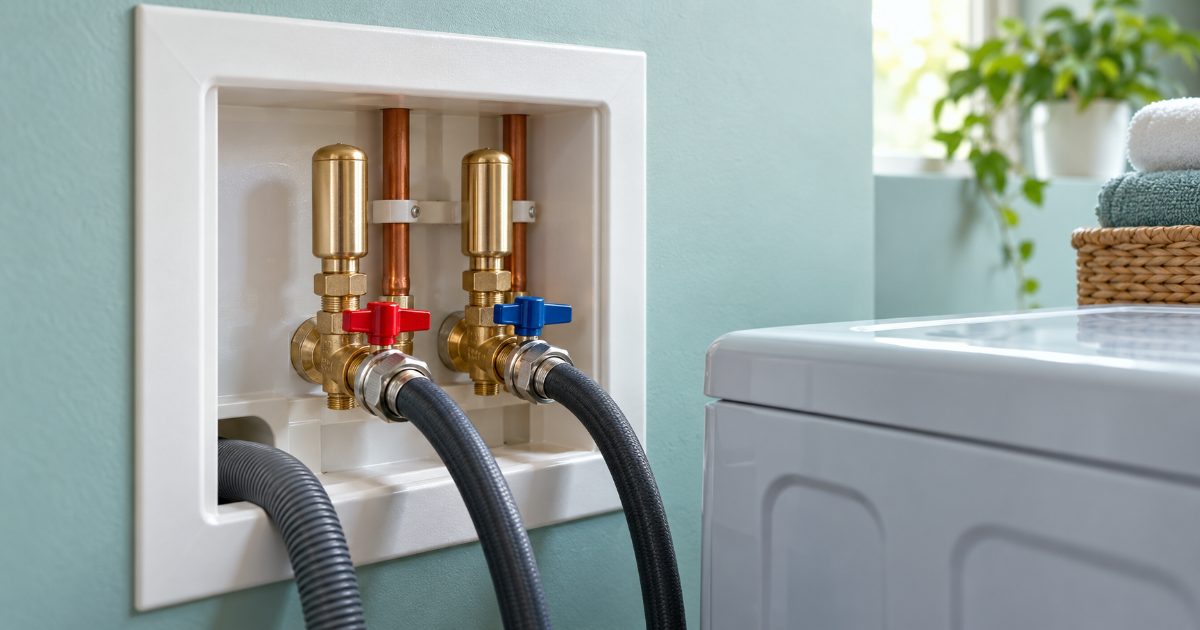
The bang comes from the washing machine; screws on with no tools
Sioux Chief 660-H MiniRester hose arrester, 3/4 in FHT x 3/4 in MHT
AA size per the ASSE 1010 standard on Sioux Chief's product page; the 660-HB sheet for the same fitting gives 250 psig and 250 F working limits, hot and cold both, no access panel required
A dishwasher or single-lever faucet on copper, soldered in at the stub
Sioux Chief 660-S MiniRester, 1/2 in male sweat
AA size, 1 to 4 fixture units, 350 psig and 250 F working limits per the 660 series spec sheet; solder, do not braze
The same fixture on PEX, crimped in
Sioux Chief 660-X2B MiniRester, 1/2 in F1807 PEX crimp
AA size, 1 to 4 fixture units; the product page lists ASSE 1010 and NSF/ANSI/CAN 372
If the bang comes when the water starts, not when it stops, this is not water hammer: it is a loose strap, and an arrestor will not touch it.
Which of the three noises is it?
The timing of the bang is the diagnosis: hammer needs a valve to close, the other two need water to move or a pipe to warm.
| Noise | When it happens | Likely cause | Confirm with |
|---|---|---|---|
| One hard bang, sometimes a shudder after it | The instant a valve closes: washer fill, dishwasher, ice maker, a single-lever faucet flicked off | Water hammer, the pressure spike ASPE describes | Close the same valve slowly by hand; a slow close is quiet |
| Knocking or rattling while water runs | While a tap is open, stops when it closes | A loose or missing pipe strap letting the pipe move | Bob Vila: find the run that knocks and tighten or add straps |
| Ticking or creaking, no valve involved | Minutes after hot water starts flowing, or as it cools | A hot line expanding against framing or a tight hole | Listen with only a hot tap running; no source read this session puts a number on it |
A washing machine’s fill valve is a solenoid and cannot close slowly, which is why the laundry is where most houses hear it first.
What is the pressure wave doing?
Stopping a column of moving water in an instant. ASPE’s explainer puts it in one line: liquid pressure rises when the liquid’s velocity falls, a decrease in kinetic energy and an increase in potential energy.
Water hammer is the pressure change that follows a sudden change in flow rate in a pipe. The waves, ASPE says, move forward, backward and back again at the speed of sound in the liquid, more than 4,800 feet per second for water at 70 F, until they reach the next solid obstruction. ASPE’s mitigations run from slow-closing valves to holding flow velocity at or below 5 feet per second; the only one a homeowner can buy is an air chamber, which today means a sealed arrestor.
Why do the old air chambers stop working?
Because they are open to the water. An air chamber is a capped stub of vertical pipe above a fixture, trapping air to cushion the spike.
Watts’ sheet explains the failure in one sentence: the Series 15 sealed chamber prevents the loss of air to the water, which is what an open stub cannot do. Bob Vila gives the temporary fix, draining the system from the highest and lowest faucets so air refills the chamber, and says the chamber can stop working again once it waterlogs.
That is why the codes moved on. Inspectapedia quotes the International Plumbing Code text requiring a water hammer arrestor where quick-closing valves are used and requiring it to conform to ASSE 1010, and quotes Sioux Chief that air chambers made from a piece of vertical pipe do not provide acceptable protection. Codes are adopted locally and vary.
Which arrestor size fits?
For a single fixture, AA. Sioux Chief’s sizing guideline splits the job into three tiers.
| Tier | Where | Sizing rule per the guideline | Arrester group |
|---|---|---|---|
| Residential | Ice makers, dishwashers, washing machines, tub and shower valves | Point of use, AA size on both hot and cold lines | Any ASSE 1010 certified AA size arrester |
| Commercial | A branch line serving several fixtures | Add the fixture units on each hot and cold branch, place at the end of the branch | Any ASSE 1010 certified A, B, C, D, E or F |
| Industrial | Pumps, process piping | A custom equation | 200 to 400 cubic inch units |
The letter sizes come from PDI-WH 201, the Plumbing and Drainage Institute’s fixture-unit method; a fixture unit is the load value assigned to each fixture on a branch. Watts’ ES-15 sheet, listed to ASSE 1010, ANSI A112.26.1M and PDI WH201, and MIFAB’s guide print the same table:
| PDI size | Fixture units | Watts Series 15 connection |
|---|---|---|
| A | 1 to 11 | 1/2 in |
| B | 12 to 32 | 3/4 in |
| C | 33 to 60 | 1 in |
| D | 61 to 113 | 1 1/4 in |
| E | 114 to 154 | 1 1/2 in |
| F | 155 to 330 | 2 in |
Placement follows two rules both sheets share: on a branch up to 20 feet long, one arrestor between the last two fixtures served; over 20 feet, a second unit near the midpoint, the two ratings adding up to at least the branch’s fixture units. Plumbing & Mechanical adds one size when branch pressure exceeds 55 psi; no maker document read this session prints that rule.
The three picks above are Sioux Chief 660 series MiniRester units, and each product page prints “AA Size per the ASSE 1010 standard”. The 660-H is the washing machine fitting, 3/4 inch swivel female hose thread by 3/4 inch male, screwed between the box valve and the fill hose. Sioux Chief’s 660-HB sheet, the same fitting without clamshell packaging, calls for one on both the hot and cold inlets, rates it to 250 psig and 250 F and says no access panel is required.
For a dishwasher or faucet stub inside the wall, the 660-S is 1/2 inch male sweat and the 660-X2B is 1/2 inch F1807 PEX crimp. The 660 series sheet rates both AA, 1 to 4 fixture units, 350 psig and 250 F, and says to solder, never braze, the sweat version. Only the 660-X2B page adds NSF/ANSI/CAN 372 to its listing.
Does high pressure make it worse?
Yes, and past a point the sizing table stops applying. MIFAB’s guide states its sizing data is based on flow velocities of 10 feet per second or less, and that when static pressure exceeds 65 psig the installer should contact its engineering department.
If a gauge on a hose bib reads above 80 psi, the fix is upstream of the arrestor: see when you need a pressure reducing valve, and the PRV and gauge comparison for reading the number.
Before you buy anything
Do not order an arrestor until you have closed the noisy valve slowly by hand and heard it go quiet. If the knock is there while the water runs, a strap fixes it and the arrestor does nothing. If the bang is on closure, read the static pressure next: above 65 psig MIFAB says its sizing table is no longer enough, and the 660-H
on the washing machine box is the right first purchase only once that number is known.
What should you do first?
- Note whether the bang comes when water starts, runs or stops; only the last is hammer.
- Close the offending valve slowly by hand. Quiet means hammer, and the fixture is found.
- Read the static pressure at a hose bib; above 80 psi, fix the pressure first.
- Fit an ASSE 1010 AA arrester on both the hot and cold lines of that fixture.
- Tighten or add straps on any run that still knocks while water flows.
Frequently asked questions
Why do my pipes bang only when the washing machine stops filling?
Because the washing machine's fill valve is a solenoid that closes in an instant. ASPE explains that abruptly closing a valve is the most frequent cause of water hammer: the moving water's kinetic energy turns into a pressure spike that travels back through the pipe at more than 4,800 feet per second until it finds a point of relief. Dishwashers and ice makers do the same.
What size water hammer arrestor does a house need?
For a single fixture, AA size on both the hot and cold lines. Sioux Chief's sizing guideline places an ASSE 1010 certified AA arrester at the point of use on ice makers, dishwashers, washing machines and tub and shower valves. Sizes A through F, chosen by adding up fixture units, are for a branch line serving several fixtures, which is a commercial problem.
Can I just drain the pipes to recharge the old air chambers?
Temporarily. Bob Vila describes shutting the main, opening the highest and lowest faucets and reopening the main so air refills the chambers. Watts' spec sheet explains why it fails again: an open chamber loses its air to the water, which is why the Series 15 uses a sealed chamber. The model plumbing codes call for a manufactured ASSE 1010 arrestor, not a pipe stub.
Does high water pressure make water hammer worse?
Yes, and it can outrun the sizing table. MIFAB's guide notes that all of its sizing data assumes flow velocities of 10 feet per second or less and tells the installer to contact its engineering department when static pressure in the line exceeds 65 psig. Read the static pressure with a gauge first; above 80 psi a pressure reducing valve is the fix, not a bigger arrestor.
Do I need an access panel for a water hammer arrestor?
Not for the sealed type. Sioux Chief's 660 series spec sheet states the arresters are approved for installation at any angle with no access panels required, and Watts says the Series 15 may be installed in concealed locations without access panels because it is not rechargeable in the field. A hose-thread unit on a washing machine box needs no wall opening at all.
Fact sheet and how to cite this page
- Answer
- Pipes that bang the moment a valve shuts have water hammer: ASPE explains the moving water’s kinetic energy becomes a pressure spike that travels at more than 4,800 feet per second in 70 F water. The fix is a sealed water hammer arrestor certified to ASSE 1010, which for a single home fixture is AA size on both the hot and cold lines per Sioux Chief’s sizing guideline.
- Basis
- ASSE 1010, the standard the model plumbing codes require an arrestor to meet, and PDI-WH 201, the fixture-unit sizing method that Watts and MIFAB both print as sizes A (1 to 11 fixture units) through F (155 to 330).
- Assumptions
- A house on a pressurised supply with at least one quick-closing valve: a washing machine, a dishwasher, an ice maker or a single-lever faucet.
- The bang happens when water stops. A knock while water runs, or a tick as a hot line warms, is a different noise and a different fix.
- Fixture-unit sizing above AA is for a branch serving several fixtures; a single home fixture takes the AA point-of-use unit.
- Method
- Physics read from ASPE’s Plumbing 101 explainer. Sizing table and placement rules read from the Watts ES-15 spec sheet and MIFAB’s sizing guide, which print the same A to F ranges. Residential AA rule and product certifications read from Sioux Chief’s sizing guideline, product pages and spec sheets. Air chamber behaviour from the Watts sheet and Bob Vila. All read on 24 September 2026.
- Primary source
- Sioux Chief, Water Hammer Arresters Sizing Guideline (PDF) (manufacturer or vendor document)
- Facts verified
- Last updated
- Cite as
- OwnerSpec, "Water hammer: why pipes bang when a valve closes, and the arrestor size that stops it", https://ownerspec.com/plumbing/guides/water-hammer-banging-pipes-arrestor/, facts verified 24 September 2026.
Every figure above also appears, with its source, in the article. All sources · How OwnerSpec verifies numbers
Sources
- ASPE Pipeline, Plumbing 101: Breaking Down the Water Hammer Phenomena (manufacturer or vendor document)
- Watts, ES-15 Series 15 Water Hammer Arrestor specification sheet (PDF) (manufacturer or vendor document)
- MIFAB, Water Hammer Arrestor Sizing guide (PDF) (manufacturer or vendor document)
- Sioux Chief, Water Hammer Arresters Sizing Guideline (PDF) (manufacturer or vendor document)
- Sioux Chief, 660 Series MiniRester water hammer arrester spec sheet (PDF) (manufacturer or vendor document)
- Sioux Chief, 660-HB MiniRester water hammer arrester spec sheet (PDF) (manufacturer or vendor document)
- Sioux Chief, 660-H MiniRester product page (manufacturer or vendor document)
- Sioux Chief, 660-S MiniRester product page (manufacturer or vendor document)
- Sioux Chief, 660-X2B MiniRester product page (manufacturer or vendor document)
- Plumbing & Mechanical, Water Hammer Arresters: Sizing and Placement (manufacturer or vendor document)
- Inspectapedia, Water Hammer Preventer / Arrestor Installation and Repair Guide (manufacturer or vendor document)
- Bob Vila, Solved! What to Do About Water Hammer (manufacturer or vendor document)