Water heater leaking: find where the water starts before you buy anything, because only one of the five spots means a new heater
Five places a tank water heater leaks, from the T&P pipe to the tank itself. Makers say drips at the T&P pipe mean pressure over 80 psi; a tank leak means replace.
- Verified
- Updated
- 7 min read
- 7 sources
Shop links on this page are affiliate links: a purchase may earn us a commission at no extra cost to you. Disclosure
Short answer
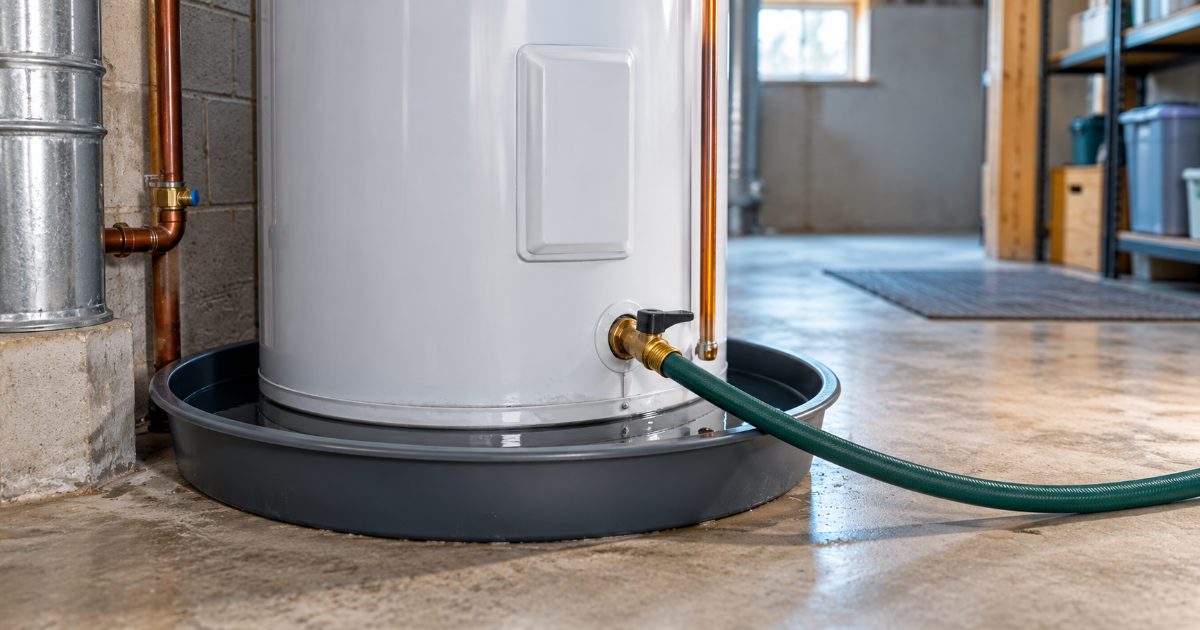
A leaking tank water heater is diagnosed by where the water starts, not by how much is on the floor. A.O. Smith’s leaking guide puts two steps first: turn off the power or gas, then turn off the water supply. Drips from the T&P relief valve discharge pipe almost always mean house pressure above 80 psi or a missing thermal expansion tank, and A.O. Smith says replacing that valve almost never stops them. Water at the drain valve or the top hot and cold connections is a fitting to tighten or a valve to replace. Drops hitting a gas burner right after a cold fill are condensation, which Bradford White’s manual 238-51008-00R calls normal and not a leak. Water coming from the tank body or its base is a corroded inner tank: A.O. Smith, Bradford White and Rheem all say that heater is replaced, not repaired. Bradford White’s drain pan rule is 4 inches wider than the tank, piped with 3/4 inch line.
The picks
If the drain valve itself weeps and will not close
ZGTools 3/4 in MIP x 3/4 in GHT Full-Port Brass Water Heater Drain Valve
3/4 inch male pipe thread into the tank, 3/4 inch garden hose thread outlet, full-port brass body with a 2 inch shank; confirm the old valve's thread is 3/4 inch NPT before ordering
The pan for a tank up to 22 inches across, under Bradford White's 4 inch rule
Everflow PWHP26 26 in Plastic Water Heater Drain Pan with PVC Fitting
26 inch inside diameter plastic pan with a 1 to 1.5 inch PVC drain fitting; measure the tank diameter first and pipe the outlet to a drain with 3/4 inch line
The alarm that tells you the pan is wet while the leak is still a drip
X-Sense Wi-Fi Water Leak Detector Kit, 3 Sensors plus Base Station (SWS54)
Three battery sensors and one Wi-Fi base station; one sensor sits in the pan, the other two cover a washer or sink; the base pushes a phone alert
If the water seeps from the steel of the tank itself, skip to the age guide: three makers say that heater is finished, and no part on this page changes that.
Where is the water coming from?
Dry the heater with a towel and watch for ten minutes: the first wet spot is the answer.
| Where the water appears | Likely cause | What the maker says to do |
|---|---|---|
| End of the T&P discharge pipe, in drips after heating | House pressure over 80 psi or no expansion tank | A.O. Smith: fix the pressure or add an expansion tank; a new valve almost never stops the drips |
| Drain valve at the bottom, around the knob or outlet | Valve not fully closed, or worn | Bradford White: knob clockwise to close. A.O. Smith: replace a valve that will not close |
| Hot or cold connections and nipples on top | Loose or poorly sealed threaded fitting | A.O. Smith: tighten with a wrench, not over-tightened; on a new heater this is almost always the cause |
| Drops on the burner or a sizzle, gas unit, right after filling | Condensation on the cold tank | Bradford White: normal, not a leak, clears as the tank heats |
| Tank body, seams, or a steady pool from under the jacket | Corroded or cracked inner tank | A.O. Smith, Bradford White, Rheem: replace the heater |
The first row has its own page, the T&P relief valve dripping guide, with the pressure test and the expansion tank. This page covers the other four rows.
What should you shut off first?
A.O. Smith’s leaking guide lists the order: power or gas first, then water. Its Lowe’s support page says to turn the circuit breaker off, and the water off before redoing any connection.
Bradford White’s gas manual 238-51008-00R prints the full drain sequence, which doubles as the safe shutdown for a leaking gas unit:
- Turn the thermostat to its lowest setting.
- Set the gas control knob to OFF.
- Shut off the gas supply.
- Close the cold-water supply shut-off valve.
- Open the drain valve (knob counterclockwise; the threaded end takes a standard hose coupling).
- Open a hot water faucet to let air into the tank.
An electric heater skips steps 1 to 3 and starts at the breaker: draining with the elements powered burns them out, as the no hot water guide explains.
Is it the tank, or just a fitting?
On a new heater, assume the fitting. A.O. Smith’s support page says it is extremely rare for a new tank to leak and that leaks on a new heater are almost always threaded connections or the home’s plumbing pipes.
On an older heater the makers draw a hard line at the tank wall. A.O. Smith says a cracked tank typically results in full replacement and a corroded tank is more practical to replace than repair. Bradford White’s blog says a leak coming from the tank often signals the heater is beyond repair, and that rust or corrosion on the tank cannot be fixed. Rheem says leaks from the bottom often signal tank corrosion that requires replacement.
Bradford White’s For The Pro page gives technicians a test: a pressure gauge on the drain valve outlet with the cold inlet shut and every hot fixture closed. If the pressure holds for 15 minutes or more, the tank is not leaking; a slow drop with dry connections points at the tank. That is a technician procedure, printed so you know what the plumber is doing.
Bradford White’s rule of thumb is that once a repair costs more than 50 percent of a new unit, replacement is the sensible choice, and a tank leak sits on the far side of that line. Date the heater from its serial number with the age guide before calling for quotes.
Does the heater need a drain pan?
The makers answer yes wherever a leak can damage anything. Bradford White’s manual says the heater must be located where leakage of the tank, water line connections or the T&P valve will not damage the adjacent area or lower floors, and where that cannot be avoided a suitable drain pan must be installed. Its dimensions:
- Pan length and width at least 4 inches (10.2 cm) greater than the heater’s diameter.
- Piped to an adequate drain, with drain piping at least 3/4 inch (1.9 cm) in diameter and pitched to drain.
- The pan must not restrict combustion air flow on a gas unit.
Rheem’s hybrid manual AP23657 recommends an adequately drained pan in the same situations, says it must conform to local codes, names the same 3/4 inch drain line, and adds that the pan must not block the cold inlet or drain valve. This page cites no code section number: your local inspector’s version governs.
A 22 inch tank therefore needs a 26 inch pan under Bradford White’s rule. The Everflow PWHP26 is a 26 inch plastic pan with a PVC drain fitting; measure your tank first.
Before you buy a pan or a valve
Put a leak alarm in the pan first: Bradford White’s manual lists a six-flash water-leak code for excess water in the drain pan on some models with an accessory module, so the makers expect the pan to catch something. The X-Sense SWS54 kit drops one sensor in the pan and sends the alert to your phone. If your insurer offers a credit for one, the smart leak detector review lists the hub-based units that qualify. Skip both only if the heater stands over a floor drain in an unfinished basement.
Bradford White’s maintenance schedule asks for a gallon drained monthly to clear sediment, and the popping noise and sediment flush guide covers the full flush. A drain valve not opened in years is the one most likely to weep afterwards. If the valve will not reseat, the ZGTools 3/4 inch full-port brass valve fits a 3/4 inch NPT tank port. No maker document read for this page recommends brass over plastic; the full-port choice is for drain speed, not a maker rule.
What should you do first?
- Power or gas off, then the cold supply closed, in that order.
- Dry everything and watch for ten minutes to find the first wet spot.
- T&P pipe dripping: measure house pressure and check for an expansion tank before buying a valve.
- Drain valve or top fittings: tighten, or replace the drain valve after draining below it.
- Tank wall or base: date the heater, photograph the leak as Rheem suggests, and get replacement quotes.
Frequently asked questions
Is water under a gas water heater always a leak?
Not right after a fill or a long draw of hot water. Bradford White's manual says that whenever the heater is filled with cold water, condensate forms on the cool tank surface, drops fall on the hot burner with a sizzling noise, and this is normal and not a leak. It disappears when the tank heats. Rheem adds that pooling water indicates a problem.
Can I stop a leaking drain valve without replacing it?
Try closing it fully first, turning the knob clockwise as Bradford White's manual describes. If it still weeps, A.O. Smith says a drain valve that will not close properly should be replaced. Shut off power or gas and the cold supply, drain the tank below the valve, then swap it. Confirm the thread size of the old valve before ordering the new one.
My water heater is leaking from the bottom. Can it be repaired?
Not if the water comes from the tank rather than the drain valve above it. A.O. Smith says a cracked tank typically results in full replacement and a corroded tank is more practical to replace than repair. Bradford White says tank rust or corrosion cannot be fixed. Rheem says bottom leaks often signal tank corrosion requiring replacement. Check the drain valve and T&P pipe first.
Does a water heater have to sit in a drain pan?
The makers require or recommend one wherever a leak would damage the surroundings or lower floors, and local code decides the rest. Bradford White's manual calls for a pan at least 4 inches larger than the tank diameter, piped to a drain with 3/4 inch line pitched to drain. Rheem's hybrid manual recommends a pan conforming to local codes. This page cites no code section number.
Should I replace the T&P valve if its pipe drips?
Not first. A.O. Smith's support page says drips from the T&P discharge pipe almost always mean the home's water pressure is too high or a thermal expansion tank is needed, and that replacing the valve almost never stops them because T&P valves rarely fail. It says to keep house pressure at 80 psi or less. Measure pressure and check for an expansion tank before touching the valve.
Fact sheet and how to cite this page
- Answer
- Where a tank water heater leaks decides the fix: A.O. Smith says drips from the T&P discharge pipe almost always mean house pressure above 80 psi or a missing expansion tank, and that leaks on a new heater are almost always threaded connections. Water from the tank body or base is a corroded inner tank, and every maker read for this page says that heater is replaced, not repaired.
- Basis
- Manufacturer manuals and support pages: Bradford White gas-fired manual 238-51008-00R (drain procedure, condensation, drain pan 4 inches larger than the tank and 3/4 inch pitched drain line), A.O. Smith’s leaking guide and Lowe’s support page (80 psi, connections, replacement), Rheem’s pre-plumber article and hybrid manual AP23657. No code section number is cited: the drain pan requirement is given as the makers print it, and local code governs.
- Assumptions
- A residential storage (tank) water heater, gas or electric, with a factory T&P relief valve, a bottom drain valve and top hot and cold connections.
- The drain pan dimensions are Bradford White’s for its gas-fired tanks; Rheem’s hybrid manual says the pan must conform to local codes and names the same 3/4 inch drain line.
- The 15-minute pressure hold is Bradford White’s For The Pro procedure for technicians, not a homeowner step.
- Method
- Spec and manual comparison, no leak was staged. Bradford White manual 238-51008-00R and Rheem manual AP23657 Rev 01 read as PDFs on 3 October 2026. A.O. Smith’s hotwater.com leaking guide and aosmithatlowes.com support page, Bradford White’s repair-or-replace blog and For The Pro pressure-test page, and Rheem’s pre-plumber article read the same day. The Bradford White service manual was too large to fetch, so its troubleshooting table is not cited. Picks confirmed in stock through the Amazon Creators API the same day.
- Primary source
- Bradford White, Gas-Fired Water Heater Installation and Operation Manual 238-51008-00R (PDF) (manufacturer or vendor document)
- Facts verified
- Last updated
- Cite as
- OwnerSpec, "Water heater leaking: find where the water starts before you buy anything, because only one of the five spots means a new heater", https://ownerspec.com/plumbing/guides/water-heater-leaking-where-from/, facts verified 3 October 2026.
Every figure above also appears, with its source, in the article. All sources · How OwnerSpec verifies numbers
Sources
- Bradford White, Gas-Fired Water Heater Installation and Operation Manual 238-51008-00R (PDF) (manufacturer or vendor document)
- A.O. Smith, Why Is My Water Heater Leaking? (hotwater.com info center) (manufacturer or vendor document)
- A.O. Smith at Lowe's, What to do if your water heater leaks (retailer listing or retailer-hosted document)
- Bradford White, Deciding Between Water Heater Repair and Replacement (manufacturer or vendor document)
- Bradford White For The Pro, Pressure Testing A Tank For Leaks (manufacturer or vendor document)
- Rheem, What to Do Before Calling a Plumber or Replacing Your Water Heater (manufacturer or vendor document)
- Rheem, Electric Residential Hybrid Water Heater Use and Care Manual AP23657 Rev 01 (PDF) (manufacturer or vendor document)