Water heater pilot light won't stay lit: the thermocouple test that decides it, the blink codes, and the safety switch that is working on purpose
Bradford White's service manual: 10 millivolts closed-circuit keeps a thermocouple, 350 to 850 mV is a normal thermopile, two LED flashes is a weak pilot.
- Verified
- Updated
- 8 min read
- 7 sources
Shop links on this page are affiliate links: a purchase may earn us a commission at no extra cost to you. Disclosure
Short answer
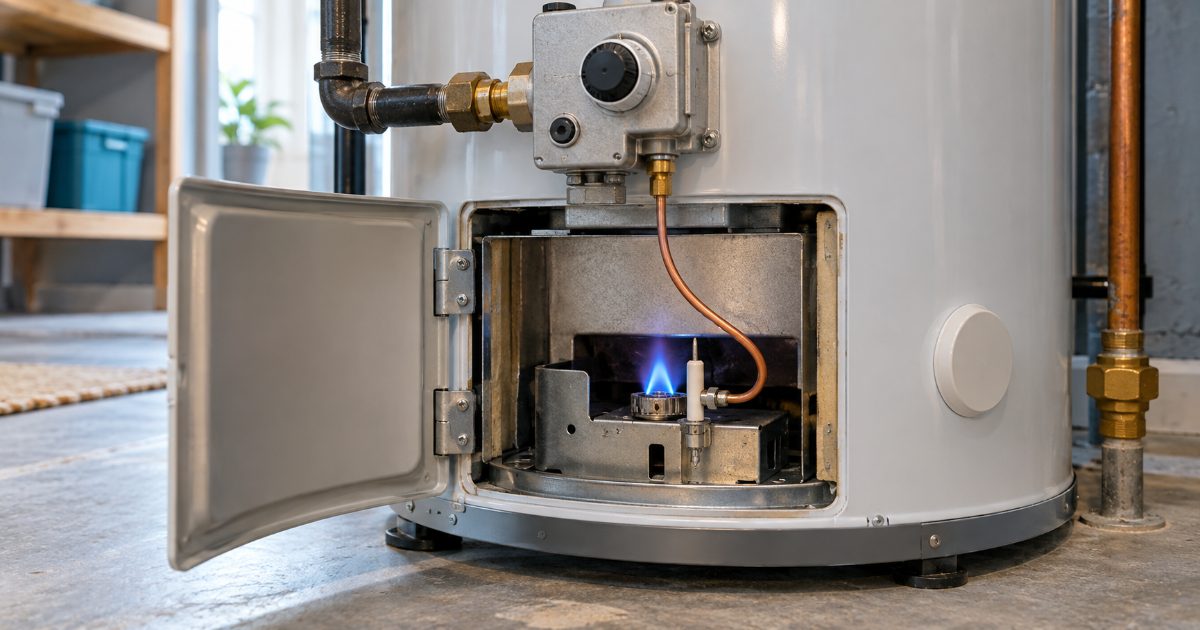
A gas tank water heater pilot that dies the moment you release the button has a thermocouple-circuit fault, and Bradford White’s service manual 238-51542-00E lists the causes in order: a loose thermocouple connection at the gas valve (finger tight plus a 1/4 turn is correct), a thermocouple not fully seated in the pilot bracket, a pilot flame that does not envelop the tip, a weak thermocouple, an open ECO, a defective gas valve magnet, or a tripped resettable thermal switch. The same manual’s closed-circuit test decides it: run the pilot for three minutes and read millivolts at the back of the gas valve. 10 millivolts or higher means the thermocouple is fine and the fault is in the valve or a switch; below 10 millivolts, replace it. Heaters with a status LED use a thermopile instead, normal at 350 to 850 millivolts, and two LED flashes with a three second pause means weak pilot signal.
If the flame is on a furnace, fireplace or gas log, this is the wrong page: those have their own controls, and this page covers a gas tank water heater only. If you smell gas, stop reading: Bradford White’s manual says do not light anything or touch an electrical switch, leave, and call the fire department from a neighbor’s phone.
Which control system do you have?
Two systems share the symptom and need different tests; look at the gas control on the tank.
| What you see | System | Sensor in the pilot flame | First test |
|---|---|---|---|
| A plain knob with OFF, PILOT and ON, no light, and the pilot dies when you release the button | Mechanical gas valve (White Rodgers on Bradford White) | Thermocouple, a single copper lead | Closed-circuit millivolt test at the gas valve |
| A knob plus a small status LED, piezo igniter button, often a temperature dial | Millivolt electronic control (Bradford White ICON, Resideo and White Rodgers electronic) | Thermopile, a thicker lead with two wires | Read the LED blink code, then thermopile voltage |
A thermocouple is a probe that makes a few millivolts when the pilot flame heats it, holding the gas valve’s safety magnet open. A thermopile is a stack of thermocouples making hundreds of millivolts, enough to run an electronic gas control with no house wiring.
If the pilot is lit and there is still no hot water, start with the no hot water guide.
Why does the pilot go out when you release the button?
Bradford White’s service manual chart for “pilot will not stay lit when button is released” lists seven causes in this order. Work down it.
| Order | Cause (Bradford White 238-51542-00E) | What confirms it |
|---|---|---|
| 1 | Poor thermocouple connection at the gas valve | Nut looser or tighter than finger tight plus 1/4 turn (Rheem bulletin 1410: no more than 1/4 turn beyond hand tight) |
| 2 | Thermocouple not fully engaged in the pilot bracket | Tip sits low; Rheem says the flame should envelop the top 3/8 to 1/2 inch of the tip |
| 3 | Pilot flame not enveloping the thermocouple bulb | Small, yellow or lifting flame; debris in the pilot’s primary air openings (Service Procedure RG-III) |
| 4 | Weak or defective thermocouple | Closed-circuit reading below 10 millivolts after a three minute run (RG-II) |
| 5 | Open ECO in the gas valve | Thermocouple reads 10 millivolts or more and the pilot still drops out |
| 6 | Defective magnet in the gas valve | Same reading, ECO checks out: gas valve replacement, a qualified service provider’s job |
| 7 | Resettable thermal switch has opened | No continuity across the switch with a multimeter (RG-VIII) |
The ECO is the energy cut-off, a high-limit switch inside the gas valve that opens the thermocouple circuit if the tank overheats. Causes 5 to 7 are why a new thermocouple sometimes changes nothing.
What do the millivolt readings mean?
Three thresholds, all from Bradford White’s Service Procedure RG-II; the manual calls the first the preferred method.
| Test | How | Reading | Verdict |
|---|---|---|---|
| Thermocouple, closed circuit | Pilot lit three minutes (hold the button if it will not stay lit); meter between the copper sheath and the top terminal at the back of the gas valve | 10 mV or higher | Thermocouple OK; look at the ECO, magnet or thermal switch |
| Below 10 mV | Replace the thermocouple | ||
| Thermocouple, open circuit | Thermocouple disconnected from the valve, button held for the three minute run | 20 to 30 mV | Good thermocouple output |
| Thermopile, open circuit (ICON, Resideo, White Rodgers electronic) | Pilot lit; meter from the resettable thermal switch terminal to an earth ground | 350 to 850 mV | Normal |
| Below 350 mV | Test the thermal switch; if it is closed, the manual recommends replacing the pilot assembly |
One meter reading separates a thermocouple from a gas valve, which is the reason to borrow a multimeter before ordering anything. Bradford White’s manual reserves this work for qualified service providers; the readings tell you what to ask for.
What do the LED blink codes mean?
Bradford White’s Quick Service Guide 238-55593-00A prints the ICON table; the service manual adds the ICON V2 Resideo LED colours. Other makers print their own tables on the heater label.
| LED | Meaning | Action the guide lists |
|---|---|---|
| No light | No pilot light, heater not in operation | Follow the lighting instructions on the heater |
| Two flashes, three second pause | Weak pilot signal (low thermopile voltage; main valve not turned on) | Verify pilot is lit, check thermopile voltage, check wire connections at the gas valve; parts in order: pilot assembly, then gas valve |
| Four flashes | High tank temperature | Not a pilot problem |
| Five flashes | Thermostat sensor fault | Not a pilot problem |
| Eight flashes (ICON 1.0) | Pilot remains lit with the knob in OFF | Gas control fault |
| Yellow LED (ICON V2) | Low thermopile voltage | Check thermopile and connections, check pilot flame |
| Red LED (ICON V2) | Valve fault | Gas control |
The service manual traces the two-flash code to thermopile failure, an unstable pilot, or a blocked pilot tube, and says the control resets once the flame is sufficient. Only the Resideo pilot orifice comes out (7/16 inch nut) for cleaning; on the electronic pilots the whole pilot assembly is replaced.
Why does the pilot go out once a day or once a week?
Because a safety feature may be doing its job. Rheem’s Technical Service Bulletin 1417 prints the requirement: from July 1, 2003, residential gas water heaters of 30, 40 or 50 gallons had to meet ANSI Z21.10.1-2001 and not ignite flammable vapors spilled outside the unit. Rheem’s FAQ spells FVIR out as Flammable Vapor Ignition Resistant, and Bradford White’s I&O manual names Z21.10.1 as its certification standard.
Bradford White’s DEFENDER system pairs a flame arrestor plate with a resettable thermal switch that shuts down pilot and burner if flammable vapors reach the burner, and also if lint, dust or oil on the arrestor restricts airflow. Rheem’s bulletin describes a 20-plus hour lint, dust and oil test the heater must survive or shut down safely.
For a pilot that goes out periodically, the service manual lists three causes.
| Cause | Action (Bradford White 238-51542-00E) |
|---|---|
| Insufficient combustion air supply | Clear the jacket slot openings of dirt, dust and restrictions |
| Incorrect or clogged vent system or terminal | Check venting size and operation |
| Inconsistent gas supply or pressure | Check gas supply and line pressure |
It also says to clean the flame arrestor plate with a stiff bristled brush and compressed air. The thermal switch is tested for continuity: none means it opened, the red button at its centre resets it, and RG-VIII says the overheating cause must be found before the heater goes back in service. Colour codes give its approximate opening temperature: blue 240, yellow 270, red 290, as the manual prints them.
Before you buy a thermocouple
Do not order one on the symptom alone: a 10 millivolt closed-circuit reading, per Bradford White, keeps the thermocouple you have and points at the gas valve or thermal switch. If the meter reads below 10, the Honeywell Home Resideo CQ100A1013 and the Eastman 60036 are both listed as 24 inch universals. Those lengths come from the listing titles only (Resideo’s product page returned a 404 during research), so match your old thermocouple’s length and fitting yourself, and skip both if your heater has a status LED: that system uses a thermopile. The thermocouple and thermopile parts table maps each system to its part.
How do you relight it?
Follow the lighting label on the heater. The lighting pages of Bradford White’s I&O manual 238-51012-00V are images, so this page quotes only its text warnings: wait at least 2 minutes after the gas control is pressurized before lighting the pilot or pushing the igniter, and if you smell gas, leave.
For a new thermocouple, Rheem bulletin 1410 adds: flame on the top 3/8 to 1/2 inch of the tip, no more than 1/4 turn beyond hand tight, a soap-and-water leak check at the gas valve, and a vacuumed combustion chamber and brushed burner plate while the burner is out.
What should you do first?
- Identify the system: plain knob and copper lead is a thermocouple; LED and igniter button is a thermopile. Read the blink code.
- Check the nut at the gas valve for finger tight plus 1/4 turn, and that the pilot flame wraps the tip.
- Take the three minute closed-circuit reading: 10 millivolts or more keeps the thermocouple.
- If the pilot drops out days apart, clear the jacket slots, brush the flame arrestor and test the thermal switch.
- ECO, magnet, gas valve and gas line: a qualified service provider, as every maker quoted requires.
Frequently asked questions
How do I know if the thermocouple is bad without replacing it?
Bradford White's service manual gives a closed-circuit test it calls the preferred method: light the pilot, run it three minutes holding the button if needed, and read millivolts between the thermocouple's copper sheath and its terminal at the back of the gas valve. 10 millivolts or higher is OK. Below 10 millivolts, replace the thermocouple. The open-circuit test, disconnected from the valve, should read 20 to 30 millivolts.
How tight should the thermocouple nut be at the gas valve?
Finger tight plus a quarter turn, and no more. Bradford White's service manual lists a poor thermocouple connection at the gas valve as the first cause of a pilot that will not stay lit and specifies finger tight plus 1/4 turn. Rheem's Technical Service Bulletin 1410 agrees: no more than 1/4 turn beyond hand tight, then leak-check the connections with soap and water.
What does the blinking light on my water heater gas valve mean?
On Bradford White ICON controls, two flashes then a three second pause means weak pilot signal: verify the pilot is lit, check the thermopile voltage and check the wire connections at the gas valve. No light means no pilot. On the ICON V2 Resideo control a yellow LED is low thermopile voltage and a red LED is a valve fault. Other makers print their own tables on the heater label.
Why does the pilot stay lit for days and then go out on its own?
Bradford White's service manual lists three causes for a pilot that goes out periodically: insufficient combustion air, an incorrect or clogged vent, and inconsistent gas supply or pressure. Its DEFENDER FVIR system also shuts the pilot and burner down when lint, dust or oil restricts airflow through the flame arrestor plate. Cleaning the jacket slots and the arrestor comes before buying a thermocouple.
Can I just press the red reset button and relight?
The red button at the centre of the resettable thermal switch resets it, but Bradford White's Service Procedure RG-VIII says the overheating cause must be determined before the heater goes back in service. The switch opens at roughly 240, 270 or 290 degrees depending on its colour code, and it opened for a reason: a blocked flame arrestor, restricted combustion air or flammable vapors.
Fact sheet and how to cite this page
- Answer
- A gas tank water heater pilot that dies when the button is released is a thermocouple-circuit fault until a meter says otherwise. Bradford White’s service manual 238-51542-00E keeps a thermocouple reading 10 millivolts or more closed-circuit after a three minute pilot run, and calls 350 to 850 millivolts normal for a thermopile. Below those figures, replace the part; above them, suspect the gas valve, ECO or resettable thermal switch.
- Basis
- Bradford White Service Manual 238-51542-00E (REV 08/22), troubleshooting charts and Service Procedures RG-II, RG-III and RG-VIII; Bradford White Quick Service Guide 238-55593-00A for ICON blink codes; Rheem Technical Service Bulletins 1410 and 1417 for thermocouple placement, connection torque and the FVIR requirement under ANSI Z21.10.1-2001.
- Assumptions
- A residential atmospheric-vent gas tank water heater with a standing pilot, either a mechanical gas valve with a thermocouple or a millivolt electronic control with a thermopile and status LED. Power-vent, direct-vent and tankless heaters have different controls and are outside this page.
- The thresholds are Bradford White’s for its own controls; another maker’s service manual overrides them for that maker’s heater.
- Every maker quoted says gas-train service is for qualified service providers. The readings here tell you what to ask for, not what to open.
- Method
- Spec comparison of maker service documents: Bradford White service manual 238-51542-00E, Quick Service Guide 238-55593-00A and Installation and Operation Manual 238-51012-00V, and Rheem Technical Service Bulletins 1410 and 1417, all PDFs with text extracted, plus Rheem’s FAQ and technical bulletin index pages. Nothing was bench-tested. The lighting-instruction pages of the Bradford White I&O manual are images and could not be read, so no relight step is quoted beyond the two text warnings.
- Primary source
- Bradford White Service Manual 238-51542-00E REV 08/22, atmospheric vent FVIR gas water heaters (PDF) (manufacturer or vendor document)
- Facts verified
- Last updated
- Canonical URL
- https://ownerspec.com/plumbing/guides/water-heater-pilot-light-wont-stay-lit-thermocouple/
- Cite as
- OwnerSpec, "Water heater pilot light won't stay lit: the thermocouple test that decides it, the blink codes, and the safety switch that is working on purpose", https://ownerspec.com/plumbing/guides/water-heater-pilot-light-wont-stay-lit-thermocouple/, facts verified 2 October 2026.
Every figure above also appears, with its source, in the article. All sources · How OwnerSpec verifies numbers
Sources
- Bradford White Service Manual 238-51542-00E REV 08/22, atmospheric vent FVIR gas water heaters (PDF) (manufacturer or vendor document)
- Bradford White Quick Service Guide 238-55593-00A / 238-55592-00A, ICON 2.0 and ICON 1.0 blink codes (PDF) (manufacturer or vendor document)
- Bradford White Installation and Operation Manual 238-51012-00V REV 08/26, FVIR gas water heaters (PDF) (manufacturer or vendor document)
- Rheem Technical Service Bulletin 1417, Flammable Vapor Ignition Resistant, ANSI Standard Z21.10.1-2001 (PDF) (manufacturer or vendor document)
- Rheem Technical Service Bulletin 1410, How to Replace a Thermocouple, Residential Standing Pilot Gas (PDF) (manufacturer or vendor document)
- Rheem, Frequently Asked Questions (FVIR definition) (manufacturer or vendor document)
- Rheem, Water Heating Technical Bulletins index (manufacturer or vendor document)