Best heat cable for pipes: self-regulating vs constant wattage, on what the makers print about overlap, insulation and pipe material
HEATIT's JHSF prints 3 W/ft, a 37 F on / 50 F off thermostat and overlap allowed; Frost King's 7 W/ft kits say never overwrap. Who should skip both.
- Verified
- Updated
- 12 min read
- 12 sources
Shop links on this page are affiliate links: a purchase may earn us a commission at no extra cost to you. Disclosure
OwnerSpec compares published manufacturer specifications, certification listings and sourced technical documents. Unless a page explicitly states otherwise, OwnerSpec has not laboratory-tested or used the products it compares. Editorial policy
Short answer
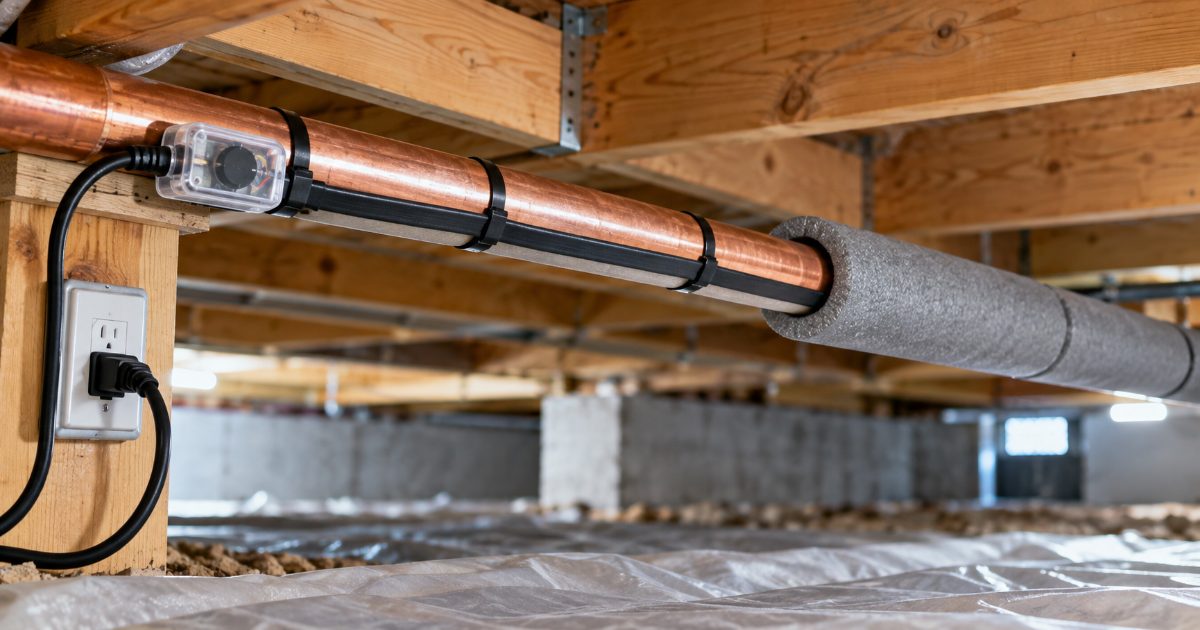
For a water pipe that cannot be moved indoors, the pick is self-regulating heat cable with a built-in thermostat, and the in-stock example is the HEATIT JHSF: its page prints 3 watts per foot at 50 F, a thermostat that switches on at 37 F and off at 50 F, use on rigid plastic and metal pipe up to 1.5 in, and installation straight, spiralled or overlapped. The runner-up is constant-wattage cable such as the Frost King HC series, 7 watts per foot with a thermostat on below 38 F and off above 45 F, which must never be overlapped, spiralled or buried under more than 1/2 in of fiberglass. Every cable here needs power, so it does nothing in an outage, and Wrap-On’s Q&A says a pipe cable cannot thaw a pipe that is already frozen. Skip both if the pipe can be rerouted inside the heated envelope, or if the problem is a hose bib, which wants a frost-free sillcock instead.
The picks
A run with valves or bends that a straight-only cable cannot follow
HEATIT JHSF 40 ft self-regulating heat cable, 3 W/ft, built-in thermostat
HEATIT's JHSF page: self-regulating, 3 W/ft at 50 F, thermostat on at 37 F and off at 50 F, rigid plastic and metal pipe up to 1.5 in, straight, spiral or overlap, at least 1/2 in insulation recommended, IP65 seals, 'ETL approved' with no standard number, two-year limited warranty
A short straight run of metal or Schedule 40 supply pipe, 3/8 to 1-1/2 in
Frost King HC12A automatic electric heat cable kit, 12 ft
Frost King's page and instruction sheet: 120 V, 7 W/ft, thermostat on below 38 F and off above 45 F, keeps water flowing to -40 F, never overwrap, not wrapped or spiralled, 1/2 in fiberglass over the whole installation, not for PVC, not above 155 F, lighted plug, 12-month replacement warranty
A PEX supply line, and a manual that states the GFCI rule in print
EasyHeat AHB-019A automatic heat cable, 9 ft (6 to 10 ft of pipe)
EasyHeat's AHB owner's manual (11001-118 Rev 12): thermostat on below 38 F and off near 45 F, protects to -40 F, water-filled metal or plastic (including PEX) supply pipe 3/8 to 1-1/2 in and at least 3 ft, GFCI receptacle or GFCI cord required, 5 amps or less, no spiral and no crossing, 1/2 in insulation and no more, 12-month warranty
Self-regulating cable with a UL and CSA line printed on the spec sheet
EasyHeat Freeze Free self-regulating heating cable kit, 15 ft (10815)
EasyHeat's Freeze Free specification: self-regulating, 3 W/ft at 50 F, 120 VAC, maximum 75 ft per run, metal or rigid plastic pipe up to 2 in, can be overlapped, 1/2 in fiberglass required, no built-in thermostat (EH38 optional), 'UL Listing: Mobile Homes' and 'CSA Certification: Pipe Tracing' with no standard number, 1-year limited warranty
If the pipe that freezes is a hose bib, or a run you could move inside the heated envelope, close this page: read what actually prevents frozen pipes first, because heat cable is the fix for the pipe you cannot move.
How was this shortlist built?
Every figure on this page is a manufacturer’s published specification, read on 2026-09-30 from the page, sheet or manual named beside it. Nothing was installed, powered or tested by this site. Listings were found through current Amazon search, kept or rejected on the maker’s document, and confirmed buyable the same day. Frost King’s instruction-sheet URL answered 406 to a direct fetch and was read from a text extract made earlier the same day.
The cables were compared on type, watts per foot, thermostat on and off points, pipe materials and diameters allowed, overlap rules, insulation over the cable, plug and ground-fault statements, listing wording as printed, lengths and warranty term.
Two names from the brief are absent on purpose. Raychem’s FrostEx is not a current cable line: Chemelex’s design guide names its pre-assembled line FrostGuard, and the FrostGuard kits were not found in stock. WarmlyYours’ PRO-Tect and Wrap-On’s cable are in the table but not the picks, because Amazon listed both as scarce on 2026-09-30.
Self-regulating or constant wattage: what is the difference?
Self-regulating cable has a conductive polymer core that, in Chemelex’s words, adjusts heat output at each point along the pipe, which is why Chemelex, EasyHeat’s Freeze Free sheet and HEATIT’s JHSF page all say the cable can be straight-traced, spiralled or overlapped.
Constant-wattage cable is a resistance wire that puts out the same watts per foot wherever it is, so two crossed sections double the heat at that spot. Frost King’s page says “never ever overwrap the heat cable” and that over-wrapping may cause it to overheat; HEATIT’s HISD page says “only straight” with no crossing, spiral or overlap.
The box rarely uses either phrase. Frost King’s page never says which kind its kits are; the 7 W/ft figure, the “do not spiral” rule and the 1/2 in insulation cap are the tell.
How do the cables compare on paper?
Manufacturer figures. “Not printed” means the cited document carries no value; “not seen” means the sentence may exist in an instruction sheet this page did not open.
| Cable | Type | W/ft | Thermostat | Pipe allowed | Overlap | Insulation over cable | Plug and ground fault | Listing wording |
|---|---|---|---|---|---|---|---|---|
| HEATIT JHSF (3, 6, 9, 12, 15, 18, 24, 30, 40, 60, 80, 100, 120 ft) | Self-regulating | 3 at 50 F | On 37 F, off 50 F | Rigid plastic and metal up to 1.5 in | Straight, spiral or overlap | At least 1/2 in recommended | Grounded plug; no ground-fault statement | “ETL approved” |
| EasyHeat Freeze Free (kits 5 and 15 ft, max 75 ft) | Self-regulating | 3 at 50 F | None built in; EH38 optional | Metal or rigid plastic up to 2 in | “Can be safely wrapped over itself” | 1/2 in fiberglass required | Grounded cord with power light; no ground-fault statement | “UL Listing: Mobile Homes”, “CSA Certification: Pipe Tracing” |
| Chemelex WinterGard H311 (cut to length, 250 ft max circuit) | Self-regulating | 3 minimum at 40 F | None; H908 plug kit | Metal or plastic up to 2 in, dry areas | Straight, spiral or overlap | Tables select 0.5 to 2 in | H908 kit has built-in GFEP; guide requires it on every branch circuit | “UL System Listed (718K Pipe Heating Cable)”, “CSA Certified” |
| Frost King HC (3, 6, 9, 12, 18, 24, 30 ft) | Not stated; 7 W/ft fixed | 7 | On below 38 F, off above 45 F | Metal; plastic only Schedule 40 supply 3/8 to 1-1/2 in OD; “not made for PVC” | “Never ever overwrap”; not wrapped or spiralled | 1/2 in fiberglass | Lighted plug; no ground-fault statement on the page | Not printed |
| EasyHeat AHB (AHB013 to AHB180, 3 to 81 ft of pipe) | Fixed output; 5 A or less | Not printed | On below 38 F, off near 45 F | Water-filled metal or plastic incl. PEX, 3/8 to 1-1/2 in, at least 3 ft | No spiral, no touching or crossing; two cables may overlap up to 3 ft | 1/2 in, “do not use more” | GFCI receptacle or GFCI cord required | Not printed in the manual |
| HEATIT HISD (3 to 80 ft) | Constant wattage | 7 | On 37 F, off 50 F | Water-filled plastic incl. PEX or metal, 3/8 to under 1-1/2 in | “Only straight”, no crossing, spiral or overlap | Maximum 1/2 in fiberglass | Grounded lighted plug, 5 A or less | “Both CSA and ETL approved” |
| WarmlyYours PRO-Tect PTC120-7W-012 (12 ft) | Constant wattage | 7 (84 W, 0.7 A) | On 37.4 F, off 50 F | 3/8 to 3/4 in up to 14 ft; 1 to 1-1/2 in up to 12 ft; material not printed | Not seen | Not printed | NEMA 5-15 plug, 2 ft cord; no ground-fault statement | “cUL Listed, CSA Listed, and cETLus Listed” |
| Wrap-On 31003 to 31100 (3 to 100 ft) | Fixed output | 2 | Closes about 38 F, opens about 45 F (Q&A) | Metal and rigid plastic incl. Schedule 40 PVC rated 140 F+; 1 in or less (Q&A) | Wrapped around the pipe (Q&A); overlap rule not seen | 1-1/2 in fiberglass (Q&A) | Not printed | Not printed |
No maker in this table prints a standard number next to its certifier. Chemelex’s 718K is a UL product category, not a standard, and the only standard named anywhere in this research is UL 2049, which the City of Paola’s fact sheet tells homeowners to check a heat tape conforms to. Frost King prints no listing at all.
HEATIT JHSF: buy it or skip it?
Buy it if the run has a valve, a tee or an elbow, because the JHSF is the in-stock cable whose page allows straight, spiral and overlapped installation. HEATIT prints 3 W/ft at 50 F, a built-in thermostat that turns on at 37 F and off at 50 F, rigid plastic and metal pipe up to 1.5 in, IP65 seals, thirteen lengths from 3 to 120 ft and a two-year limited warranty. The heat cable sizing calculator turns pipe length, valves and supports into the length to order.
The flaw is the paperwork. “ETL approved” is all the page says: no standard number, no ground-fault statement and no PEX by name (the page says rigid plastic). HEATIT’s 5 W/ft 5JHSF page rates pipe up to 2.5 in; the 3 W/ft page stops at 1.5 in, so a 2 in line wants the heavier cable or Chemelex’s WinterGard; the calculator’s 40 ft pick quotes the larger figure from HEATIT’s listing.
Skip it for a 6 ft straight stub on copper: a Frost King kit covers that.
Frost King HC series: buy it or skip it?
Buy it if the pipe is metal or Schedule 40 supply pipe between 3/8 and 1-1/2 in, the run is straight, and one cable covers it. Frost King’s page prints 120 V, 7 W/ft, a thermostat on below 38 F and off above 45 F, water flowing to -40 F and a lighted plug; the instruction sheet adds tape rated at least 176 F (80 C), 1/2 in of fiberglass over the whole installation and a 12-month replacement warranty.
The flaw is everything the sheet forbids. The cable must not be wrapped or spiralled, must lie flat on the pipe, must not be buried or touch the ground, and is not for drain lines, fuel lines, hoses or pipe heated above 155 F. Frost King answers the PVC question in one line: “They aren’t made for PVC pipes.” Its page prints no UL, ETL or CSA wording and no ground-fault rule; the City of Paola’s fact sheet, quoted in the frozen pipes guide, is the only document here that names a standard to check for, UL 2049.
Skip it on PVC, on any pipe you would need to spiral, and anywhere the insulation is already thicker than 1/2 in.
EasyHeat AHB and Freeze Free: buy them or skip them?
Buy the AHB if the supply line is PEX and you want the electrical rule in print. EasyHeat’s owner’s manual names PEX, requires a grounded 120 V receptacle protected by a GFCI or a GFCI portable cord, states 5 amps or less, prints the thermostat at on below 38 F and off near 45 F, and lists eleven pre-assembled models from AHB013 (3 to 4 ft of pipe) to AHB180 (77 to 81 ft).
The AHB’s flaw is that it is a straight-only cable with a manual that says so three ways: do not spiral, do not let it touch or cross itself, never cut or splice it. Two cables may overlap along 3 ft of pipe and no more, insulation is 1/2 in and “do not use more”, and the manual prints no watts per foot and no listing mark.
Buy the Freeze Free instead if the run needs overlap and you want a UL and CSA line on the sheet. EasyHeat’s specification prints 3 W/ft at 50 F, a 75 ft maximum, metal or rigid plastic pipe up to 2 in, “UL Listing: Mobile Homes” and “CSA Certification: Pipe Tracing”, and says the cable can be safely wrapped over itself.
The Freeze Free’s flaw is control. It connects directly to power with no thermostat; the EH38 thermostat is an optional accessory, and without it the cable draws what the pipe temperature dictates all season. The sheet this page read is a 2008 distributor copy, so read its warranty and kit numbers as the older print of that sheet.
Measure and insulate before you buy a cable
Do not buy any cable until two numbers are known: the pipe’s outside diameter, which picks the pipe insulation size and rules a 2 in line out of the 1.5 in cables, and the run length with its valves and supports, which the heat cable sizing calculator turns into feet of cable. If the frozen fitting is an outdoor faucet, stop here and fit a frost-free sillcock of the right length instead: no cord, no thermostat, nothing to fail in an outage.
What goes wrong?
The power goes out. Every cable here is a resistance heater on a cord. EasyHeat’s manual lists three ways it loses power: a GFCI trip, a tripped breaker or fuse, and an outage, and suggests a power failure alarm on the circuit. The frozen pipes guide covers what holds without electricity.
The wrong pipe. Frost King allows plastic only when it is Schedule 40 supply pipe and says its kits are not made for PVC; Wrap-On says its cable is tested on Schedule 40 PVC rated 140 F or above. A cable on a pipe its maker excludes is outside its listing, and the instruction sheet is what the listing was granted on.
Too much insulation. Frost King, EasyHeat’s AHB manual and HEATIT’s HISD page cap the fiberglass over a constant-wattage cable at 1/2 in, and EasyHeat’s manual adds “never use insulation that is too thick or that is flammable”. Wrap-On asks for 1-1/2 in over its 2 W/ft cable. Read the box before the insulation goes on.
The thermostat reads air, not pipe. Wrap-On’s Q&A says its light will not come on until the air is below 38 F; EasyHeat’s manual shows the AHB thermostat under the insulation, touching the pipe. Read which yours does before choosing where the pod sits.
It is already frozen. Wrap-On’s Q&A: pipe cables “do not generate enough heat to thaw a pipe that is already frozen.” The cable is prevention for next time, not the fix for today.
Frequently asked questions
Can you overlap or spiral heat tape on a pipe?
Only if the maker says so, and the two families disagree. Chemelex, EasyHeat's Freeze Free sheet and HEATIT's JHSF page say their self-regulating cables can be straight-traced, spiralled or overlapped. Frost King's constant-wattage page says never overwrap the heat cable, HEATIT's HISD page says only straight, and EasyHeat's AHB manual forbids the cable touching or crossing itself.
Does heat cable work on PEX or PVC pipe?
Read the maker's line for your pipe. EasyHeat's AHB manual and HEATIT's HISD page name PEX by name. Frost King says its kits are not made for PVC and allows plastic only when it is Schedule 40 supply pipe between 3/8 and 1-1/2 in. Wrap-On's Q&A says its cable is tested on rigid plastic including Schedule 40 PVC rated 140 F or above.
How much insulation goes over heat cable?
The makers do not agree, so follow the one on your box. Frost King, EasyHeat's AHB manual and HEATIT's HISD page all say 1/2 in of fiberglass, and EasyHeat and HEATIT say not more than that. Wrap-On's Q&A recommends 1-1/2 in of fiberglass for its 2 W/ft cable. Chemelex's design tables let you pick 0.5 to 2 in for self-regulating cable.
Does heat cable need a GFCI outlet?
EasyHeat's AHB manual requires a grounded 120 V receptacle protected by a GFCI, or a GFCI portable cord. Chemelex's design guide prints a fire-hazard warning that ground-fault equipment protection must be used on every heating cable branch circuit, and its H908 plug-in kit builds it in. A new receptacle is licensed electrician work, and electrical codes are adopted locally and vary.
Will heat cable thaw a pipe that is already frozen?
Not by the maker's own account. Wrap-On's Q&A says pipe cables are designed to prevent freezing and do not generate enough heat to thaw a pipe that is already frozen. The cable also needs power, so a GFCI trip, a tripped breaker or an outage leaves the pipe unprotected; EasyHeat's manual suggests a power failure alarm on the circuit.
Fact sheet and how to cite this page
- Answer
- Two families sell under the one name. Self-regulating cable (HEATIT JHSF at 3 W/ft, EasyHeat Freeze Free at 3 W/ft, Chemelex WinterGard H311 at 3 W/ft) may be overlapped by its maker’s own statement. Constant-wattage cable (Frost King HC at 7 W/ft, HEATIT HISD at 7 W/ft, WarmlyYours PRO-Tect at 7 W/ft, Wrap-On at 2 W/ft) must never cross itself, and Frost King, EasyHeat AHB and HEATIT cap the insulation over it at 1/2 in.
- Comparison basis
- Manufacturer-published product pages, specification sheets and owner’s manuals: cable type, watts per foot and the pipe temperature it is rated at, built-in thermostat on and off temperatures, pipe materials and diameters allowed, whether spiralling or overlapping is permitted, insulation thickness required or capped over the cable, plug and ground-fault statements, the listing wording as printed, pre-assembled lengths and warranty term.
- Assumptions
- A water-filled residential supply pipe in an unheated space, plugged into a 120 V receptacle: every maker here excludes drain lines, empty pipes, fuel lines and hoses
- Frost King’s instruction sheet URL answered 406 to a direct fetch on 2026-09-30 and was read from a text extract made earlier the same day; WarmlyYours’ installation instructions and Wrap-On’s printed instruction sheet were not opened, so their overlap rules are reported as not seen
- No maker opened prints a UL, ETL or CSA standard number next to its certifier, so the table repeats the wording each maker uses and adds nothing
- Method
- OwnerSpec read the maker documents named in the Sources list on 2026-09-30, built the comparison table from the figures they print, and confirmed each listed ASIN buyable the same day with the Amazon Creators API; it did not install, power or test any cable.
- Primary source
- HEATIT, JHSF 120 V Self-Regulating Pre-assembled Pipe Heating Cable, 3 W/ft (24 ft listing) (manufacturer or vendor document)
- Facts verified
- Last updated
- Cite as
- OwnerSpec, "Best heat cable for pipes: self-regulating vs constant wattage, on what the makers print about overlap, insulation and pipe material", https://ownerspec.com/plumbing/reviews/best-heat-cable-for-pipes/, facts verified 30 September 2026.
Every figure above also appears, with its source, in the article. All sources · How OwnerSpec verifies numbers
Sources
- HEATIT, JHSF 120 V Self-Regulating Pre-assembled Pipe Heating Cable, 3 W/ft (24 ft listing) (manufacturer or vendor document)
- HEATIT, Pipe Heating Cable with Built-in Thermostat (HISD, 7 W/ft) (manufacturer or vendor document)
- HEATIT, 5JHSF 120 V Self-Regulating Pre-assembled Water Pipe Heat Cable (5 W/ft) (manufacturer or vendor document)
- Frost King, Automatic Electric Heat Cable Kits product page (manufacturer or vendor document)
- Frost King, Instruction Sheet: Automatic Electric Heat Cables (PDF) (manufacturer or vendor document)
- EasyHeat (Emerson), AHB Automatic Electric Water Pipe Heating Cable Owner's Manual, 11001-118 Rev 12 (PDF) (retailer listing or retailer-hosted document)
- EasyHeat, Freeze Free Pipe Freeze Protection Self-Regulating Heating Cable Product Specification (PDF, distributor copy) (manufacturer or vendor document)
- Chemelex, Raychem Residential and Light Commercial Self-Regulating Heating Products Application and Design Guide (PDF) (manufacturer or vendor document)
- WarmlyYours, PTC120-7W-012 PRO-Tect DIY Plug-in Heating Cable for Pipes, Constant Wattage (7 W/ft), 120 V (manufacturer or vendor document)
- Wrap-On, Pipe Heating Cables product page (manufacturer or vendor document)
- Wrap-On, Pipe Heating Cable Common Questions (PDF, distributor copy) (manufacturer or vendor document)
- City of Paola, Freezing and Bursting Pipes fact sheet (PDF, citing the Building Research Council at the University of Illinois) (manufacturer or vendor document)