Micron rating picker: which sediment filter micron for grit, haze, cysts, RO or UV
Coarse to fine: a 700 to 15 micron screen, then a 5 micron cartridge (NDSU: 10 to 15 micron for a drilled well, 2 for a dug well), absolute 1 micron for cysts.
- Verified
- Updated
- 7 min read
- 10 sources
Shop links on this page are affiliate links: a purchase may earn us a commission at no extra cost to you. Disclosure
Short answer
A sediment filter micron rating is picked coarse to fine, one stage per particle class, and the finest stage is set by the water source, not the housing. NDSU Extension’s rule: rust on a public supply needs 15 micron, a drilled well needs 10 to 15 micron, and a dug or bored well needs the finest available, 2 micron, because fine clay is present. Worked example, a drilled well with visible grit and haze at 7.2 gpm peak: stage 1 is a flushable spin-down screen (Rusco lists 24 to 1000 mesh, 700 to 15 micron), stage 2 is a 5 micron nominal 20 x 4.5 in cartridge such as the Pentek DGD-5005-20, the nearest published rating under NDSU’s 15. A 1 micron nominal cartridge is the dug-well answer. Cysts are a separate question: EPA’s Filtration Facts puts Cryptosporidium at 4 to 6 microns, and EPA and CDC ask for an absolute 1 micron filter or NSF/ANSI 53 cyst certification, which no nominal cartridge carries.
If you are shopping for a 1 micron cartridge because “finer is better”, stop: the table below shows a 1 micron nominal cartridge is the wrong buy for a drilled well and does not qualify for cysts either.
Micron rating for each stage, from source, symptom and flow
Targets are NDSU Extension WQ1029: 15 micron for public-supply rust, 10 to 15 for a drilled well, 2 for a dug or bored well. Cartridge ratings are Pentair's DGD series (25, 5, 1 micron nominal, each under 1 psi at 20 gpm). Screens are Rusco (700 to 15 micron) and iSpring WSP (50 to 1000 micron). Cyst rule is CDC and EPA: absolute 1 micron or NSF/ANSI 53 or 58. Housing flow is Pentair 150233 at 1 psi at 15 gpm.
What is the formula?
A micron is one thousandth of a millimetre; EPA’s Filtration Facts sheet says the period at the end of its sentence is 500 microns. The picker matches each stage’s rating to a published size or threshold:
| Particle or threshold | Size in microns | Source |
|---|---|---|
| Public-supply rust and iron flakes | stopped by 15 micron | NDSU Extension WQ1029 |
| Drilled-well sediment plus fine iron | stopped by 10 to 15 micron | NDSU Extension WQ1029 |
| Fine clay in a dug or bored well | needs 2 micron, the finest available | NDSU Extension WQ1029 |
| Giardia lamblia cysts | 8 to 12 | EPA Filtration Facts 816-K-05-002 |
| Cryptosporidium parvum oocysts | 4 to 6 | EPA Filtration Facts 816-K-05-002 |
Nominal and absolute are not the same rating. CDC: a nominal (mean) rating is an average pore size, so some pores are larger than the stated number; an absolute rating puts every pore at or below it, and WQA’s glossary adds that an absolute rating traps 99.9 percent of particles above the stated size. Cyst reduction needs an absolute 1 micron filter or NSF/ANSI 53 or 58 certification; every DGD cartridge on this page is nominal, so none qualifies on its own.
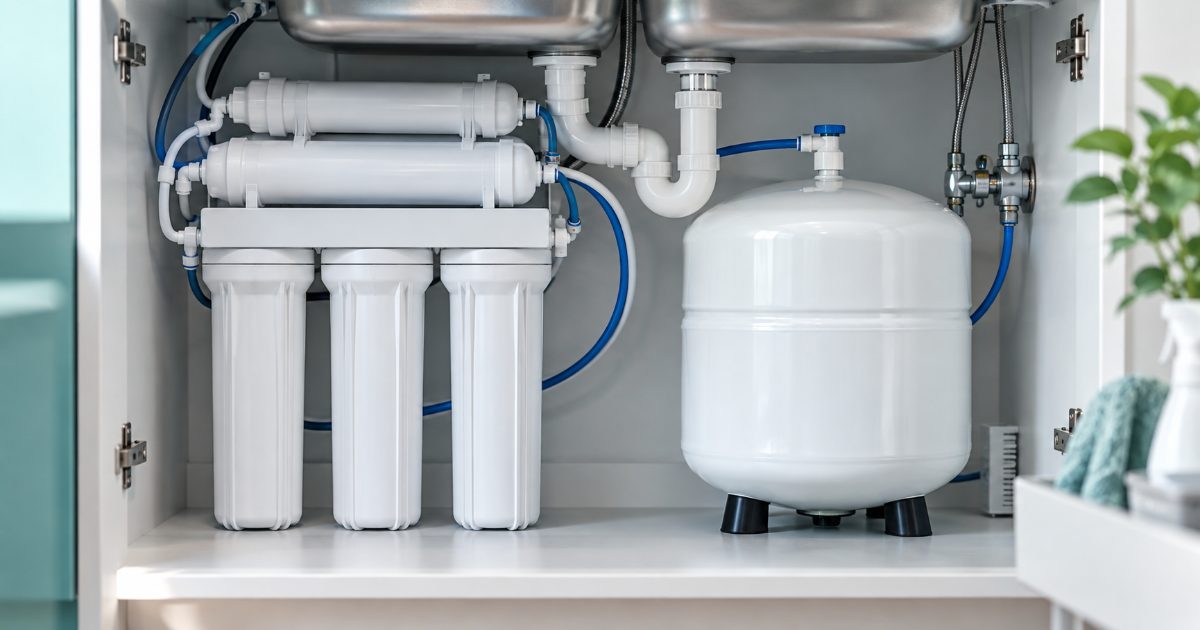
Stages run coarse to fine, sediment first. NDSU puts the sediment filter first on the line, right after the pressure tank on a private system, and ahead of any activated-carbon filter:
| Stage | Rating | Device | Published flow or drop | Source |
|---|---|---|---|---|
| 1, flushable screen | 700 to 15 micron (24 to 1000 mesh); 50 to 1000 micron | Rusco 1 in spin-down; iSpring WSP | Rusco 1 to 25 GPM, 150 PSI; WSP 20 GPM max, flush weekly | Rusco product page; iSpring WSP manual |
| 2, coarse cartridge | 25 micron nominal | Pentek DGD-7525-20, 4.50 x 20 in | under 1 psi at 20 gpm | Pentair 310061 Rev E |
| 2, fine cartridge | 5 micron nominal | Pentek DGD-5005-20 , 4.50 x 20 in | under 1 psi at 20 gpm | Pentair 310061 Rev E |
| 3, polish | 1 micron nominal | Pentek DGD-2501-20 , 4.50 x 20 in | under 1 psi at 20 gpm | Pentair 310061 Rev E |
| 4, carbon | 50 to 0.5 micron (general range); iSpring FC25B unrated | iSpring WGB32B stages 2 and 3 | housing 3 to 15 GPM | NDSU WQ1029; iSpring WCB/WGB manual |
Rusco’s mesh conversions: 24 mesh is 700 micron, 100 is 150, 250 is 50 and 1000 is 15. The iSpring WGB32B ships its 5 micron FP25B at stage 1 and carbon at stages 2 and 3; its fits are on the WGB32B replacement filter page.
A finer cartridge does not cost pressure on day one: Pentair’s DGD spec sheet lists the 25, 5 and 1 micron cartridges at the same under 1 psi at 20 gpm, on clean media. The cost is service life: NDSU says a 2 to 5 micron filter has smaller pores and needs more pressure to push water through as it loads, and finer media fills sooner. Flow sets the housing, not the micron: Pentair’s 150233 Big Blue 20 in housing drops 1 psi at 15 gpm and iSpring’s WGB housings run 3 to 15 GPM; above that, size parallel housings on the whole-house filter flow rate calculator.
What does a worked example look like?
Drilled well, visible grit plus haze, 7.2 gpm peak (the 2-bathroom, 4-person house from the flow-rate calculator).
- Grit that settles: stage 1 is a flushable screen, Rusco 700 to 15 micron or iSpring WSP 50 to 1000 micron, flushed weekly per iSpring’s manual.
- Haze on a drilled well: NDSU’s target is 10 to 15 micron. Pentair publishes 25, 5 and 1; the nearest rating under 15 is the 5 micron DGD-5005-20.
- No RO, UV or cyst concern: the ladder stops at 5 micron. The 1 micron DGD-2501-20 would only shorten the interval.
- Flow: 7.2 gpm is under the 15 gpm at 1 psi of a Pentek 150233 housing, so one 20 x 4.5 in housing per stage.
Swap in a dug or bored well and step 2 becomes NDSU’s 2 micron, met by the 1 micron nominal DGD-2501-20. Tick the cyst box and the answer is a certified unit, because neither DGD cartridge is absolute.
Where do the numbers come from?
- Particle sizes and the absolute-rating rule: EPA Filtration Facts 816-K-05-002 and CDC’s home water filter page.
- Nominal and absolute definitions: CDC and the WQA Glossary of Terms.
- Micron targets by source, stage order and the pressure note: NDSU Extension WQ1029.
- Cartridge ratings and pressure drop: Pentair DGD sheet 310061 Rev E; housing flow: Pentair 310053.
- Screen ranges and flush interval: Rusco’s spin-down page and iSpring’s WSP manual.
Two readers should skip this picker: coliform-positive water is not a sediment question, and tannin color is a dissolved problem no micron rating touches.
Only after the picker has a stage list
Two Pentek cartridges match the 20 x 4.5 in spec sheet: the Pentek DGD-5005-20, 5 micron nominal for a drilled well or public-supply rust, and the Pentek DGD-2501-20, 1 micron nominal for a dug or bored well.
Both are nominal, NSF/ANSI 42 for material requirements only, and neither removes cysts: CDC’s rule is absolute 1 micron or NSF/ANSI 53 or 58. Skip both if the picker put a screen first; the sediment filter shortlist covers the spin-down units.
Frequently asked questions
What micron sediment filter do I need for well water?
NDSU Extension's rule: a drilled well carries larger particles plus fine iron and should have a 10 to 15 micron filter; a dug or bored well needs the finest available, 2 micron, because fine clay is present; rust on a public supply needs 15 micron. Pentair's DGD cartridge series is published at 25, 5 and 1 micron nominal, so 5 covers a drilled well and 1 covers a dug well.
What is the difference between a nominal and an absolute micron rating?
CDC's definition: a filter with an absolute pore size of 1 micron has every pore at 1 micron or smaller, while a nominal (mean) 1 micron filter has an average pore of 1 micron with some pores larger. WQA defines an absolute rating as trapping 99.9 percent of particles above the stated size. CDC says the absolute filter catches a 1 micron germ; the nominal one may not.
Does a 1 micron filter remove Giardia and Cryptosporidium?
Only an absolute 1 micron filter, or one certified to NSF/ANSI 53 or 58 for cyst reduction. EPA's Filtration Facts puts Giardia lamblia at 8 to 12 microns and Cryptosporidium parvum at 4 to 6 microns, and EPA and CDC both say to look for an absolute, not nominal, 1 micron rating. The Pentek DGD-2501-20 is 1 micron nominal, so it does not qualify.
Does a finer micron cartridge cut water pressure?
Not when it is new, on Pentair's published figures: the DGD-7525-20 (25 micron), DGD-5005-20 (5 micron) and DGD-2501-20 (1 micron) are all listed at under 1 psi at 20 gpm on the same spec sheet. The cost shows up in service: NDSU Extension says a 2 to 5 micron filter needs more pressure to push water through as it loads, and it loads faster than a coarser one.
Which order do sediment filter stages go in?
Coarse to fine, and sediment before carbon. NDSU Extension says the sediment filter is the first device on the line, right after the pressure tank on a private system, and that a sediment filter ahead of an activated-carbon filter prolongs the carbon's life. A flushable spin-down screen (Rusco lists 700 to 15 micron) goes first, then the 25, 5 or 1 micron cartridge, then carbon.
Sources
- US EPA, Filtration Facts, Water Health Series, publication 816-K-05-002 (PDF)
- CDC, About Choosing Home Water Filters
- Water Quality Association, Glossary of Terms
- NSF International, NSF/ANSI 42, 53 and 401 Filtration Systems Standards (PDF)
- NDSU Extension, Filtration: Sediment, Activated Carbon and Mixed Media, WQ1029 (PDF)
- Pentair, Pentek DGD Series Specification Sheet 310061 Rev E (PDF)
- Pentair, Pentek Big Blue Heavy Duty Filter Housings spec sheet 310053 (PDF)
- Rusco, 1 inch Spin-Down Filter product page
- iSpring, WSP Series Spin-Down Sediment Filter User Manual (PDF)
- iSpring, WCB/WGB Series User Manual, version 2020-03 (PDF)