Black specks in water after a new carbon filter: carbon fines, manganese or rubber, and how much to flush
Black specks after a filter change are carbon fines: GE says flush 2 to 3 gallons. Specks that outlast the flush point to manganese at 0.05 mg/L or rubber.
- Verified
- Updated
- 6 min read
- 6 sources
Short answer
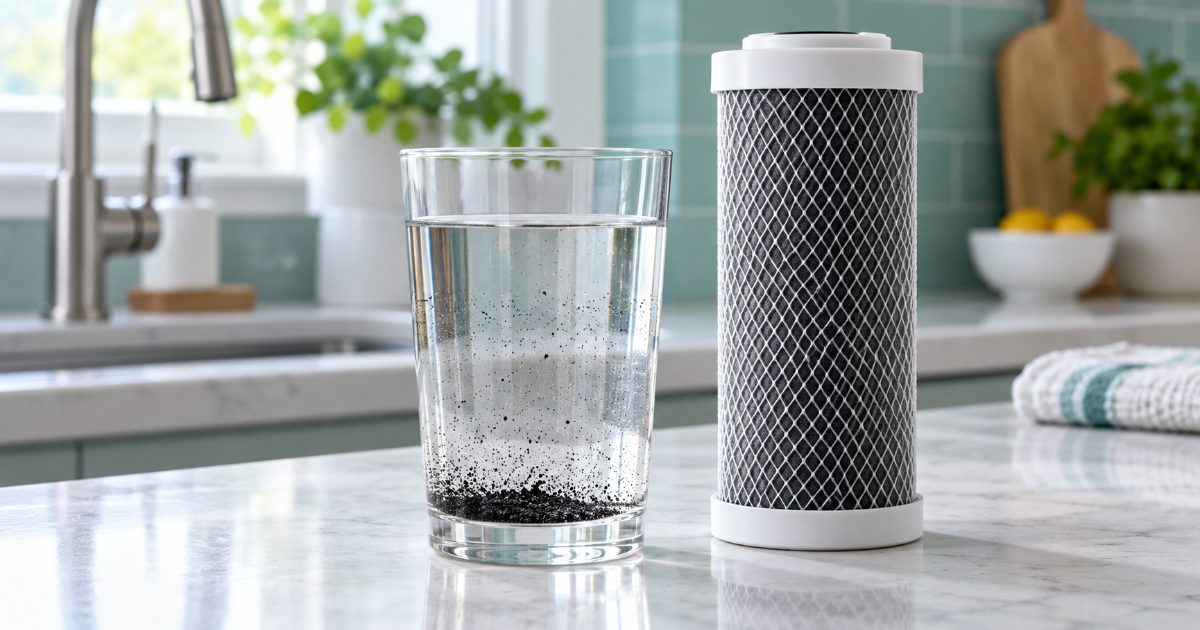
Black specks in water right after a filter change are almost always carbon fines, the dust left on a new activated carbon cartridge by manufacturing. GE Appliances’ support page on black particles calls them fine carbon particles left over from the water filter manufacturing process, and tells owners to dispense 2 to 3 gallons from the refrigerator dispenser, or purge for about 5 minutes, to clear them. Brita says to discard the first 3 pitchers from a new pitcher filter and to flush a faucet system for 5 minutes; iSpring’s RO manual says to let the faucet trickle for at least 10 minutes and warns the water may appear black at first. Specks that survive a full flush point elsewhere: manganese, which EPA’s secondary standard lists at 0.05 mg/L beside black staining, or crumbling rubber from a faucet aerator gasket or a supply hose. Flush the maker’s full volume first, then test the water if the specks come back.
If the specks were there before the filter change, or the toilet bowl has stained black for months, this is the wrong page: that is manganese, and the manganese guide has the breakpoints.
What do the specks tell you?
Carbon fines are loose particles of activated carbon shed by a new cartridge until water has carried them out. They smear gray when rubbed between two fingers, which is the quickest way to tell them from rubber.
| Symptom | Likely cause | Confirm with |
|---|---|---|
| Specks start at the filter change and thin out as you run water | Carbon fines from the new cartridge | They are gone inside the maker’s flush volume in the table below |
| Specks outlast the full flush, and the toilet bowl, laundry or sink also stain black or brown | Manganese | A certified lab test read against EPA’s 0.05 mg/L secondary standard |
| Specks at one faucet only, gritty, glossy black, hold their shape on the aerator screen | Rubber breaking down in the aerator gasket or a supply hose | Unscrew the aerator and look; rubber crumbs do not smear gray |
| Specks or slime keep coming for weeks from an old or long-idle housing | Growth inside the housing | The filter housing growth guide |
How much does each maker say to flush?
Every figure below is copied from the maker’s own support page or manual. None of it was measured here, and the volumes are for clearing carbon, not for proving the filter works.
| Brand and cartridge type | Flush volume | Flush time | Where the maker says it |
|---|---|---|---|
| GE refrigerator filter, black-particle page | 2 to 3 gallons from the dispenser | About 5 minutes as the alternative | GE support, contentId 18760 |
| GE refrigerator filter, replacement instructions | 1 to 2 gallons, to purge air | Not stated | GE support, contentId 21284 |
| Brita Original and Elite pitcher filters | Discard the first 3 pitchers | 15-second rinse before inserting | Brita replacement filters FAQ |
| Brita Stream pitcher filter | Discard the first 3 pitchers | 15-second flush under cold water | Brita replacement filters FAQ |
| Brita faucet system | Not stated | 5 minutes | Brita replacement filters FAQ |
| Waterdrop, any cartridge | Not on a reachable maker page | Not on a reachable maker page | The instruction sheet in the box |
| iSpring RCC7-series reverse osmosis | First 3 stages flushed to a bucket until clear | At least 10 minutes of faucet trickle at start-up | iSpring manual Ver. 11/2018, steps 8.2 and 8.5 |
The two GE figures are not a contradiction: the 2 to 3 gallons on the black-particle page is for carbon, the 1 to 2 gallons on the replacement page is for air. Use the larger one when specks are the complaint. Fit and interval for the GE cartridges are on the GE MWF and GE XWF and XWFE parts pages.
Other refrigerator brands publish a flush step in the cartridge leaflet rather than on a black-particle page, so this page cites no figure for them. Which cartridge fits is a separate question, answered on the Samsung HAF-CIN, LG LT800P and Whirlpool Filter 1 parts pages.
Waterdrop is in the table without a number because no Waterdrop-operated page or manufacturer PDF with a flush figure could be reached this session; the numbers that circulate online for Waterdrop come from retailer blogs, and this site does not repeat them. Flush per the sheet in the box. Check the Waterdrop G3 parts page for which cartridge goes where.
iSpring’s sequence matters for an RO system: the manual has you flush stages 1 to 3 into a bucket until clear with the membrane line still disconnected, so loose carbon never reaches the membrane. The iSpring RCC7 parts page lists those stages; the Brita compatibility page covers which Brita filter takes which rinse.
What does the manganese number mean?
EPA’s National Secondary Drinking Water Standards list manganese at 0.05 mg/L, and the effects column beside it reads black to brown color, black staining and bitter metallic taste. A secondary standard is a non-enforceable guideline for nuisance effects such as taste, color and staining, not a health limit.
That is the figure a lab report is read against when specks and stains outlast the flush. Carbon fines have no limit because they are not a water contaminant: they are cartridge residue, and the only number that applies is the maker’s flush volume.
Rubber has no number either. A degraded aerator gasket or hose liner is a physical fault found by inspection, and no regulator publishes a standard for it.
Which fix fits?
| Cause | Deciding figure | Fix class |
|---|---|---|
| Carbon fines | Clears inside the maker’s flush volume or time | Flush per the table; no treatment |
| Manganese | Lab result above EPA’s 0.05 mg/L secondary standard | Oxidation and filtration, sized on the manganese guide |
| Degraded rubber | Crumbs on the aerator screen, one fixture only | Replace the aerator or the supply hose; not a water-treatment job |
| Growth in the housing | Persists for weeks, slime with the specks | Sanitize per the housing growth guide |
Before you buy anything
Do not order another cartridge, and do not order a manganese filter, until the first one has been flushed to the maker’s full figure: 2 to 3 gallons for a GE refrigerator filter, 3 pitchers for a Brita, 10 minutes of trickle for an iSpring RO. A second cartridge sheds its own fines and proves nothing. If the specks are still there after that, a certified lab test against EPA’s 0.05 mg/L manganese standard is the purchase that decides the next one, and a replacement aerator is cheaper than either.
What should you do first?
- Rub a speck between two fingers: gray smear is carbon, a glossy crumb that keeps its shape is rubber.
- Flush to the maker’s full figure from the table, 2 to 3 gallons or about 5 minutes for a GE refrigerator filter, and run the dispenser to waste rather than into the ice maker.
- If the specks are at one tap only, unscrew the aerator and inspect the gasket and screen before touching the filter again.
- If the specks outlast the flush or the toilet bowl stains black, send a sample to a certified lab and read manganese against EPA’s 0.05 mg/L.
- If specks or slime keep returning from a housing that sat idle, sanitize the housing before fitting the next cartridge.
Frequently asked questions
Are black specks in water after a new filter dangerous?
GE Appliances' support page on black particles describes them as fine carbon particles left over from the water filter manufacturing process and treats them as a flushing issue, not a contamination one. This site makes no health claim either way. The practical test is whether the specks clear inside the maker's stated flush: GE's figure is 2 to 3 gallons. If they do not, test for manganese.
How much water do I need to run through a new GE refrigerator filter to clear black specks?
GE Appliances' page on black particles in refrigerator water recommends dispensing 2 to 3 gallons from the dispenser to flush carbon particulates out of the filter and the water distribution system, and says purging for approximately 5 minutes should also eliminate the particles. GE's general filter replacement page gives a smaller 1 to 2 gallons, but that figure is for purging air, not carbon.
How long should I flush a new iSpring reverse osmosis system before the water runs clear?
iSpring's RO installation manual, version 11/2018, says to flush the first three stages into a bucket until the water turns clear, with the tubing to the membrane housing still disconnected, then let the faucet trickle for at least 10 minutes to flush the whole system apart from the tank. The manual warns the water may appear black from loose carbon in the new filters and will eventually turn clear.
How many pitchers of water should I discard after installing a new Brita filter?
Brita's replacement filters FAQ says to discard the first 3 pitchers of water, or use them to water plants, after fitting a new pitcher filter. Before that, the Original and Elite filters get a 15-second rinse before insertion and the Stream filter a 15-second flush under cold water. A Brita faucet system is flushed for 5 minutes instead, which Brita says activates the filter and removes carbon.
What is the EPA limit for manganese that causes black staining in water?
EPA's National Secondary Drinking Water Standards list manganese at 0.05 mg/L, with black to brown color, black staining and a bitter metallic taste as the noticeable effects. The standard is a non-enforceable guideline for nuisance effects. A certified lab test against that figure is what separates manganese from carbon fines, because manganese specks and stains return no matter how many cartridges are flushed.
Fact sheet and how to cite this page
- Answer
- Black specks right after a filter change are carbon fines from the new cartridge. GE Appliances says they are residue from filter manufacturing and clear after 2 to 3 gallons dispensed, or about 5 minutes of purging. Specks that outlast the maker’s full flush point to manganese, which EPA’s secondary standard sets at 0.05 mg/L, or to rubber crumbling from an aerator or supply hose.
- Basis
- Maker flush instructions from GE Appliances, Brita and iSpring for carbon fines; EPA’s National Secondary Drinking Water Standards, manganese 0.05 mg/L, for the black-staining alternative.
- Assumptions
- The cartridge is activated carbon or a carbon block, the type that sheds fines when new
- The specks started at the filter change; specks that predate it are diagnosed on the manganese guide
- Waterdrop’s flush figure is not on a reachable maker page, so the page names the brand without a number
- Method
- Flush volumes and times copied from each maker’s support page or installation manual, and the manganese limit from EPA’s secondary standards table, all read on 2026-09-15; nothing was tested.
- Primary source
- GE Appliances support, Refrigerator - Black Particles In The Water (manufacturer or vendor document)
- Facts verified
- Last updated
- Cite as
- OwnerSpec, "Black specks in water after a new carbon filter: carbon fines, manganese or rubber, and how much to flush", https://ownerspec.com/water/guides/black-specks-after-new-carbon-filter/, facts verified 15 September 2026.
Every figure above also appears, with its source, in the article. All sources · How OwnerSpec verifies numbers
Sources
- GE Appliances support, Refrigerator - Black Particles In The Water (manufacturer or vendor document)
- GE Appliances support, Refrigerator - Replacing the Water Filter (manufacturer or vendor document)
- Brita, Replacement Filters FAQ (manufacturer or vendor document)
- Brita, How to Set Up Your Water Pitcher (manufacturer or vendor document)
- iSpring Water Systems, Reverse Osmosis Water Filtration Systems Installation Instructions and Owner's Manual, Ver. 11/2018 (hosted by 123filter.com) (manufacturer or vendor document)
- EPA, Secondary Drinking Water Standards: Guidance for Nuisance Chemicals (government or regulatory source)