Coliform-positive well water: what total coliform vs E. coli means, and what fixes each
A coliform-positive well test means the sanitary barrier failed: shock chlorinate at up to 200 ppm, retest in 2 to 4 weeks, then UV at 40 mJ/cm2 if it returns.
- Verified
- Updated
- 8 min read
- 10 sources
Shop links on this page are affiliate links: a purchase may earn us a commission at no extra cost to you. Disclosure
Short answer
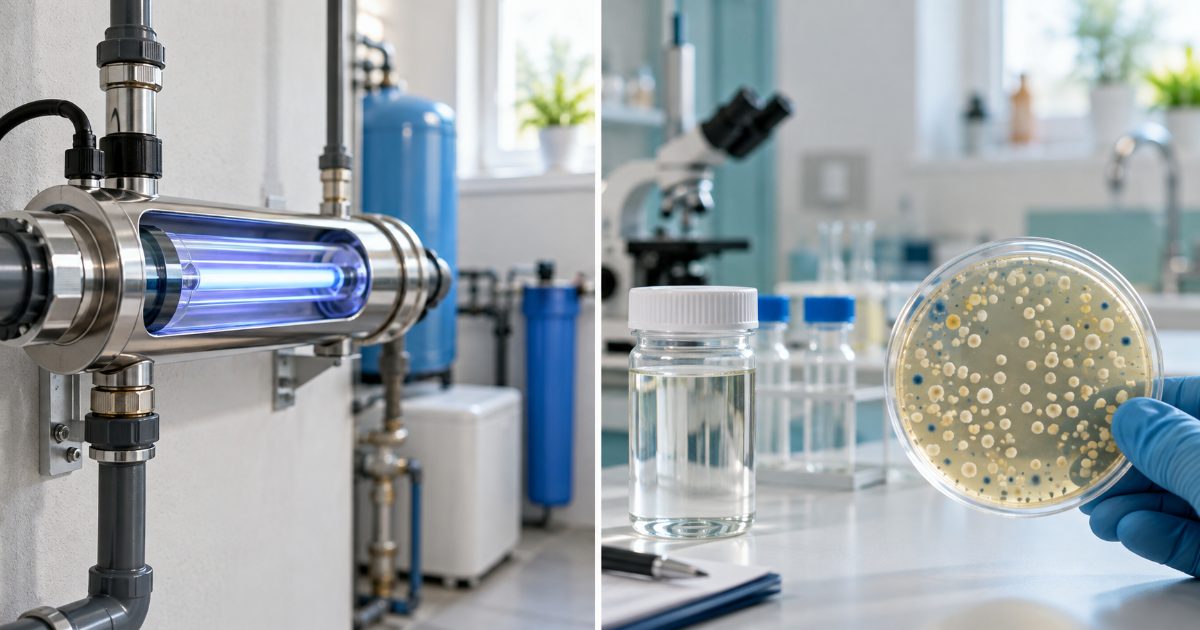
A coliform-positive result on a private well means the laboratory found total coliform bacteria in the sample, reported as present or absent: EPA’s Total Coliform Rule sets a goal of zero and binds public systems only, so no numeric limit applies. EPA Region 8 reads total coliform as a sign that the barrier protecting the water has been breached, and E. coli as a more specific indicator of fecal contamination. The Minnesota Department of Health’s response is the same for both: boiled or bottled water, shock chlorinate the well at close to but not above 200 ppm, retest 2 to 4 weeks later, repeat if still positive. Penn State Extension found that shocking plus a sanitary cap kept water clear for a year in only 15% of contaminated wells, so a second positive means continuous treatment: an ultraviolet unit dosing 40 mJ/cm2, the NSF/ANSI 55 Class A dose, behind water under 1 NTU turbidity, 0.3 mg/L iron and 7 gpg hardness, per Viqua’s manual.
If the report says total coliform present and E. coli absent, do not buy a UV unit yet: the Minnesota Department of Health’s first step is a jug of bleach and a retest, and the first table shows when that is the whole story.
What does the result tell you?
Total coliform is a group of bacteria that a laboratory reports as present or absent in a water sample. E. coli is one member of that group, and EPA Region 8’s more specific indicator of fecal contamination.
| Result | What it means | Immediate step | Continuous treatment? |
|---|---|---|---|
| Total coliform absent, E. coli absent | No indicator found | CDC: test again at least once every year, sooner after any change in taste, colour or smell | No |
| Total coliform present, E. coli absent | EPA Region 8: the barrier protecting the water may have been breached; the coliforms themselves are generally not the concern | MDH: boiled or bottled water, shock chlorinate at close to but not above 200 ppm, retest in 2 to 4 weeks | Only if the retest is positive again |
| Total coliform present, E. coli present | EPA Region 8: a more specific indicator of fecal contamination; for a public system this is an acute violation with a Tier 1 notice within 24 hours | Same MDH steps, plus CDC’s advice to contact the local health or environmental department | Plan for it: Penn State found shocking worked best where there was no E. coli |
EPA Region 8’s 24-hour repeat samples and 30-day Level 2 assessment are Revised Total Coliform Rule requirements for public water systems. EPA does not regulate private wells; the homeowner is responsible for the water.
One retest rule matters more than any other. MDH says chlorine must be absent before a bacterial sample is taken, because residual chlorine can cause a false-negative result, so the retest waits until a chlorine test strip reads 0 ppm.
What does the number mean?
Most reports carry no number: total coliform is reported as present or absent, and MDH’s private-well guidance gives no count threshold.
The only limit with a number is EPA’s Total Coliform Rule for public systems: a maximum contaminant level goal of zero, and a maximum contaminant level of no more than 5.0% of monthly samples positive for a system collecting 40 or more samples a month, one positive a month for smaller systems. A confirmed E. coli violation is acute and triggers a Tier 1 public notice within 24 hours.
When a laboratory does report a count, Penn State Extension’s benchmark is the useful one: shock chlorination worked best where counts were under 10 colonies per 100 mL with no E. coli.
Coliform is one line of CDC’s annual panel (total coliform, nitrates, total dissolved solids and pH); the well water test panel covers the rest.
Which treatment fits, and in what order?
Shock chlorination comes first: it is the only step MDH and Penn State both give before any equipment, and continuous treatment is what a second positive buys.
| Option | Role | What the sources say limits it |
|---|---|---|
| Shock chlorination | One-time dose at close to but not above 200 ppm, held at least 2 hours and preferably 6 or overnight, retest in 2 to 4 weeks (MDH). Doses by casing size are in the shock chlorination guide | Penn State: with a sanitary cap it kept water clear for a year in 15% of contaminated wells; MDH: repeat if positive, and a well that keeps failing may need cleaning or a licensed well contractor |
| Continuous ultraviolet (UV) | An NSF/ANSI 55 Class A unit delivering 40 mJ/cm2, which Viqua’s manual says conforms to the standard for disinfection of microbiologically contaminated water that meets all other public health standards | Viqua: iron under 0.3 mg/L, hardness under 7 gpg, turbidity under 1 NTU and UV transmittance above 75% first; lamp replacement on schedule; no residual downstream |
| Continuous chlorine injection | Chlorine fed ahead of a contact tank; Penn State says bacteria returning in either follow-up test means a continuous disinfection system | MDH does not usually recommend continuous chlorine injection on a private well, because it can hide other bacterial contamination and cause corrosion |
Class A or Class B?
NSF/ANSI 55 is the standard for ultraviolet water treatment systems and splits them into two classes by dose, the UV energy delivered to the water in millijoules per square centimetre (mJ/cm2).
| Class A | Class B | |
|---|---|---|
| Dose | 40 mJ/cm2 over the entire life of the lamp, the column Viqua’s spec sheet labels “NSF/EPA 40 mJ/cm2” | 16 mJ/cm2, the column Viqua’s spec sheet labels “U.S. Public Health 16 mJ/cm2” |
| Certified for | Disinfection of microbiologically contaminated water that meets all other public health standards (Viqua manual quoting NSF/ANSI 55) | Not stated in Viqua’s documentation |
| Fits a coliform-positive well? | Yes | No |
The same chamber earns different flow ratings at each dose, and that is where the listing number misleads. Viqua’s VH-series spec sheet rates the VH410 at 34 gpm at 16 mJ/cm2, 18 gpm at Viqua’s own 30 mJ/cm2 standard, and 14 gpm at the NSF/EPA 40 mJ/cm2 dose, all at 95% UV transmittance. The 18 gpm on the Amazon listing is the middle column.
The Viqua VH410 is a 304 stainless chamber rated to 125 psi, on 100 to 240 V at 60 W, per the same spec sheet. Neither the spec sheet nor the listing states an NSF/ANSI 55 Class A certification for the VH410 itself; the explicit “Tested and Certified by NSF International against CSA B483.1 and NSF/ANSI 55, Class A” badge in Viqua’s manual belongs to the PRO10, PRO20 and PRO30. Buy the VH410 as a unit that meets the 40 mJ/cm2 dose at 14 gpm, and skip it if the house’s peak flow from the flow rate calculator is higher than that.
Lamps are a schedule, not a symptom. Viqua’s manual rates the PRO-series lamp at about 18,000 hours and calls for replacement every two years; the base VH410 has no UV sensor to warn when output drops, only the VH410M adds one.
What does the UV unit need upstream?
UV works only through clear water. Viqua’s manual and pretreatment page give the same six limits, and explain that particles and hardness let microorganisms hide from the lamp.
| Parameter | Viqua’s limit | If the well exceeds it |
|---|---|---|
| Turbidity | Under 1 NTU | Viqua names a 5-micron sediment pre-filter; see the whole-house sediment filter review |
| Iron | Under 0.3 mg/L | An iron filter first; the iron in well water guide picks the class by mg/L |
| Manganese | Under 0.05 mg/L | Same oxidizing-filter classes; see the manganese guide |
| Hardness | Under 7 gpg (120 mg/L) | Viqua: soften the water; below 7 gpg, periodic quartz-sleeve cleaning suffices. Size it with the softener calculator |
| Tannins | Under 0.1 mg/L | See the tannins guide |
| UV transmittance (UVT) | Above 75% | Viqua: call the factory for a recommendation |
Viqua’s manual adds one more condition. If the source is surface water, or ground water under the direct influence of surface water, a device certified for cyst reduction under the appropriate NSF/ANSI standard goes upstream of the UV unit.
Before you buy anything
Do not buy a UV unit on the strength of the first positive. The purchase that decides the next one is the retest, at a laboratory, after the chlorine strip reads 0 ppm and 2 to 4 weeks have passed: MDH clears a well on that result and nothing else. A Safe Home DIY bacteria test kit is a fair first screen in the meantime, with a colour change in as little as 6 hours and up to 72, but its listing describes a presence or absence result across 50 coliform species, not a certified laboratory report.
What should you do first?
- Use boiled or bottled water for drinking and cooking until the well retests clear (MDH); if E. coli is present, contact the local health department (CDC).
- Shock chlorinate at close to but not above 200 ppm, hold at least 2 hours and preferably overnight, and flush until a chlorine test strip reads 0 ppm.
- Retest at a laboratory 2 to 4 weeks after disinfection, with no chlorine residual in the sample.
- If the retest is positive, have a licensed well contractor check the cap, casing and location before buying equipment, as MDH and Penn State both advise.
- If the well is sound and still positive, correct any pretreatment number above Viqua’s limits, then install a 40 mJ/cm2 UV unit sized to peak flow.
Frequently asked questions
What is the difference between total coliform and E. coli on a well water test?
Total coliform is a group of bacteria the laboratory reports as present or absent in the sample. EPA Region 8 reads a total coliform positive as a sign that the barrier protecting the water has been breached, and an E. coli positive as a more specific indicator of fecal contamination. The Minnesota Department of Health's response steps are the same for both: boiled or bottled water, shock chlorination, retest.
How soon can I retest a well after shock chlorinating it?
The Minnesota Department of Health says to retest between two and four weeks after disinfection, and to repeat the procedure if total coliform is detected again. Chlorine must be absent before the sample is taken, because residual chlorine can cause a false-negative coliform result; a chlorine test strip reading 0 ppm is the check. Penn State Extension retests at 10 to 14 days and again in 2 to 3 months.
Does a UV unit for coliform need to be NSF/ANSI 55 Class A?
Class A is the class written for this job. Viqua's owner's manual states that Class A systems conform to NSF/ANSI 55 for disinfection of microbiologically contaminated water that meets all other public health standards, at a dose of 40 mJ/cm2. Viqua's own spec sheet labels a lower dose, 16 mJ/cm2, as "U.S. Public Health" only, not NSF/ANSI 55 Class A.
Why does the Viqua VH410 listing say 18 gpm when the Class A dose gives 14 gpm?
The two figures are the same unit at two doses. Viqua's VH-series spec sheet rates the VH410 at 34 gpm for a 16 mJ/cm2 dose, 18 gpm for Viqua's own 30 mJ/cm2 standard, and 14 gpm for the NSF/EPA 40 mJ/cm2 dose, all at 95% UV transmittance. The 18 gpm on the listing is the 30 mJ/cm2 column, so size a coliform-positive well by the 14 gpm figure.
Can a home coliform test kit replace the laboratory retest?
As a first screen, not as the retest. The Safe Home DIY kit's listing says it detects 50 coliform species including E. coli, down to one organism, with a colour change in 6 to 72 hours, and it reports presence or absence only. CDC recommends a laboratory test at least once a year, and the Minnesota Department of Health clears a well on a laboratory result, not a kit.
Sources
- EPA Region 8, Addressing Total Coliform Positive or E. coli Positive Sample Results
- EPA, National Primary Drinking Water Regulations
- CDC, Guidelines for Testing Well Water
- Minnesota Department of Health, Bacterial Safety of Well Water
- Minnesota Department of Health, Well Disinfection
- Minnesota Department of Health, Iron Bacteria in Well Water
- Penn State Extension, Shock Chlorination of Wells and Springs
- VIQUA, Owner's Manual for H, K, H+, K+, PRO10, PRO20, PRO30, PRO50 UV Systems (PDF)
- VIQUA, Spec Sheet: VH150, VH200, VH410, VH410M (PDF)
- VIQUA, UV Pretreatment