Flooded well: what to do first, in the order that keeps the pump and the plumbing out of trouble
A flooded well: power off and an electrician first, purge until clear, then disinfect, then a certified lab test at 7 to 10 days, 2 to 4 weeks and 3 to 4 months.
- Verified
- Updated
- 7 min read
- 8 sources
Shop links on this page are affiliate links: a purchase may earn us a commission at no extra cost to you. Disclosure
Short answer
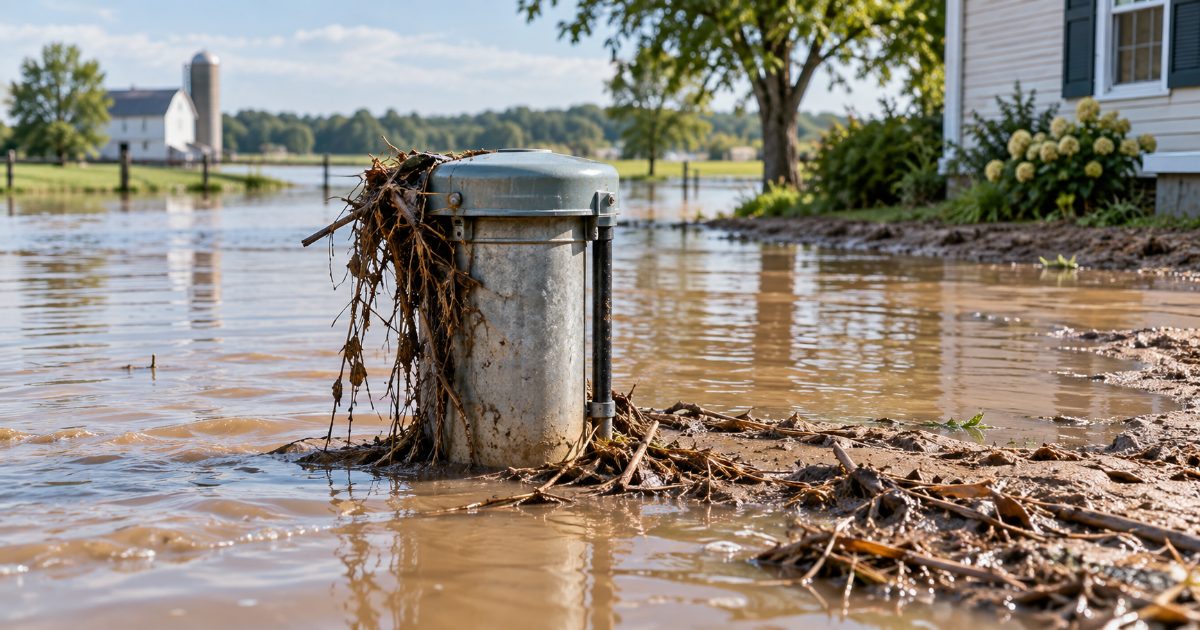
A flooded well is treated as contaminated until a certified laboratory reports total coliform and E. coli not detected. EPA’s fact sheet on what to do after a flood prints one instruction in capitals, DO NOT TURN ON THE PUMP, because of the danger of electrical shock and damage to the well or pump. EPA also says wells more than 10 years old or less than 50 feet deep are likely to be contaminated even with no apparent damage. The order is fixed. CDC says to cut all electricity to the well area before clearing debris, and to leave the equipment off until a qualified electrician, well contractor or pump contractor has checked the wiring. Then run the outside faucet nearest the well until the water is clear, so the contaminated water never enters household plumbing. Disinfection comes after that. CDC then samples 7 to 10 days later, again at 2 to 4 weeks, and again at 3 to 4 months.
The picks
The confirmation sample, run by an accredited lab network
SimpleLab Tap Score Essential Well Water Test
Mail-in kit, 54 analytes including E. coli and total coliform; SimpleLab states results in 5 business days at the lab, and network accreditations ranging from ISO to NELAC/ELAP, Direct State, DoD, DoE and DoH
An at-home screen between the lab samples, not a substitute for one
Watersafe Bacteria Water Test Kit, 2-pack
Two presence or absence bacteria tests; the listing states detection of coliform including E. coli and non-coliform bacteria, results as fast as 6 hours, USA-made
If floodwater never reached the well and a routine sample simply came back positive, this is the wrong page: start with the coliform-positive well guide instead.
Why does the pump stay off until someone checks the wiring?
EPA’s fact sheet “What to Do After the Flood” (EPA 816-F-05-021) carries two boxed warnings. The first is DO NOT TURN ON THE PUMP, for danger of electrical shock and damage to the well or pump if they have been flooded. The second is DO NOT WASH WITH WELL WATER.
EPA says that after floodwaters recede and the pump and electrical system have dried, the equipment is not turned on until the wiring system has been checked by a qualified electrician, well contractor or pump contractor. If the pump’s control box was submerged, all electrical components must be dry before electrical service is restored.
CDC puts the same rule one step earlier: turn off all electricity to the well area before clearing debris. NC State Extension says to shut it off at the circuit breaker box, and not to enter a dug well pit, because gases and vapours make it hazardous.
Silt is the second reason to wait. EPA says pumps and their electrical components can be damaged by sediment and flood water, that the pump including valves and gears needs cleaning of silt and sand, and that pumps not cleaned and properly lubricated can burn out.
What is the right order after the water recedes?
| # | Step | What it means | Who does it |
|---|---|---|---|
| 1 | Stop using the water | Switch to bottled water, a community supply or a neighbour’s well you know is clean (Wisconsin DNR) | The household |
| 2 | Kill the power | All electricity to the well area off before debris is cleared, at the breaker box (CDC, NC State Extension) | The household |
| 3 | Inspect | Casing, cap and wiring, checking for broken insulation and moisture (CDC, EPA) | Qualified electrician, well or pump contractor |
| 4 | Purge | Run the outside faucet nearest the well until the water is clear (CDC) | Contractor or owner |
| 5 | Disinfect | The well and the entire plumbing system, best done by a licensed well driller or pump installer (Wisconsin DNR) | Contractor |
| 6 | Flush | Run the water until no chlorine odour remains (EPA) | Owner |
| 7 | Test | Total coliform and E. coli at a certified laboratory (Wisconsin DNR, Vermont Department of Health) | The lab |
CDC’s reason for using the outside faucet closest to the well at step 4 is that it drains the well without letting the contaminated water into interior household plumbing. The Vermont Department of Health says running until clear may take 30 minutes to several hours or days, depending on the size and depth of the supply.
Step 5 is deliberately thin here. The dose, the contact time and the flush are a page of their own: see how to shock chlorinate a well for the procedure, and the well shock chlorination bleach calculator for the arithmetic. NC State Extension specifies only unscented household liquid chlorine bleach in the 5 to 8.25% range, and a wait of 12 to 24 hours.
One limit on the whole sequence: CDC says water carrying fuel or chemical contamination is not addressed by boiling or disinfection, and that bottled water is used until the water is known to be free of contaminants. EPA adds that because of the extent of a flood area and the speed and direction of groundwater flow, a well may not be usable as a drinking source for many months afterwards.
Which test confirms the well, and when?
| Sample | When | Looking for | Source |
|---|---|---|---|
| First | 7 to 10 days after disinfection | Bacteria | CDC, EPA, NC State Extension |
| Vermont variant | 2 to 3 days after the chlorine smell is gone | Bacteria | Vermont Department of Health |
| Confirmation | After any positive result | Total coliform | Wisconsin DNR |
| Follow-up 1 | 2 to 4 weeks after the first sample | Bacteria | CDC |
| Follow-up 2 | 3 to 4 months after the first sample | Bacteria | CDC |
The two first-sample intervals genuinely differ, and the pages give different reasons: CDC and EPA want chlorine fully gone before sampling, Vermont ties the clock to the smell of chlorine disappearing. Taking the later of the two costs nothing.
Wisconsin DNR says the certified laboratory supplies the sampling kit and the sample must reach the lab within 48 hours for an accurate test, that a first positive is confirmed with a second sample, and that a clear result is retested within a month. The Vermont Department of Health says bacteria results arrive within two business days, and that the water is not used until total coliform and E. coli both read “not detected”.
A mail-in kit from an accredited lab is what those two intervals call for. A strip or vial test such as the Watersafe Bacteria Water Test Kit is a presence or absence screen, useful between samples and not a replacement for the lab report. For what else belongs on the same order, see the well water test panel guide.
Before you order a kit
Do not order anything until steps 2 and 3 are done. A lab report on water drawn through a pump nobody has inspected tells you about the water and nothing about the well, and the sample gets repeated anyway after disinfection. There is a second reason not to skip the 3-to-4-month retest this winter: NOAA’s Climate Prediction Center issued an El Nino Advisory on 10 September 2026, with a greater than 90% chance of a very strong event during Northern Hemisphere fall and winter 2026-27. Wisconsin DNR’s prevention measure is having the well casing pipe raised to at least 2 feet above the regional flood elevation for the location, by a licensed contractor.
What should you do first?
- Stop drinking and cooking with the water and switch to another source (Wisconsin DNR).
- Shut all electricity to the well area off at the breaker box before touching debris (CDC).
- Call the local or state health department or the agriculture extension agent, which CDC asks for before any work starts.
- Book the electrician or well contractor for the wiring check, and the pump clean EPA describes.
- Purge, disinfect, flush, then sample at 7 to 10 days, 2 to 4 weeks and 3 to 4 months (CDC).
Frequently asked questions
Can you run the well pump after the water goes down?
Not until the wiring has been checked. EPA's fact sheet prints DO NOT TURN ON THE PUMP in capitals, citing danger of electrical shock and damage to the well or pump. EPA says the equipment stays off until a qualified electrician, well contractor or pump contractor has checked the wiring system, and that a submerged control box must be fully dry first.
Does a flooded well need disinfecting if nothing looks damaged?
EPA says wells more than 10 years old or less than 50 feet deep are likely to be contaminated after a flood even if there is no apparent damage, because sediment and floodwater can enter a well that is not tightly capped. Wisconsin DNR says the well and the entire plumbing system should be disinfected, and that a licensed well driller or pump installer is best placed to do it.
How long after disinfecting a flooded well should you test?
CDC says to wait at least 7 to 10 days after disinfection before sampling, and EPA and NC State Extension both give the same 7 to 10 day interval. CDC then asks for two follow-up samples, one in the next 2 to 4 weeks and another in 3 to 4 months. Wisconsin DNR retests within a month of a clear result.
What does the lab test for after a flood?
The Vermont Department of Health says bacteria are the most common drinking water contaminants after a flood, and names total coliform and E. coli as the two that must read not detected before the water is used again. Wisconsin DNR asks for total coliform bacteria at a certified laboratory, says the lab supplies the sampling kit, and requires the sample to reach it within 48 hours.
Is boiling enough while waiting for results?
Wisconsin DNR allows a one-minute rolling boil as an interim measure when no other source is convenient, after switching to bottled water, a community supply or a known-clean neighbour's well. CDC is blunt about the limit: water carrying fuel or chemical contamination is not addressed by boiling or disinfection, and bottled water is used until the water is known to be free of contaminants.
Fact sheet and how to cite this page
- Answer
- A flooded well stays out of use until a certified laboratory reports total coliform and Escherichia coli not detected, and EPA’s warning is DO NOT TURN ON THE PUMP. CDC’s order is the electrical check, then pumping until clear, then disinfection. Sampling follows 7 to 10 days later, with retests at 2 to 4 weeks and again at 3 to 4 months.
- Basis
- CDC’s How to Disinfect Wells After an Emergency and EPA fact sheet EPA 816-F-05-021, What to Do After the Flood; total coliform and E. coli are the two indicator organisms the Vermont Department of Health names after a flood.
- Assumptions
- A private drilled, driven, bored or dug well that floodwater reached or submerged, with the floodwater now receded.
- No fuel, pesticide or industrial chemical contamination is suspected; CDC says boiling and disinfection do not address those.
- Disinfection dose and contact time are taken from the separate shock chlorination pages, not from this one.
- Method
- Sequence and intervals taken from EPA’s post-flood fact sheet, CDC’s emergency well disinfection guidance, Wisconsin DNR, the Vermont Department of Health and NC State Extension, all read on 21 September 2026 and cited below.
- Primary source
- CDC, How to Disinfect Wells After an Emergency (government or regulatory source)
- Facts verified
- Last updated
- Cite as
- OwnerSpec, "Flooded well: what to do first, in the order that keeps the pump and the plumbing out of trouble", https://ownerspec.com/water/guides/flooded-well-what-to-do-first/, facts verified 21 September 2026.
Every figure above also appears, with its source, in the article. All sources · How OwnerSpec verifies numbers
Sources
- CDC, How to Disinfect Wells After an Emergency (government or regulatory source)
- EPA, What to Do After the Flood (EPA 816-F-05-021) (government or regulatory source)
- Wisconsin DNR, Flooded wells and drinking water (government or regulatory source)
- Vermont Department of Health, After a Flood: Private Drinking Water Guidance (government or regulatory source)
- NC State Extension, After the Flood: Inspect, Purge, and Disinfect Your Well (university or extension service)
- SimpleLab, Tap Score Essential Well Water Test product page (manufacturer or vendor document)
- SimpleLab, Certifications Held by Labs Used by Tap Score (manufacturer or vendor document)
- NOAA Climate Prediction Center, ENSO Diagnostic Discussion, 10 September 2026 (government or regulatory source)