Fluoride in tap water: how to find your level after the 2025 state bans, and which filters reduce it
Utah and Florida stopped adding fluoride in 2025; EPA's MCL stays 4.0 mg/L. How to read your CCR, and which filter classes reduce fluoride, and which do not.
- Verified
- Updated
- 6 min read
- 14 sources
Shop links on this page are affiliate links: a purchase may earn us a commission at no extra cost to you. Disclosure
Short answer
Fluoride in tap water comes from two places: what the utility adds, and what the source water carries naturally. HHS’s Public Health Service recommends 0.7 mg/L for community systems that add fluoride (Federal Register, 2015). Utah’s HB 81 (effective May 7, 2025) and Florida’s SB 700 (effective July 1, 2025) stopped the adding, not the natural part. EPA’s enforceable maximum contaminant level for fluoride is 4.0 mg/L; its secondary standard is 2.0 mg/L, and a system above that must give public notice within 12 months. Your utility’s number is on its Consumer Confidence Report or in CDC’s My Water’s Fluoride lookup; a private well needs a certified-lab test. Standard activated carbon does not remove fluoride (UNL Extension G1489). Reverse osmosis certified to NSF/ANSI 58 for fluoride reduction does: iSpring publishes 97.4% for its NSF-listed RCC7-BLK. Activated alumina reaches up to 99% or more under the right pH, per EPA. Get the number before buying anything.
The state bans changed the number on your report only if your utility was adding fluoride, and in Utah that was 66 of 484 reporting systems in 2024 (KUER): most Utah taps read exactly what they read before.
What does your water situation tell you?
There is no stain, taste or smell that points to fluoride. The reader’s situation does the work a symptom does on other pages, and each row ends in the document that gives the number.
A Consumer Confidence Report (CCR) is the annual water quality report a community water system sends its customers.
| Your situation | What the fluoride line likely shows | Confirm with |
|---|---|---|
| City water in Utah or Florida, and the utility fluoridated before 2025 | The natural level of the source water only: the added portion stopped on May 7, 2025 (Utah HB 81) or July 1, 2025 (Florida SB 700), per KUER and WUSF | The next CCR. CDC’s My Water’s Fluoride may lag, because CDC says states report voluntarily and the data is not real-time |
| City water elsewhere, and the utility fluoridates | Close to 0.7 mg/L, the HHS/PHS recommended level for systems that add fluoride | The CCR fluoride line, or CDC’s My Water’s Fluoride by state and system |
| City water, and the utility never fluoridated | The natural level, listed on the CCR only when detected | The CCR; ask the utility for its source-water fluoride result |
| A public notice about fluoride arrived | Above EPA’s 2.0 mg/L secondary standard: 40 CFR 141.208 requires notice within 12 months of the exceedance | The notice itself states the measured level |
| Private well | Unknown. Nothing is added, and nobody measures it for you | A certified-lab test with fluoride on the panel |
What does the number mean?
Three figures cover every report, and they come from two agencies. Read the CCR line against the one that matches.
| Level | Who sets it | What it is |
|---|---|---|
| 0.7 mg/L | HHS Public Health Service, 2015 | The recommended concentration for community systems that add fluoride. It replaced the 1962 range of 0.7 to 1.2 mg/L, which varied by climate |
| 2.0 mg/L | EPA secondary standard | Non-enforceable. A community water system that exceeds it must give public notice within 12 months of learning of the exceedance (40 CFR 141.208) |
| 4.0 mg/L | EPA maximum contaminant level, 1986 | The enforceable ceiling for public water systems |
A maximum contaminant level (MCL) is the highest concentration of a contaminant EPA allows in water delivered by a public water system. A secondary standard is a non-enforceable guideline EPA publishes for aesthetic and cosmetic effects.
The 2025 bans did not move any of these numbers. Utah’s HB 81 bars adding fluoride to public water systems (Utah Legislature). Florida’s SB 700, Chapter 2025-22, does not use the word fluoride: WUSF reports that it bans any water-system additive that fails a new “water quality additive” definition, which is what ends fluoridation. A reader checking the bill text alone will not find fluoride named.
Which treatment class reduces fluoride?
Fluoride is a dissolved ion, so the classes that work are the ones that reject or adsorb ions. Every figure in the table comes from the regulator, extension bulletin or manufacturer page named in the row.
| Treatment class | Published fluoride reduction | Source and conditions |
|---|---|---|
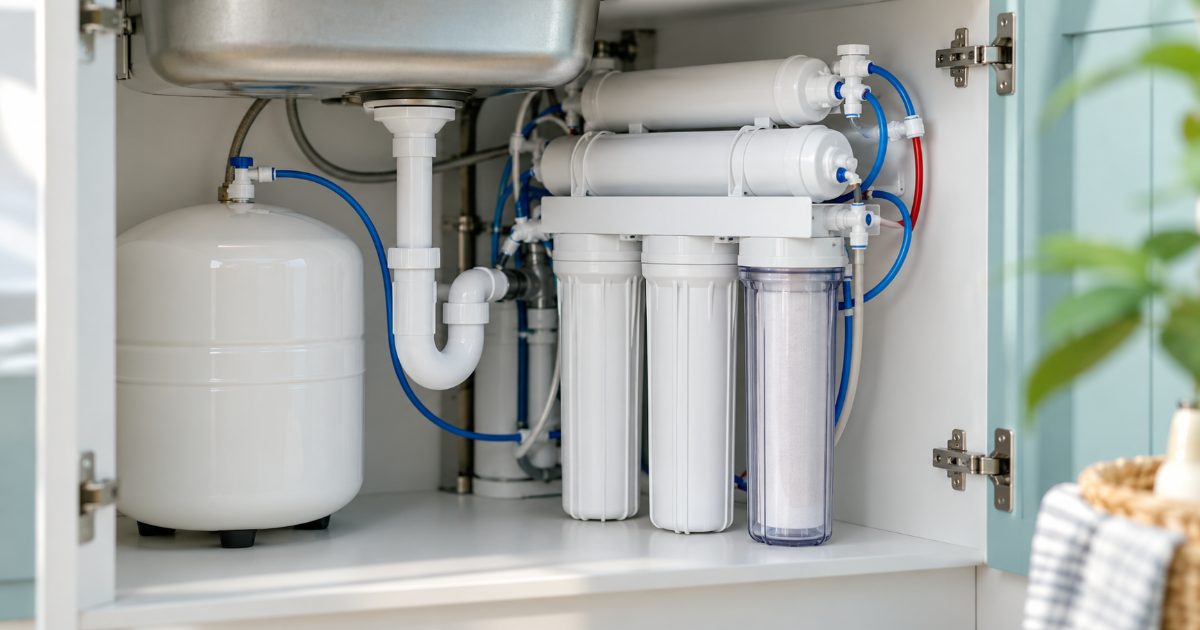
| Reverse osmosis, point of use | 97.4% | iSpring’s published certified figure for the RCC7-BLK , which NSF’s certified product listing shows under the NSF/ANSI 58 Fluoride Reduction claim. 75 gallons per day, 3.2-gallon tank |
| Activated alumina | Up to 99% or more | EPA’s Overview of Drinking Water Treatment Technologies lists activated alumina as adsorptive media for fluoride, at that reduction when the media suits the water, pH included |
| Bone char | No certified consumer figure found | An adsorptive medium sold mostly for small-scale defluoridation. No NSF/ANSI 58 or 53 fluoride-reduction listing for a consumer unit was located for this page, so no percentage is given |
| Standard activated carbon (pitcher, refrigerator, most whole-house) | None | UNL Extension G1489: activated carbon filters will not remove fluoride, hardness minerals, nitrate or microbial contaminants |
NSF/ANSI 58 is the American National Standard for point-of-use reverse osmosis systems, and a manufacturer certifies each contaminant claim under it separately. A unit can be certified to 58 for TDS and not for fluoride, so look for the fluoride claim on NSF’s listing, not the 58 badge on the box.
The iSpring figure is the manufacturer’s statement of its certified result. NSF’s public listing confirms the RCC7-BLK carries the fluoride reduction claim but does not print the percentage, and the RCC7AK, RCC7UV and RCC7P variants are separate entries with their own results.
A private well sits outside both state bans and outside any CCR: whatever fluoride the water carries is natural, and the only number is the one you order. Add fluoride to the well water test panel and read the result against the same 2.0 mg/L and 4.0 mg/L figures EPA sets for public systems. A point-of-use RO unit at the kitchen tap is the usual fit, because it only has to reduce fluoride in drinking and cooking water; a whole-house activated alumina bed covers every tap and is sized from the whole-house flow rate calculator.
Before you buy anything
Do not buy an RO system because your state was in the news. If your utility was not among the 66 of 484 Utah systems that added fluoride (KUER), the ban changed nothing, and if it was adding, the CCR now shows only the natural level. Read the CCR, or CDC’s My Water’s Fluoride, or a lab result first. If that number is one you want lower at the kitchen tap, the iSpring RCC7-BLK is on NSF’s fluoride reduction listing with a published 97.4%. It is a 75 gallon per day under-sink unit with a 3.2-gallon tank: it serves one faucet, not the house, and its filters are a recurring cost.
What should you do first?
- Find the fluoride line on the current CCR, or search CDC’s My Water’s Fluoride by state and water system; on a private well, order a certified-lab test with fluoride on the panel.
- Match the figure to the reference table: 0.7 mg/L is the level added systems target, 2.0 mg/L triggers public notice, 4.0 mg/L is the enforceable MCL.
- In Utah or Florida, wait for the first CCR covering the period after May 7 or July 1, 2025 before buying equipment: the added portion is already gone.
- If you want the number lower, pick a class from the treatment table: RO with a fluoride claim under NSF/ANSI 58 for one tap, activated alumina for the whole house, never standard carbon.
- Before paying, confirm the exact model on NSF’s certified product listing under the Fluoride Reduction claim.
Frequently asked questions
Do Brita, refrigerator or whole-house carbon filters remove fluoride?
No. The University of Nebraska-Lincoln Extension bulletin G1489 states that activated carbon filters will not remove fluoride, along with bacteria, hardness minerals and nitrate. A carbon filter reduces chlorine taste and some organic compounds. Fluoride reduction needs reverse osmosis certified to NSF/ANSI 58 for that claim, or an adsorptive medium such as activated alumina, which EPA lists for fluoride.
How do I find out how much fluoride is in my tap water?
Read your utility's annual Consumer Confidence Report, which lists fluoride when detected, or search CDC's My Water's Fluoride by state and water system. CDC notes the tool relies on voluntary state reporting, is not real-time and does not cover every state. A private well is not in either: order a certified-lab test and add fluoride to the panel.
Did the Utah and Florida bans take all the fluoride out of tap water?
No. Utah's HB 81, effective May 7, 2025, and Florida's SB 700, effective July 1, 2025, stopped utilities from adding fluoride. Fluoride already present in the source water stays. KUER reported that only 66 of 484 reporting Utah systems fluoridated in 2024, so most Utah taps changed nothing; WUSF reported over 70% of Floridians on community systems had received fluoridated water.
What is the EPA limit for fluoride in drinking water?
EPA's enforceable maximum contaminant level for fluoride is 4.0 mg/L, set in 1986. EPA also lists a secondary standard of 2.0 mg/L, which is not enforceable, but a community water system that exceeds it must give public notice within 12 months of learning of the exceedance under 40 CFR 141.208. Separately, HHS's Public Health Service recommends 0.7 mg/L for systems that add fluoride.
Does reverse osmosis remove fluoride?
Yes, when the unit is certified to NSF/ANSI 58 for the fluoride reduction claim. NSF's certified product listing shows the iSpring RCC7-BLK under that claim, and iSpring's product page publishes 97.4% fluoride reduction for it, alongside 97.9% TDS and 98.9% lead. Check the specific model on NSF's listing: iSpring sells several RCC7 variants and each carries its own certification.
Sources
- EPA, Drinking Water Regulations and Contaminants (fluoride MCL and secondary standard)
- EPA, Secondary Drinking Water Standards: Guidance for Nuisance Chemicals
- EPA, Overview of Drinking Water Treatment Technologies
- Federal Register, Public Health Service Recommendation for Fluoride Concentration in Drinking Water for Prevention of Dental Caries (2015)
- CDC, My Water's Fluoride (search by water system)
- CDC, About My Water's Fluoride
- Utah Legislature, H.B. 81 Fluoride Amendments (2025)
- KUER, With Cox's signature, Utah is 1st state to ban fluoride in public drinking water (March 28, 2025)
- Florida Senate, CS/CS/CS/SB 700 (2025), Chapter 2025-22
- WUSF, Gov. Ron DeSantis signs measure banning fluoride in Florida tap water (May 15, 2025)
- University of Nebraska-Lincoln Extension, G1489 Drinking Water Treatment: Activated Carbon Filtration
- NSF, NSF/ANSI 58: Reverse Osmosis Drinking Water Treatment Systems
- NSF, Certified Product Listings: Fluoride Reduction (NSF/ANSI 58)
- iSpring, RCC7-BLK 5-Stage Reverse Osmosis System product page (certified reduction rates)