White dust from a humidifier: it is the minerals in the fill water, and a softener will not stop it
White dust from an ultrasonic humidifier is tap-water minerals in the mist, per EPA. Distilled or RO water stops it; softened water only swaps calcium for sodium.
- Verified
- Updated
- 7 min read
- 7 sources
Shop links on this page are affiliate links: a purchase may earn us a commission at no extra cost to you. Disclosure
Short answer
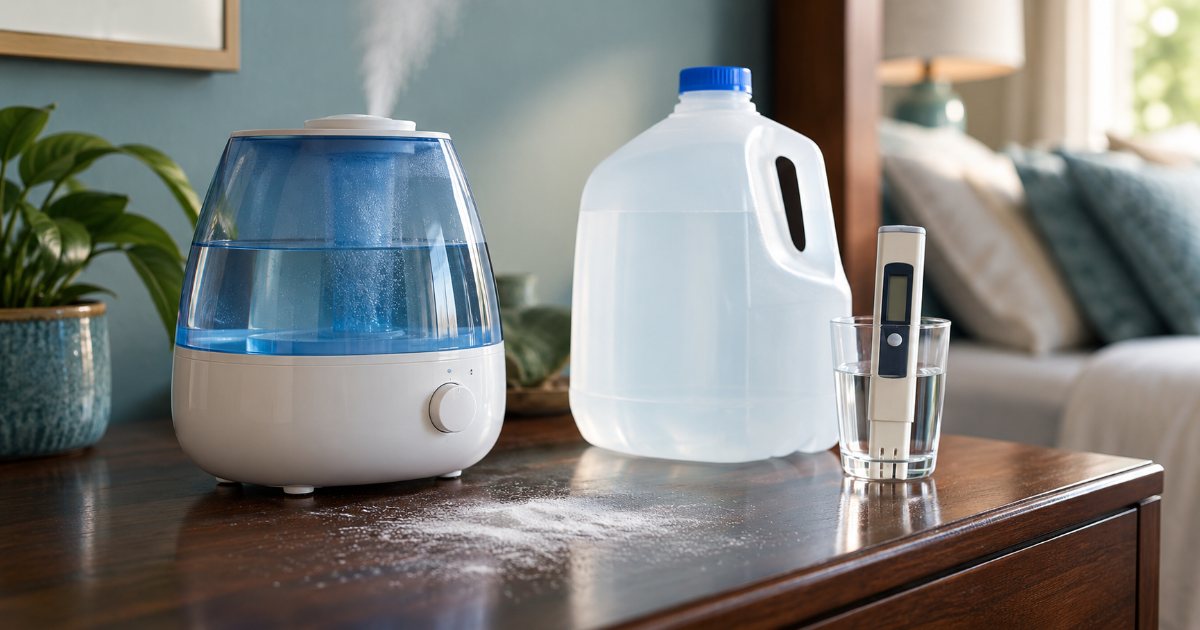
White dust on the furniture around an ultrasonic humidifier is the dissolved mineral content of the fill water, carried out in the mist and left behind when each droplet dries. EPA’s Use and Care of Home Humidifiers page states that ultrasonic and impeller (cool mist) humidifiers “are very efficient at dispersing minerals in tap water into the air,” while steam vaporizer and evaporative units “are not expected to disperse substantial amounts of minerals.” The fix is the water, not the machine. EPA recommends distilled water because distillation is the most effective method for removing minerals, names deionization and reverse osmosis as the other two demineralization processes, and allows a demineralization cartridge with the warning that its performance “may vary widely.” A water softener does not help: NDSU Extension puts the exchange at about 8 mg/L of sodium added per grain of hardness removed, so the dissolved solids stay. Read the tap water with a TDS meter first, then pick a source from the table below.
The picks
A Levoit ultrasonic unit that must keep running on tap water
Levoit 3-Pack Humidifier Demineralization Cartridge
Levoit-branded replacement demineralization cartridge, sold as a pack of three; the listing does not print a fit list or a service life, so match it to your unit's model number in the Levoit manual first
Wants a number for the tap and the treated water before choosing
HM Digital TDS-3 handheld TDS meter
HM Digital's page: 0 to 9,990 ppm range, 1 ppm resolution to 999 ppm then 10 ppm, plus or minus 2 percent accuracy from 0 to 5,000 ppm
If you already switched to distilled water and the dust is still arriving, do not buy anything yet: empty the tank, scrub the white crust off the reservoir and the mist outlet, and give the new water a clean tank to work from before you judge it.
What does the white dust tell you?
The powder is a symptom of two things at once: how much dissolved solid the fill water carries, and whether the humidifier is a type that throws that solid into the air. Change either and the dust stops.
| What you see | Likely cause | Confirm with |
|---|---|---|
| Fine white powder on surfaces nearest the humidifier, only while it runs | Minerals in tap water aerosolised by an ultrasonic or impeller unit, the mechanism EPA describes | A TDS meter reading on the fill water, and a check of the manual for the humidifier type |
| Same powder after switching to distilled water | Old mineral crust in the tank and mist outlet still shedding | Look inside the reservoir; a white film on the transducer and the outlet is the evidence |
| White crust inside the tank but no powder in the room | An evaporative unit: the minerals are staying on the wick, which is what EPA’s “less, if any” wording predicts | A grey, stiff wick that needs replacing |
| Dust plus a chalky ring in the kettle and spots on glassware | Hard water throughout the house, not a humidifier problem alone | The hard water white scale guide and a hardness test |
An ultrasonic humidifier uses a vibrating plate to break water into a fine mist without heating it. Whatever is dissolved in that water goes out with the mist, because nothing in the process separates the two.
What does the number mean?
The reading that predicts the dust is total dissolved solids. A TDS meter estimates it from the water’s conductivity, and the TDS meter guide explains what that estimate can and cannot tell you. The HM Digital TDS-3 reads 0 to 9,990 ppm at plus or minus 2 percent from 0 to 5,000 ppm per HM Digital’s page, which is more than enough range for tap water and treated water.
No regulator or manufacturer that could be read for this page publishes a TDS or hardness figure above which the dust begins. EPA’s guidance describes the mechanism and the remedies and stops there, so the honest reading is relative: the higher the number, the more powder the same tank leaves behind, and a source that reads near zero leaves none.
Hardness is the calcium and magnesium share of those dissolved solids, reported as calcium carbonate. Montana State University Extension gives the conversion as 1 grain per gallon equals 17.1 mg/L, and USGS classifies 0 to 60 mg/L as soft, 61 to 120 mg/L as moderately hard, 121 to 180 mg/L as hard, and more than 180 mg/L as very hard. If your utility report or test strip is in grains, the water hardness unit converter does the arithmetic.
Which water source fits?
| Option | Does it stop the dust? | What the source says | Who should pick it |
|---|---|---|---|
| Distilled water | Yes | EPA: distillation is the most effective method for removing minerals; distilled water still contains some mineral content, but likely less than most tap water | A small humidifier run a few nights a season |
| Reverse osmosis water | Yes | EPA names reverse osmosis and deionization as the two other demineralization processes, removing most of the minerals; Levoit accepts RO water if the system works properly | A household that runs a humidifier all winter; see the countertop RO review |
| Demineralization cartridge | Partly, and it varies | EPA: consider one if supplied or recommended for your humidifier, but the ability to remove minerals “may vary widely” | A Levoit or similar ultrasonic unit whose maker sells a matching Levoit demineralization cartridge |
| Evaporative (wick) humidifier | Yes, by design | EPA: steam vaporizer and evaporative units are not expected to disperse substantial amounts of minerals; Levoit states its evaporative models do not release minerals into the air | Anyone replacing the unit anyway; the minerals collect on the wick instead |
| Softened water | No | NDSU Extension: calcium and magnesium ions trade places with sodium ions, about 8 mg/L of sodium added per grain removed; EPA’s guidance does not mention softening | Nobody, for this purpose |
A demineralization cartridge is a small ion-exchange or adsorbent insert that sits in the tank and takes up some of the dissolved minerals before the water reaches the transducer. It is the only option on the table that keeps a tap-water habit, and it is also the only one EPA hedges.
Softened water reads high on a TDS meter for exactly the reason NDSU describes: the softener removed calcium and magnesium and put sodium in their place, grain for grain. The powder changes composition, not quantity.
Before you buy anything
Do not order cartridges or a new humidifier until you have read the fill water. The HM Digital TDS-3 costs less than a season of distilled water and tells you three things at once: how high the tap reads, whether your softened water is really any lower (it will not be, per NDSU), and whether a cartridge or an RO tap is actually delivering water near zero.
The flaw is that a TDS pen reads conductivity, not hardness, and it cannot name any single mineral. For a hardness number in grains you still want a test strip or a lab result, and the hard water guide carries that path. For this problem, the pen is enough: the dust follows the total, not the species.
The Levoit demineralization cartridge is sold as a Levoit accessory in a pack of three. Its listing prints neither a fit list nor a service life, so match it against your unit’s model number in the Levoit manual before ordering, and skip it entirely if your humidifier is another brand.
What should you do first?
- Empty the tank and scrub the white film off the reservoir, the transducer plate and the mist outlet, so old crust stops shedding into the new water.
- Read the tap water with a TDS meter and note the number; if the house has a softener, read the softened tap too and expect it to be no lower.
- Fill with distilled water for a week; if the dust stops, the water was the whole problem, per EPA’s guidance.
- Choose the long-term source from the table: distilled for occasional use, an RO tap for a humidifier that runs all season, a maker-matched cartridge if you must stay on tap water.
- If you are replacing the unit anyway, buy an evaporative model, which EPA does not expect to disperse substantial amounts of minerals.
Frequently asked questions
Does a water softener stop the white dust from an ultrasonic humidifier?
No. NDSU Extension's ion-exchange publication explains that as hard water passes through a softener, the calcium and magnesium ions trade places with sodium ions, and that about 8 mg/L of sodium is added for every grain of hardness removed. The dissolved solids are exchanged, not removed, so the mist still carries minerals to the furniture. EPA's humidifier guidance does not list softening as a remedy.
Can I use reverse osmosis water in a humidifier instead of buying distilled?
Yes. EPA's Use and Care of Home Humidifiers page names deionization and reverse osmosis as two demineralization processes that remove most of the minerals from water, alongside distillation, which it calls the most effective method. Levoit's own guidance also accepts reverse osmosis water as an alternative to distilled if the RO system is working properly. A TDS meter on the RO tap confirms that.
Do evaporative humidifiers make white dust?
EPA's guidance says steam vaporizer and evaporative humidifiers are not expected to disperse substantial amounts of minerals, and that in general they disperse less, if any, of these pollutants into the air compared with ultrasonic and impeller units. Levoit states that its evaporative models do not release minerals into the air. The minerals stay behind on the wick, which is why the wick needs replacing.
How hard does tap water have to be before a humidifier leaves white dust?
No regulator or manufacturer that could be read for this page publishes an onset threshold, and EPA's guidance covers the mechanism and the remedies only. USGS classifies 0 to 60 mg/L as calcium carbonate as soft and more than 180 mg/L as very hard; Montana State University Extension gives 1 grain per gallon as 17.1 mg/L. The higher the reading, the more powder the same tank leaves behind.
How often does a demineralization cartridge need replacing?
The Levoit cartridge listing checked for this page does not print a service life, and Levoit's support article on humidifier water could not be opened, so this page does not state an interval. EPA warns that the ability of these cartridges and filters to remove minerals may vary widely. Follow the interval in your humidifier's manual, and treat returning dust as the sign the cartridge is spent.
Fact sheet and how to cite this page
- Answer
- White dust around an ultrasonic or impeller humidifier is the dissolved mineral content of the fill water, carried out in the mist and left behind when the droplets dry. EPA’s humidifier guidance says these types are very efficient at dispersing tap-water minerals into the air and recommends distilled water. Softened water does not fix it: NDSU Extension puts the trade at about 8 mg/L of sodium added per grain of hardness removed.
- Basis
- EPA, Use and Care of Home Humidifiers, for the mechanism by humidifier type and the distilled, deionized and reverse osmosis recommendations; NDSU Extension for the sodium exchange figure; Montana State University Extension for 1 gpg = 17.1 mg/L
- Assumptions
- The dust is a fine white powder that appears only while the humidifier runs and is heaviest closest to it
- The humidifier is an ultrasonic or impeller (cool mist) type; evaporative and steam units are covered only as alternatives
- A TDS meter reading is a screening number for how much dissolved solid the fill water carries, not a laboratory hardness result
- Method
- Mechanism and remedies from EPA’s Use and Care of Home Humidifiers page, the sodium exchange figure from NDSU Extension, the unit conversion from Montana State University Extension, the hardness bands from USGS, the meter specification from HM Digital’s TDS-3 page, Levoit’s guidance from its own blog, all read on 2026-09-27; nothing was tested.
- Primary source
- EPA, Use and Care of Home Humidifiers (government or regulatory source)
- Facts verified
- Last updated
- Cite as
- OwnerSpec, "White dust from a humidifier: it is the minerals in the fill water, and a softener will not stop it", https://ownerspec.com/water/guides/humidifier-white-dust-hard-water/, facts verified 27 September 2026.
Every figure above also appears, with its source, in the article. All sources · How OwnerSpec verifies numbers
Sources
- EPA, Use and Care of Home Humidifiers (government or regulatory source)
- NDSU Extension, Water Softening (Ion Exchange) (university or extension service)
- Montana State University Extension Water Quality, Hardness fact sheet (university or extension service)
- USGS Water Science School, Hardness of Water (government or regulatory source)
- HM Digital, TDS-3 product page (manufacturer or vendor document)
- Levoit, What Water Is Best for Your Humidifier: Evaporative vs Ultrasonic Models (manufacturer or vendor document)
- Levoit, Water for Your Humidifier (manufacturer or vendor document)