Low water pressure after installing a whole-house filter: port size, micron rating, a loaded cartridge or a bypass valve, and how a gauge tells them apart
A 20 x 4.5 in Big Blue housing drops 1 psi at 15 gpm with 1 in ports and 2 psi with 3/4 in ports per Pentair. A gauge on each side finds the cause.
- Verified
- Updated
- 8 min read
- 5 sources
Shop links on this page are affiliate links: a purchase may earn us a commission at no extra cost to you. Disclosure
Short answer
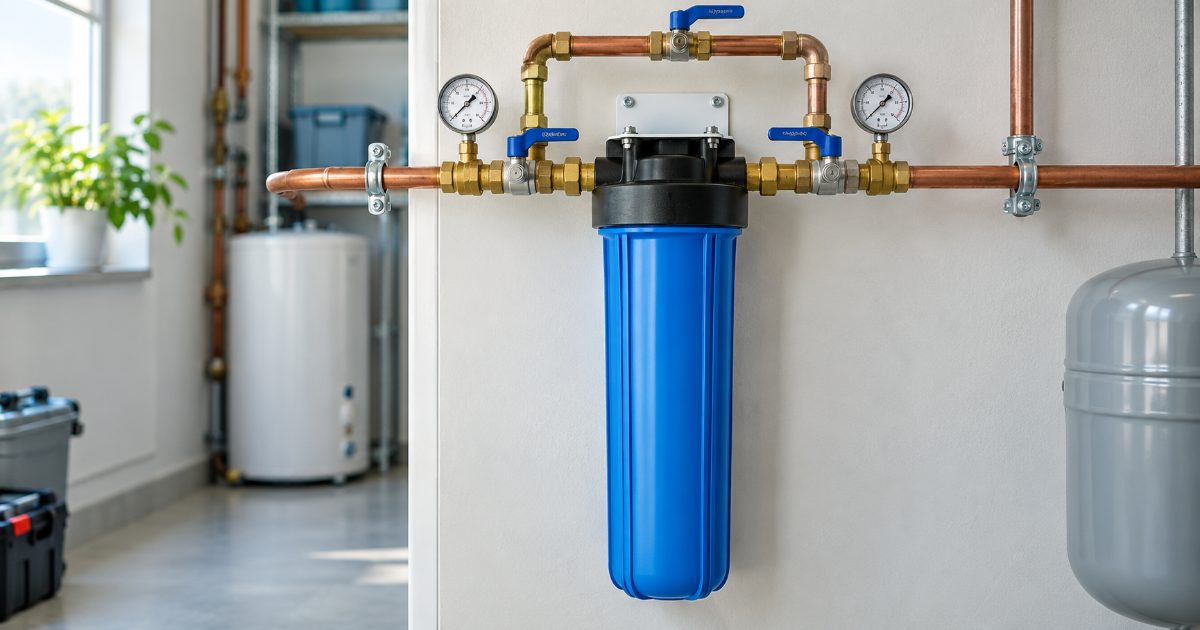
Low water pressure after installing a whole-house filter has four usual causes, and a pressure gauge on each side of the housing tells them apart. First, the housing itself: Pentair’s Big Blue spec sheet 310053 rates the 20 x 4.5 in housing with 1 in ports at a 1 psi drop at 15 gpm, and the same housing with 3/4 in ports at 2 psi at 15 gpm, double the loss at the same flow. Second, the cartridge: Pentek’s DGD spec sheet 310061 rates its 20 in cartridges at under 1 psi at 20 gpm when clean, so a large day-one loss is not a new cartridge. Third, a micron rating finer than the water needs: NDSU Extension WQ1029 says a 2 to 5 micron filter has smaller pores, needs more pressure to push water through and loads faster. Fourth, a bypass valve left partly open or a service valve not fully opened. Fit the gauges first, then compare the reading to the housing’s published drop.
If the pressure fell house-wide the day the filter went in and the housing has 3/4 in ports, do not buy a cartridge yet: on Pentair’s own sheet the port size alone doubles the loss.
What does the symptom tell you?
The pressure drop across a housing is the inlet gauge reading minus the outlet gauge reading, in psi, at whatever flow is running at that moment.
| Reading or symptom | Likely cause | Confirm with |
|---|---|---|
| Pressure dropped house-wide the day of the install and the gauge difference is well above the housing’s clean rating | Housing or port size too small for peak demand: a 3/4 in port housing on a house that peaks past 15 gpm | The whole-house filter flow rate calculator, compared to the 15 gpm and 20 gpm housing ratings below |
| Gauge difference was normal on day one, then climbed within days of a new cartridge | Micron rating finer than the source needs, so the cartridge loads fast | The micron rating picker; NDSU targets 10 to 15 micron for a drilled well |
| Pressure was normal for weeks or months, then declined gradually everywhere | Cartridge loaded with sediment past its clean baseline | Swap in the same micron rating and re-read the gauges; if the difference falls back, the cartridge was the cause |
| Loss appeared the moment the plumber finished, even at one open tap | Bypass valve partly open or a service valve partly shut, so flow splits or throttles at the valve, not the media | Open both service valves fully and close the bypass fully, following the valve layout in Pentair’s PC1665-P manual |
| Only far or upstairs fixtures lose pressure and the outlet gauge reads close to the inlet gauge | Not the filter: undersized or corroded branch plumbing downstream | An outlet gauge reading near the inlet reading clears the housing |
The last row is the permission to leave. If the two gauges read within the housing’s published drop of each other, nothing on this page fixes the fixture upstairs.
What does the number mean?
No NSF/ANSI standard sets a pressure-drop limit: NSF/ANSI 42, which both Pentek spec sheets cite, covers material and structural integrity only. The only limits are the makers’ own clean-media figures, so those are the baseline to read the gauges against.
| Component | Ports | Rated flow | Published drop, clean | Maximum working pressure |
|---|---|---|---|---|
| Pentek Big Blue 20 x 4.5 in housing (Pentair 310053) | 3/4 in NPT | 15 gpm | 2 psi at 15 gpm | 90 psi |
| Same housing | 1 in NPT | 15 gpm | 1 psi at 15 gpm | 90 psi |
| Same housing | 1-1/2 in NPT | 20 gpm | 1 psi at 20 gpm | 90 psi |
| Pentek DGD-5005-20 , 5 micron nominal (Pentair 310061) | fits the 4.5 in housing | 20 gpm | under 1 psi at 20 gpm | not published on the sheet |
| Pentek DGD-7525-20 , 25 micron nominal | fits the 4.5 in housing | 20 gpm | under 1 psi at 20 gpm | not published on the sheet |
| Pentek DGD-2501-20 , 1 micron nominal | fits the 4.5 in housing | 20 gpm | under 1 psi at 20 gpm | not published on the sheet |
| Fleck 5600 control valve alone (spec sheet 42749) | 3/4, 1 or 1-1/4 in | 20 gpm continuous, 26 gpm peak | 15 psi continuous, 25 psi peak, at a 50 psi inlet | 125 psi |
| Pentair PC1665-P high-flow tank | 1-1/2 in head, adapts to 1 in and 3/4 in | 25 gpm rated service flow | not published as a psi figure | 80 psi, 25 psi minimum |
Two things stand out in that table. The three DGD cartridges carry the same clean drop whatever their micron rating, so a fine cartridge does not cost pressure on day one; and the same Big Blue sump loses twice as much through 3/4 in ports as through 1 in ports.
The micron rating is where the loss grows. NDSU Extension WQ1029 says a 2 to 5 micron filter has smaller pores and needs more pressure to push water through, and it sets targets of 15 micron for rust on a public supply, 10 to 15 micron for a drilled well and 2 micron only for a dug or bored well.
None of the four spec sheets publishes a pressure difference at which to replace the cartridge. NDSU Extension’s cue is a noticeable reduction in pressure at the tap, with a general interval of three to six months for a high-volume filter, sooner if flow drops. That gap is why the gauges matter: they turn “noticeable” into a number you can log.
The Fleck 5600 figures show what a valve-and-tank class costs. Its spec sheet rates the valve alone at 20 gpm continuous at a 15 psi drop and 26 gpm peak at a 25 psi drop, both at a 50 psi inlet, far more than a cartridge housing, in exchange for media that backwashes instead of clogging.
Which treatment class fits?
| Cause | Limit that decides it | Fix |
|---|---|---|
| Port size too small for the flow | 2 psi at 15 gpm through 3/4 in ports versus 1 psi through 1 in ports, per Pentair 310053 | Reinstall the 1 in or 1-1/2 in port version of the same housing; cartridges are unchanged |
| Housing class too small for peak demand | 15 gpm on a single 20 x 4.5 in housing; 20 gpm continuous on a Fleck 5600 at 15 psi; 25 gpm service flow on the PC1665-P | Step up a class using the flow rate calculator’s housing table |
| Micron too fine for the source | NDSU: 15 micron for public-supply rust, 10 to 15 micron for a drilled well, 2 micron for a dug or bored well | Match the cartridge to the source with the micron rating picker; do not default to 1 micron |
| Cartridge loaded past its clean rating | No psi threshold published; NDSU’s cue is a noticeable pressure drop, interval three to six months | Replace the cartridge and log the new gauge difference as the baseline |
| Bypass valve mis-set | Mechanical, not a published limit | Open both service valves fully, close the bypass fully, in the sequence on the valve head |
Each candidate has a reader who should skip it. The Big Blue housing tops out at 90 psi on a 20 in sump per Pentair, so a booster pump or well system above that needs a pressure-reducing valve ahead of it.
The DGD-2501-20 at 1 micron sits below NDSU’s 10 to 15 micron target for a drilled well and will load faster there for no filtration the water needs.
The PC1665-P’s 25 psi minimum working pressure puts a supply below 25 psi outside its range before any drop is added.
Sediment stays the first stage regardless of class: NDSU places it right after the meter on public supply or right after the pressure tank on a well. The install order guide covers what follows it, and the 20 inch Big Blue cartridge compatibility page lists what else fits the housing.
Before you buy anything
Do not order a cartridge, a housing or a bigger class until two gauges have told you where the loss is. A 0 to 100 psi gauge with a 1/4 in NPT thread, such as the MEASUREMAN 0-100 psi glycerin gauge , fits a tee on each side of the housing.
Read both with one tap running and compare the difference to the 1 psi or 2 psi clean rating above. If the difference is near the rating and pressure is still low, the housing is not the cause and a cartridge will not help.
If the difference is well above the rating on a cartridge fitted weeks ago, the DGD-5005-20 at 5 micron nominal is the standard 20 in replacement, and the DGD-7525-20 at 25 micron is the coarser cartridge for a well that loads a 5 micron one too fast. Both are rated under 1 psi at 20 gpm clean per Pentair, and neither carries a published replace-at figure, so the gauge log is the spec.
What should you do first?
- Confirm both service valves are fully open and the bypass valve fully closed, in the order printed on the valve head.
- Fit a 0 to 100 psi gauge on each side of the housing and read both with one tap running; the difference is the drop.
- Compare the difference to the housing’s clean rating: 1 psi at 15 gpm for 1 in ports, 2 psi at 15 gpm for 3/4 in, per Pentair 310053.
- Run the whole-house filter flow rate calculator; a peak above 15 gpm on a single 20 x 4.5 in housing means the class, not the cartridge, is the limit.
- If the drop grew after a new cartridge, check its micron rating against the micron rating picker before buying the same one again.
Frequently asked questions
Does a whole-house filter always lower water pressure?
Yes, by a small amount even when clean. Pentair's Big Blue spec sheet 310053 rates a 20 x 4.5 in housing with 1 in ports at a 1 psi drop at 15 gpm, and Pentek's DGD spec sheet 310061 rates the cartridge inside it at under 1 psi at 20 gpm. The question is whether the loss stays near those figures or grows past them as the cartridge loads.
Does the port size, 3/4 inch versus 1 inch, change the pressure drop?
Yes, by a factor of two on the same housing. Pentair's spec sheet 310053 rates the 20 x 4.5 in Big Blue housing at 2 psi at 15 gpm with 3/4 in ports and 1 psi at 15 gpm with 1 in ports. The 1-1/2 in port version is rated 1 psi at 20 gpm. A house peaking above 15 gpm should not be on a 3/4 in housing.
Does a finer micron cartridge cause more pressure loss?
Not on the first day, but yes as it loads. Pentek's DGD spec sheet rates the 1, 5 and 25 micron 20 in cartridges all at under 1 psi at 20 gpm when clean. NDSU Extension WQ1029 says a 2 to 5 micron filter has smaller pores and needs more pressure to push water through, and it fills with particles faster than a coarser cartridge on the same water.
How do I know when the whole-house cartridge needs replacing?
No spec sheet on this page publishes a replacement pressure drop in psi. NDSU Extension's cue is a noticeable reduction in pressure at the tap, and its general interval for a high-volume filter is three to six months, sooner if flow drops. A 0 to 100 psi gauge on each side of the housing turns that cue into a number: replace when the difference climbs well past the clean figure.
What is the difference between a Fleck 5600 valve's continuous and peak flow rating?
Continuous is the flow the valve can pass all day; peak is a short burst. The Fleck 5600 spec sheet rates the valve alone at 20 gpm continuous at a 15 psi drop and 26 gpm peak at a 25 psi drop, both measured at a 50 psi inlet. Size against the continuous figure: a house peaking at 26 gpm through this valve loses 25 psi each time.
Fact sheet and how to cite this page
- Answer
- Pressure loss after a whole-house filter comes from the housing, the cartridge, the micron rating or the bypass valve. Pentair’s Big Blue spec sheet rates the 20 x 4.5 in housing at a 1 psi drop at 15 gpm with 1 in ports and 2 psi with 3/4 in ports; Pentek DGD cartridges add under 1 psi at 20 gpm clean. A gauge on each side of the housing separates the causes.
- Basis
- Pentair spec sheet 310053 (Big Blue housing pressure drop by port size, 90 psi maximum) and 310061 (DGD cartridge drop), with NDSU Extension WQ1029 for micron targets and the replacement cue; no NSF/ANSI standard sets a pressure-drop limit.
- Assumptions
- The filter is a single 20 x 4.5 in cartridge housing, a Fleck 5600 valve or a Pentair PC1665-P tank; other housings publish their own drop
- Published drops are clean-media figures at the stated flow; a loaded cartridge drops more and no maker on this page publishes the replace threshold in psi
- Household peak flow comes from the whole-house filter flow rate calculator, not from a guess
- Method
- Housing, cartridge, valve and tank figures read from Pentair spec sheets and manuals, micron targets and the pressure-drop cue from NDSU Extension WQ1029, all on 2026-09-15; nothing was tested.
- Primary source
- Pentair, Big Blue and Big Black Heavy Duty Filter Housings specification sheet, 310053 Rev F (manufacturer or vendor document)
- Facts verified
- Last updated
- Cite as
- OwnerSpec, "Low water pressure after installing a whole-house filter: port size, micron rating, a loaded cartridge or a bypass valve, and how a gauge tells them apart", https://ownerspec.com/water/guides/low-water-pressure-after-whole-house-filter/, facts verified 15 September 2026.
Every figure above also appears, with its source, in the article. All sources · How OwnerSpec verifies numbers
Sources
- Pentair, Big Blue and Big Black Heavy Duty Filter Housings specification sheet, 310053 Rev F (manufacturer or vendor document)
- Pentair, Pentek DGD Series specification sheet, 310061 Rev E (manufacturer or vendor document)
- Pentair, Fleck 5600 High Performance Control Valve spec sheet, 42749 Rev E (manufacturer or vendor document)
- Pentair, PC1665-P High Flow Whole House Water Filter installation manual (manufacturer or vendor document)
- NDSU Extension, Filtration: Sediment, Activated Carbon and Mixed Media, WQ1029 (revised September 2021) (university or extension service)