Nitrate in well water: the 10 mg/L limit, where it comes from, and what removes it
Nitrate in well water above EPA's MCL of 10 mg/L as N (45 mg/L as nitrate) needs RO, anion exchange or distillation. Boiling and softeners remove none.
- Verified
- Updated
- 8 min read
- 14 sources
Shop links on this page are affiliate links: a purchase may earn us a commission at no extra cost to you. Disclosure
Short answer
Nitrate in a private well has no taste, colour or smell, so the lab report is the only symptom. EPA’s Maximum Contaminant Level (MCL) for nitrate is 10 mg/L measured as nitrogen, which Penn State Extension also states as 45 mg/L measured as nitrate; the MCL for nitrite is 1 mg/L as nitrogen. EPA’s rule does not cover private wells, so the owner tests: NDSU Extension says every three years, University of Minnesota Extension every other year, and more often with an infant or a pregnancy in the house. Above 10 mg/L as N, Penn State names three treatment classes: reverse osmosis certified to NSF/ANSI 58 for nitrate/nitrite reduction, ion exchange on nitrate-selective anion resin, and distillation. Boiling concentrates nitrate as the water evaporates, and a water softener or carbon filter removes none of it. Test at a certified lab first, and put sulfate on the same panel: sulfate cuts a standard anion resin’s nitrate capacity.
Check the units before anything else: a result of 40 mg/L reported as nitrate is under the limit, because the NCBI reference gives 10 mg/L as nitrogen as 44 mg/L as nitrate ion, while the same 40 reported as nitrate-N is four times over it.
What does the well tell you before the lab does?
Nothing at the tap. Nitrate leaves no stain, taste or odour, so the clues are on the property, not in the glass. Penn State Extension names the recurring sources, and University of Minnesota Extension adds the geology that carries them into the aquifer.
| What you know about the well | Likely nitrate source | Confirm with |
|---|---|---|
| Cropland or pasture within sight of the wellhead | Agricultural fertilizer or manure runoff (Penn State) | A certified-lab nitrate result |
| Septic drainfield uphill of or close to the well | A failing or overloaded septic system (Penn State) | Nitrate and total coliform on the same well panel; both elevated points at the drainfield |
| Heavily fertilized lawn, golf course or nursery nearby | Lawn fertilizer (Penn State) | A lab nitrate result |
| Shallow well, or a well in fractured limestone or karst | Fast infiltration from the surface: UMN names southeast Minnesota’s karst geology for elevated groundwater nitrate | A lab nitrate result plus bacteria, which travel the same fractures |
| A test strip read 5 to 10 mg/L as N | A screen, not a verdict | A certified-lab nitrate and nitrite result before any purchase |
A positive coliform result next to a high nitrate result is the same story told twice: the surface is reaching the well. The shock-chlorination guide handles the bacteria; it does nothing for the nitrate, which needs a treatment class below.
What does the number mean?
Nitrate-nitrogen (nitrate as N) counts only the nitrogen atom in the nitrate ion. Nitrate (as NO3) counts the whole ion, so the same water reads about 4.4 times higher in that unit. Labs use both, and the MCL is written in the first.
| Parameter | Limit | Who sets it | Same figure in the other unit |
|---|---|---|---|
| Nitrate as N | 10 mg/L | EPA MCL and MCLG | 44 mg/L as nitrate (NCBI), 45 mg/L (Penn State, PA DEP) |
| Nitrite as N | 1 mg/L | EPA MCL and MCLG | About 3.3 mg/L as nitrite (NCBI) |
| Nitrate as N under 10 mg/L | Within the EPA limit | NDSU Extension’s reading of the rule | Retest every three years (NDSU) or every other year (UMN) |
An MCL is the enforceable limit for public water systems, and EPA’s rule sets both the nitrate and nitrite MCLs at the same value as their health-based goals. EPA’s own guidance sheet for private wells (WSG-213) and NDSU both state the consequence: the federal rule does not cover a private well, so testing and any treatment are the owner’s decision.
The MCL is a health-based number and EPA’s table names infants under six months as the population it is set for; Penn State puts the highest exposure under four months. This page cites the limit and stops there. What it means for a household is a question for the state health department the extension services point to.
One number that surprises people: boiling raises it. Penn State states that boiling does not remove nitrate and concentrates it instead, because the water leaves as steam and the nitrate stays in the pot.
Which treatment class fits?
Penn State names three classes that remove nitrate: ion exchange, reverse osmosis and distillation. The decision is which one, and at which tap.
| Lab result (as N) | Household | What to do | Why |
|---|---|---|---|
| Under 10 mg/L | Any | No nitrate treatment; retest every three years (NDSU) or every other year (UMN) | Within EPA’s limit as NDSU reads it |
| Under 10 mg/L | Infant under six months, pregnancy or planned pregnancy | Retest more often, per UMN; watch the trend, not one result | EPA sets the MCL for that population; UMN’s testing advice is specific to it |
| 10 to 27 mg/L | Drinking and cooking tap only | Point-of-use RO certified to NSF/ANSI 58 for nitrate/nitrite reduction | Whirlpool’s WHAROS5 data sheet is rated to 27 mg/L nitrate as N in the feed, at 40 psig or more |
| 10 to 27 mg/L | Every tap, or a large daily draw | Anion exchange on nitrate-selective resin at the point of entry, or distillation for drinking water | The WHAROS5 produces 18.46 gallons a day; an RO unit is a drinking-water fix, not a whole-house one |
| Above 27 mg/L | Any | Anion exchange on nitrate-selective resin, or distillation, and find the source | Above the certified RO unit’s rated feed, single-pass product water can still exceed 10 mg/L |
| Nitrite above 1 mg/L | Any | The same classes; an NSF/ANSI 58 nitrate claim is tested with a nitrite claim | NSF/ANSI 58 requires nitrite reduction to be claimed and tested whenever nitrate is claimed (WC&P) |
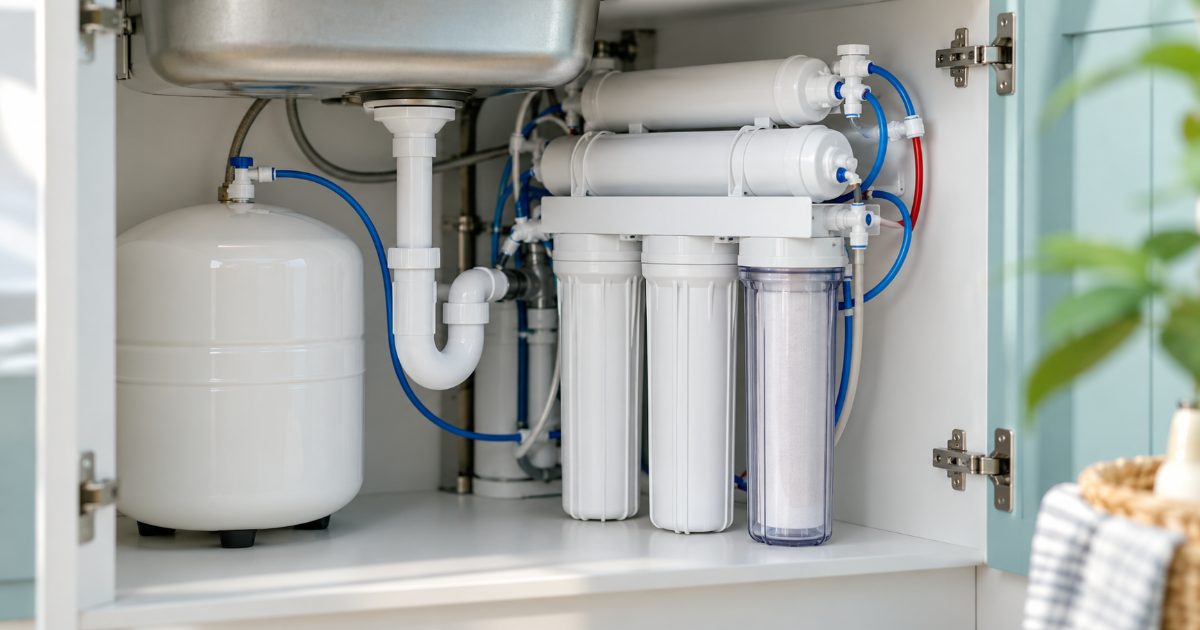
Reverse osmosis is the only one of the three with a consumer certification you can look up. NSF/ANSI 58 lists nitrate/nitrite reduction as an optional claim, separate from the standard’s base TDS claim, and NSF’s listing search for that claim is the shopping list: Whirlpool WHAROS5, WHER25 and WHAPSRO, the EcoWater ERO-385 series, GE GXRV40TBN and Pentair GRO-350B appear on it. APEC’s RO-90 does not: its own certification list covers arsenic, lead, fluoride and seven other contaminants, and nitrate is not among them.
The claim also comes with conditions. Whirlpool’s WHAROS5 performance data sheet is the clearest published example of what a certified unit needs in the feed water.
| Feed-water condition for the WHAROS5 nitrate/nitrite claim | Figure from the data sheet |
|---|---|
| Feed pressure | 40 psig (280 kPa) minimum for the certified claim; 40 to 100 psig operating |
| Nitrate as N in the feed | 27 mg/L maximum |
| Nitrite as N in the feed | 3 mg/L maximum |
| Total dissolved solids | 2,000 mg/L maximum |
| Hardness | 10 gpg (171 mg/L) maximum at pH 6.9 |
| Chlorine | 2.0 mg/L maximum |
| Iron, manganese, hydrogen sulfide | 0 mg/L: pretreat to zero |
| Result in NSF testing | 26 mg/L average feed to 6.6 mg/L average product, 74.9% average nitrate reduction; nitrite 80.9% |
The last two rows are where a well fails the sheet. A private well with iron, manganese or a rotten-egg smell has to fix those first, and a hard well above 10 gpg needs a softener ahead of the membrane: the softener removes no nitrate, but it keeps the membrane inside its rating.
Anion exchange has two conditions of its own, both from the trade references on resin selection. Standard strong-base anion resin captures sulfate alongside nitrate, so sulfate in the raw water takes capacity away from nitrate; a nitrate-selective resin de-selects sulfate. And a standard resin nearing exhaustion releases captured nitrate first, so the water leaving the unit can read higher than the water entering it. Specify nitrate-selective resin and a regeneration schedule set from the lab numbers, not the salt bin.
Distillation removes nitrate without a feed-water sheet, at the cost of a countertop unit producing a few litres at a time. Penn State lists it as effective; it is the fallback where pressure or feed chemistry rules RO out.
Before you buy anything
Do not buy an RO unit or a resin tank on a strip result. The WaterWorks 481109 nitrate/nitrite strips
read nitrate as N at 0, 0.5, 2, 5, 10, 20 and 50 mg/L and nitrite at 0.15 to 10 mg/L in one minute, which is enough to say “send a sample” and nothing more. The lab result, with sulfate, hardness, iron, manganese and pressure alongside it, is what picks the row above and the size of the unit. A strip that reads 5 or 10 is the reason to order the lab test, not a reason to skip it.
What should you do first?
- Read the unit on the report: as N or as nitrate. Convert before comparing to 10 mg/L.
- Order a certified-lab panel for nitrate, nitrite, total coliform and sulfate; add hardness, iron, manganese and hydrogen sulfide if RO is on the table.
- In a household with an infant under six months or a pregnancy, and a result at or above 10 mg/L as N, change the drinking-water source for that household before choosing equipment, and call the state health department the extension services name.
- Pick the row: a drinking tap up to 27 mg/L as N goes to a point-of-use RO on NSF’s nitrate/nitrite listing; every tap, or a higher result, goes to nitrate-selective anion exchange or distillation.
- Retest after installation and on NDSU’s three-year or UMN’s two-year cycle, with the strips in between.
Frequently asked questions
What is the difference between nitrate as N and nitrate as NO3 on a lab report?
The same water, two units. Nitrate-nitrogen (as N) counts only the nitrogen atom; nitrate (as NO3) counts the whole ion. EPA's MCL is 10 mg/L as N, which the NCBI reference gives as 44 mg/L as nitrate and Penn State Extension rounds to 45 mg/L. A report of 30 mg/L as nitrate is under the limit; 30 mg/L as N is three times over it.
Does boiling well water remove nitrate?
No. Penn State Extension states that boiling does not remove nitrate and instead concentrates it, because the water evaporates and the nitrate stays behind. A water softener and an activated carbon filter remove none of it either. Penn State names three classes that do: reverse osmosis, ion exchange and distillation, and each one needs a lab number to size against.
Does a water softener remove nitrate from well water?
No. A softener runs cation exchange resin, which swaps calcium and magnesium for sodium; nitrate is an anion and passes straight through. Nitrate removal by ion exchange needs strong-base anion resin, ideally a nitrate-selective grade. Standard anion resin loses nitrate capacity to sulfate in the raw water and can release captured nitrate as the bed nears exhaustion, so the sulfate result matters as much as the nitrate result.
Which reverse osmosis systems are certified for nitrate?
Only the units in NSF's listing for NSF/ANSI 58 Nitrate/Nitrite Reduction, a separate optional claim. Whirlpool's WHAROS5 data sheet, for example, is certified to 27 mg/L nitrate as N in the feed at 40 psig or more, with 74.9% average reduction in NSF testing. Popular units such as the APEC RO-90 are certified for other contaminants and do not list nitrate, whatever the marketing copy says.
How often should a private well be tested for nitrate?
NDSU Extension recommends testing a private well for nitrate and bacteria every three years. University of Minnesota Extension says every other year, and more often in a household with a pregnancy, a planned pregnancy or an infant on formula. EPA's rules do not cover private wells, so nobody else tests. A lab test decides treatment; a 1-minute strip only screens between lab tests.
Sources
- EPA, National Primary Drinking Water Regulations
- NCBI Bookshelf, Nitrate and Nitrite in Drinking Water: Introduction and Background
- EPA, Water Supply Guidance 213: Nitrate in private wells (PDF)
- Penn State Extension, Nitrates in Drinking Water
- NDSU Extension, Drinking Water Quality: Testing and Interpreting Your Results
- University of Minnesota Extension, Drinking water in Minnesota
- NSF, NSF/ANSI 58: Reverse Osmosis Drinking Water Treatment Systems
- NSF, Certified product listing: NSF/ANSI 58 Nitrate/Nitrite Reduction
- WC&P, Contaminant Reduction Testing of POU Reverse Osmosis Systems Under NSF/ANSI 58
- Whirlpool Water Solutions, WHAROS5 Performance Data Sheet (PDF)
- APEC Water, RO-90 product detail and certification list
- WaterTech Online, Removing nitrates with ion exchange
- WC&P, Ion Exchange Options for Nitrate Reduction
- Industrial Test Systems, WaterWorks Nitrate/Nitrite Test Strips (481109)