Algae, slime or organisms inside a filter housing: what the growth is, and what stops it
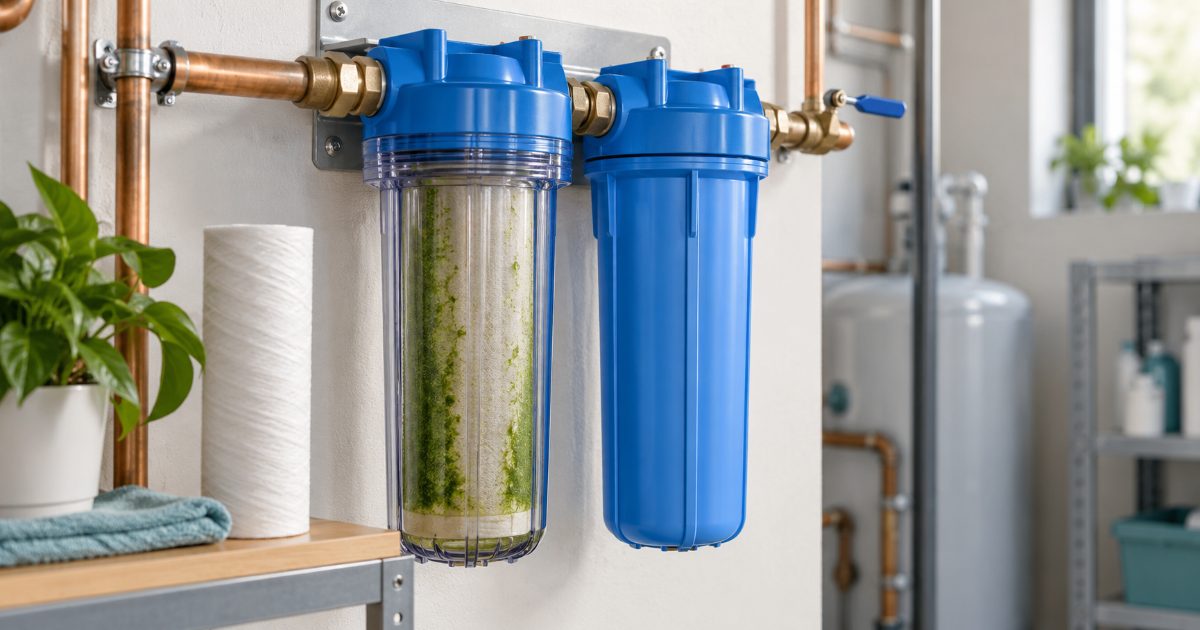
Green growth in a clear housing is algae on light: fit an opaque sump. Rusty or oily slime is iron bacteria: shock chlorinate at 200 ppm max per MDH.
- Verified
- Updated
- 9 min read
- 7 sources
Shop links on this page are affiliate links: a purchase may earn us a commission at no extra cost to you. Disclosure
Short answer
Green growth inside a clear sediment filter housing is algae, and algae needs light: a housing that shows you the cartridge also lets light reach it, so the fix is an opaque housing, not a finer cartridge. Rusty, yellow, brown or grey slime, feathery strands, or a rainbow oil-like sheen with a swampy odor is iron bacteria, and the Minnesota Department of Health says to shock chlorinate the well at close to but not above 200 parts per million. Black slime with a rotten-egg smell is sulfur bacteria, held on contact time, not ppm. Growth that appears only after a cartridge has run past its interval is biofilm on overdue media: iSpring’s listing rates the FP15B sediment cartridge at 3 to 6 months or 15,000 gallons. Small moving organisms are not screened by a coliform test, so photograph them for the state health department. On every row, start by replacing the cartridge, scrubbing the sump, and noting which side of the housing the growth is on.
Fact sheet
- Answer
- Green growth in a clear sediment housing is algae living on the light that passes through the wall, and the fix is an opaque housing. Rusty, yellow or grey slime with an oily sheen is iron bacteria, and the Minnesota Department of Health’s response is to shock chlorinate the well at close to but not above 200 ppm. The iron itself is judged against EPA’s secondary standard of 0.3 mg/L.
- Basis
- Minnesota Department of Health shock chlorination ceiling of 200 ppm; EPA secondary standards of 0.3 mg/L for iron and 0.05 mg/L for manganese. No EPA or NSF/ANSI figure exists for algae in a housing.
- Assumptions
- Private well water feeding a whole-house sediment housing that is clear or translucent and within reach of daylight or room light
- Iron bacteria and sulfur bacteria identified by the Minnesota Department of Health’s appearance list, not by a laboratory culture
- Cartridge intervals are the maker’s listing figures; a well with visible sediment shortens them
- UV is sized only after the water meets Viqua’s published pretreatment ceilings
- Method
- Figures read on 2026-09-13 from the Minnesota Department of Health, EPA, CDC and Viqua pages listed under sources, and from each Amazon listing’s title and description; nothing was tested.
- Primary source
- Minnesota Department of Health, Iron Bacteria in Well Water (government or regulatory source)
- Facts verified
- Last updated
- Cite as
- OwnerSpec, "Algae, slime or organisms inside a filter housing: what the growth is, and what stops it", https://ownerspec.com/water/guides/organisms-algae-or-growth-inside-filter-housing/, facts verified 13 September 2026.
Every figure above also appears, with its source, in the page below. All sources · How OwnerSpec verifies numbers
The picks
Growth appears only after the cartridge runs long
iSpring FP15B
5 micron polypropylene, 4.5 x 10 in, replace every 3 to 6 months or 15,000 gallons per iSpring's listing; first stage of the WGB21B
Replacing a lone clear housing with a two-stage system
iSpring WGB21B
Sediment FP15B plus carbon FC15B, 10 x 4.5 in housings, 1 in NPT ports, 50,000 gallons per the listing; housing opacity not stated on the listing, check the photos
Water that already meets Viqua's pretreatment ceilings
VIQUA VH410
14 gpm at 40 mJ/cm2 per Viqua's spec sheet, the industry's NSF/ANSI 55 Class A dose threshold, but this VH410 SKU carries no NSF/ANSI 55 listing itself; 9,000 hour lamp changed yearly; 3/4 to 1 in NPT
If the growth sits only on the lit side of the housing, you can stop reading about chlorine: the housing wall is the problem, and no cartridge rating on any listing fixes it.
What does the growth tell you?
A sediment filter housing is the sump that holds the cartridge, and a clear one is sold so the owner can watch the cartridge load up. The same wall that shows the cartridge shows it light, and the pattern of the growth is the first clue.
| Symptom | Likely cause | Confirm with |
|---|---|---|
| Green film or fuzz, worst on the side facing a window or a bulb | Algae growing on the light that passes through the clear wall | The light side is worse than the shaded side; no regulator publishes a number for this, and this page does not invent one |
| Sticky rusty, yellow, brown or grey slime, feathery strands, a rainbow oil-like sheen, a swampy or musty odor | Iron bacteria, per the Minnesota Department of Health’s appearance list | An iron test against EPA’s secondary standard of 0.3 mg/L, and the iron guide for the ferrous or ferric question |
| Black slime, rotten-egg odor at both hot and cold taps | Sulfur bacteria, covered on the rotten-egg smell guide | That guide’s hydrogen sulfide sourcing; EPA sets no limit for hydrogen sulfide |
| Growth that shows up only once the cartridge is well past its stated interval | Biofilm colonizing overdue media | The maker’s interval: 3 to 6 months or 15,000 gallons for the iSpring FP15B per its listing |
| Small moving specks, crustacean-like organisms or worms | Something entering past the well cap or screen; a coliform test does not screen for it | A photograph, a well-cap and vent-screen check, and the state health department. This page names no species |
Black stains without slime are a different page: the manganese guide covers EPA’s 0.05 mg/L secondary standard.
What do the numbers mean?
The Minnesota Department of Health’s iron bacteria page sets the shock chlorination dose at close to but not greater than 200 parts per million, and says a stronger dose reduces effectiveness rather than improving it. Shock chlorination is a one-time chlorine dose to the well and the plumbing, not a continuous feed; the shock chlorination guide has the procedure.
EPA’s secondary standards put iron at 0.3 mg/L, where it lists rusty color, sediment and reddish or orange staining, and manganese at 0.05 mg/L, where it lists black to brown color and black staining. Both are non-enforceable nuisance limits about appearance, which is exactly what a slimy housing is.
A coliform test is an indicator test: the Minnesota Department of Health says it is not practical to test water for every disease-causing microorganism, so the laboratory looks for the coliform group instead.
CDC’s annual private-well panel is total coliform, nitrates, total dissolved solids and pH, and it mentions no algae, insect or worm screen, so a clean result on the well test panel says nothing about what you can see in the sump.
No NSF/ANSI standard covers algae or visible organisms in a residential housing: 42 and 53 certify what a cartridge reduces, not what grows on it in sunlight. A coliform-positive result is a separate problem with its own page.
Which treatment class fits?
| Reading | Treatment class | Why |
|---|---|---|
| Algae, light side worse | Opaque housing, same 10 x 4.5 in or 20 in size | Excludes the light; a light-exclusion fix, not a filtration-rating one, and no standard certifies it |
| Iron bacteria slime | Shock chlorination at close to but not above 200 ppm, then treat the iron that remains | The Minnesota Department of Health’s dose; the leftover iron goes to the iron filter shortlist |
| Sulfur bacteria slime | Shock chlorination held on contact time, not a ppm ceiling | Pennsylvania DEP’s procedure on the rotten-egg smell guide: at least four hours, preferably overnight |
| Biofilm on an overdue cartridge | Replace on the maker’s interval and date the housing | 3 to 6 months or 15,000 gallons for the FP15B per iSpring’s listing, whichever comes first |
| Visible organisms | Fix the well cap or screen first; UV only after mechanical pretreatment | Viqua’s ceilings: turbidity under 1 NTU, suspended solids under 10 mg/L, iron under 0.3 mg/L, manganese under 0.05 mg/L, hardness under 7 gpg, UVT at least 95 percent, behind a 5 micron prefilter |
Every specification below is the maker’s published figure or the Amazon listing’s own title and description, read on 2026-09-13; nothing on this page was tested.
The opaque housing is the one product this wave could not verify. The Culligan WH-HD200-C is a clear sump per its listing, sold so you can “see your filter in action” with 1 in ports and the cartridge sold separately: it is the housing type that grows algae, not the fix, unless it hangs in a windowless room.
The 10 in cartridge compatibility page and the 20 in Big Blue page give the sizes an opaque replacement must match.
The iSpring WGB21B replaces a lone housing with two: a sediment FP15B and a carbon FC15B in 10 x 4.5 in housings, 1 in NPT ports, rated 50,000 gallons per the listing. The listing does not say whether the housings are opaque, so check the photos before ordering it for algae, and skip it if all you need is one sump.
The iSpring FP15B is the 5 micron polypropylene cartridge, 4.5 x 10 in, at 3 to 6 months or 15,000 gallons per the listing. It is nominal 5 micron, not absolute; the micron picker decides whether that matters for your sediment.
UV comes last. Viqua’s pretreatment page says turbidity and suspended solids absorb or scatter UV light, and iron and manganese collect on the quartz sleeve and foul it. That is why the ceilings above sit ahead of the lamp.
The VIQUA VH410 is rated 14 gpm at 40 mJ/cm2 per Viqua’s spec sheet, with a 9,000 hour lamp changed yearly. That dose is the industry’s NSF/ANSI 55 Class A threshold, but this VH410 SKU carries no NSF/ANSI 55 listing itself; the UV shortlist covers the Class A question and the lamp cross-reference covers lamps.
Skip UV if the water fails any ceiling, and do not buy it to clean out a housing: Viqua publishes no such use.
Before you buy anything
Do not order chlorine, a UV unit or a new system until two things are known: which side of the housing the growth is on, and the iron number. A lab iron result against EPA’s 0.3 mg/L standard, from the well test panel, separates algae on a clear wall from iron bacteria in the well, and only the second one needs the 200 ppm shock. The cheapest move on every row is the same: a fresh iSpring FP15B or whatever cartridge your housing takes, a scrubbed sump, and a date written on the housing.
What should you do first?
- Shut the inlet, drain the housing, and photograph the growth with the light source in the frame before you scrub anything.
- Scrub the sump, fit a new cartridge, write the date on the housing, and check it again in 2 weeks.
- If green comes back on the lit side, swap the clear sump for an opaque one of the same size or shade the housing.
- If rusty or grey slime comes back, get an iron result and run the shock chlorination at close to but not above 200 ppm. If black slime with a rotten-egg smell comes back, follow the contact-time procedure on the rotten-egg smell guide instead.
- If anything moves, check the well cap and vent screen and send the photograph to the state health department.
Frequently asked questions
Does a clean coliform result rule out algae or small organisms in a filter housing?
No. The Minnesota Department of Health describes total coliform as an indicator group, tested because it is not practical to test for every organism, and CDC's annual private-well panel is total coliform, nitrates, total dissolved solids and pH. Neither screens for algae, insects or worms. Something visible in the housing needs a photograph and a call to the state health department, not another coliform bottle.
What does iron bacteria slime look like, and what gets rid of it?
The Minnesota Department of Health lists sticky rusty, yellow, brown or grey slime, feathery filamentous growth, a rainbow oil-like sheen, and odors it calls swampy, oily, cucumber, sewage, rotten vegetation or musty. Its treatment is to clean the pump and casing, then shock chlorinate the well at close to but not greater than 200 parts per million, because a stronger dose reduces effectiveness.
Can a UV unit clear algae or organisms that are already growing in the housing?
Not as documented by the maker. Viqua ties UV performance to clarity: turbidity under 1 NTU and suspended solids under 10 mg/L, because those particles absorb or scatter UV light, plus iron under 0.3 mg/L, manganese under 0.05 mg/L, hardness under 7 gpg and UV transmittance of at least 95 percent. UV needs clean water ahead of it and is not published as a cleanup for a fouled housing.
Is there an EPA or NSF number for algae in a clear filter housing?
None. EPA's secondary standards cover iron at 0.3 mg/L and manganese at 0.05 mg/L, the two nuisance metals behind rust and black slime, but list nothing for algae. NSF/ANSI 42 and 53 certify what a cartridge reduces, not what grows on it in sunlight. An opaque housing is a light-exclusion measure, not a certified treatment class, so this page attaches no standard to it.
How often should a sediment cartridge be changed to stop biofilm?
Use the maker's interval, not the color of the cartridge. iSpring's listing for the FP15B 5 micron polypropylene cartridge says replace every 3 to 6 months or at 15,000 gallons, whichever comes first, and the same 10 in by 4.5 in cartridge is the first stage of its WGB21B system. A well that carries visible sediment reaches the gallon figure first, so date the housing at every change.
Sources
- Minnesota Department of Health, Iron Bacteria in Well Water (government or regulatory source)
- Minnesota Department of Health, Bacterial Safety of Well Water (government or regulatory source)
- EPA, Secondary Drinking Water Standards: Guidance for Nuisance Chemicals (government or regulatory source)
- CDC, Guidelines for Testing Well Water (government or regulatory source)
- VIQUA, UV Pretreatment (manufacturer or vendor document)
- VIQUA, Spec Sheet: VH150, VH200, VH410, VH410M (PDF) (manufacturer or vendor document)
- VIQUA, Owner's Manual MNL520104-EN, S2Q-PA / S5Q-PA / S8Q-PA family (PDF) (manufacturer or vendor document)