Reverse osmosis tank not filling or faucet running slow: the six causes, the check for each, and the pressure numbers that decide it
RO tanks stop filling below iSpring's 45 psi feed minimum or with precharge under 5 to 10 psi empty. Six causes, the gauge check for each, the fix.
- Verified
- Updated
- 8 min read
- 4 sources
Shop links on this page are affiliate links: a purchase may earn us a commission at no extra cost to you. Disclosure
Short answer
A reverse osmosis tank that never fills, or an RO faucet that only trickles, usually comes down to two pressures the owner has never measured. The first is feed pressure: iSpring’s owner’s manual sets a 45 psi minimum before a booster pump is needed, and APEC’s RO-TWIST manual says a non-pump system at 50 psi fills its 4-gallon tank only about 70 percent full. The second is the tank’s air precharge, read with a tire gauge on the Schrader valve with the tank empty: APEC specifies 5 to 7 psi and iSpring 7 to 10 psi. Below that, a tank can feel heavy and still deliver nothing. Only after both pressures check out do loaded prefilters (APEC: replace every 6 to 12 months), a spent membrane (12 to 24 months or 15 to 20 percent TDS creep), or an automatic shut-off valve that never sees a full-tank signal come into it. Measure first: a gauge costs less than any part.
Do not order a booster pump or a membrane yet: two gauge readings, one on the feed line and one on the tank’s air valve, settle the first three rows of the table below before any part changes hands.
What does the symptom tell you?
| Symptom | Likely cause | Confirm with |
|---|---|---|
| Faucet trickles and never gives a strong stream | Feed pressure under the maker’s minimum | Gauge the cold feed line: iSpring’s floor is 45 psi, APEC’s non-pump threshold is 50 psi |
| Tank never feels full, stays light after 2.5 hours | Feed pressure too low to fill against the tank’s air charge | APEC’s fill table for a 4-gallon tank: 70 psi or more gives 3.1 gallons, 60 psi 2.8, 50 psi 2.5, 40 psi 1.9 |
| Tank feels heavy but the faucet still runs weak | Air precharge bled off, nothing pushing the stored water out | Gauge the Schrader valve with the tank empty: 5 to 7 psi (APEC) or 7 to 10 psi (iSpring) |
| Flow faded over months, or right after a filter change | Prefilters loaded, or a new cartridge seated wrong, starving the membrane | APEC’s interval for stage 1 and 2 prefilters is 6 to 12 months, sooner on well water |
| Pressure and precharge check out, product TDS is rising | Membrane spent | APEC: replace at 12 to 24 months or when product TDS reaches 15 to 20 percent of feed; iSpring: 2 to 3 years |
| Drains to the sink without stopping, tank still empty | Automatic shut-off valve never sees a full-tank signal | iSpring: the valve closes only when tank pressure signals full; look for a kinked tank line or a collapsed precharge first |
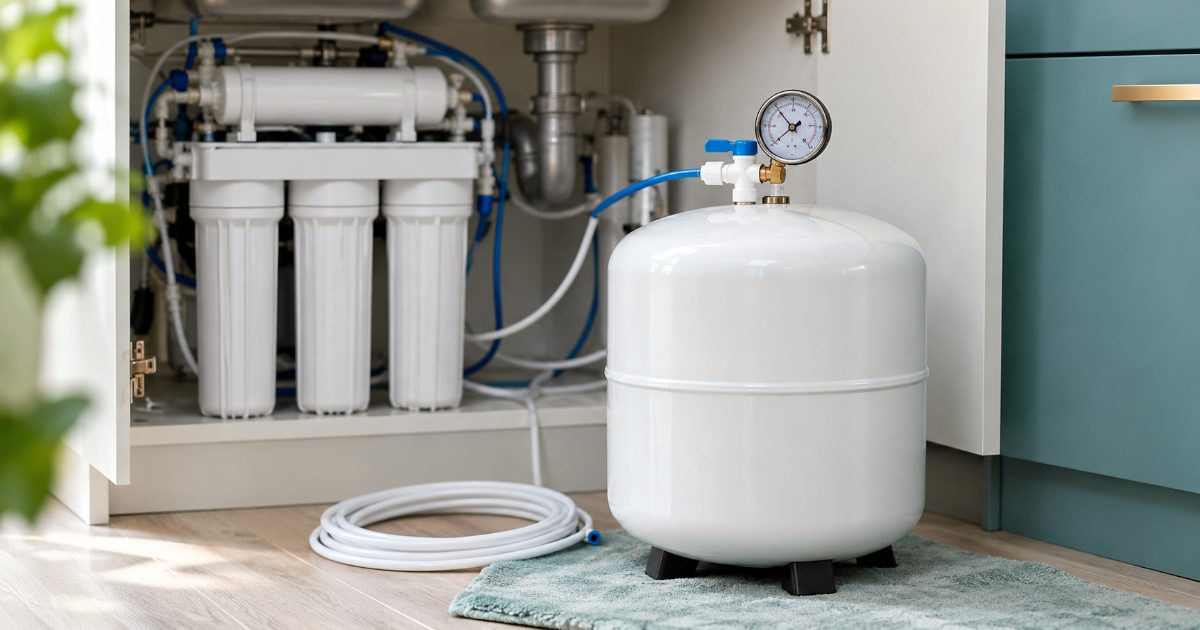
Precharge is the air pressure sealed behind the bladder inside the storage tank, and it is what pushes water to the faucet once the feed side shuts off. The automatic shut-off valve, called ASO or ASOV in both manuals, is the four-port valve that stops feed water once tank pressure reports full.
What do the pressure numbers mean?
There is no EPA or NSF/ANSI figure for RO feed pressure: these are manufacturer engineering specs, so the two owner’s manuals are the top source here. iSpring’s manual gives a working window of 45 to 70 psi, with a booster pump required below 45 and a pressure regulator required above 70. APEC’s RO-TWIST manual lists 85 psi as the operating maximum and calls anything below 50 psi insufficient for a non-pump system. Feed TDS has its own ceiling, 750 ppm for iSpring and 1,000 ppm for APEC, and water above it also slows fill.
The feed number matters twice. APEC rates its gallons-per-day output at 60 psi and 77 F, so a 40 psi feed produces slower, and per APEC’s table, fills a 4-gallon tank to only 1.9 gallons, about 50 percent. APEC adds that an ice maker needing 20 to 30 psi at its inlet needs at least 50 psi going into the RO system to see that.
The precharge number decides delivery, not production. APEC’s delivery table for the same 4-gallon tank runs from 50 psi at the faucet with 3.0 gallons stored down to 14 psi at 1.0 gallon and 5 psi at empty; a tank whose air charge has leaked out sits at the bottom of that table no matter how much water it holds.
Fill time is the quickest field check. APEC says a tank normally takes 1.5 to 2 hours; iSpring says 1.5 to 2.5 hours and names temperature (40 F to 100 F), TDS (up to 750 ppm) and feed pressure (45 to 70 psi) as the three things that stretch it. The RO GPD and tank size calculator turns those inputs into an expected daily output for your unit.
Which fix fits the confirmed cause?
| Cause confirmed | Fix | Number that decides it |
|---|---|---|
| Feed pressure below 45 psi | Diaphragm booster pump ahead of the membrane, such as the Aquatec 8800 booster pump kit | iSpring’s 45 psi floor; APEC’s 50 psi non-pump mark |
| Feed pressure above 70 psi | Pressure-reducing valve on the feed | iSpring’s 70 psi ceiling, regulator required above it |
| Precharge low, tank empty | Add air at the Schrader valve with a bicycle or tire pump, checked with a 0 to 15 psi tire gauge (skip if you already own a gauge that reads in 1 psi steps or finer) | 5 to 7 psi (APEC) or 7 to 10 psi (iSpring), tank empty |
| Prefilters loaded | Replace sediment and carbon prefilters | Every 6 to 12 months per APEC, sooner on well water |
| Membrane spent | Replace the membrane, matched on the 1812 membrane cross-reference | 12 to 24 months or 15 to 20 percent TDS creep (APEC); 2 to 3 years (iSpring) |
| ASO valve not closing | Straighten or reconnect the tank line, recharge the tank, then replace the valve if the feed still runs with the tank full | A working valve stops feed water once the tank reports full, per iSpring |
Two cautions before the first row. The booster pump fixes a pressure problem only: if the feed line already reads at or above the maker’s minimum, it will not help a loaded prefilter or a tired membrane, and the kit’s transformer and pressure switch have to be wired in. Aquatec’s own spec sheet for the CDP-8800 pump inside that kit rates output at 0.83 to 1.51 LPM against an 80 PSI discharge (1.89 to 2.35 LPM open flow, varying by pumphead model) and caps inlet pressure at 60 PSI maximum, but Aquatec, like both RO manuals, publishes no minimum inlet pressure for this pump, so this page does not state one. iSpring’s own PMP1000 booster pump, a different unit, does state a floor: 30 psi minimum working pressure.
On the precharge row, a coarse tire gauge cannot separate 5 psi from 7 psi; the listed gauge reads in 0.5 psi steps across 0 to 15 psi, which is the whole range this job uses. The storage tank replacement and precharge page has the by-maker table and what to do when a tank will not hold air at all.
Neither manual gives a numeric test for a failed ASO valve, so the last row stays a process of elimination: line straight, precharge in range, tank full, feed still running means the valve.
If the tank fills and the complaint is the drain running the whole time it does, that is normal: iSpring puts the ratio at approximately 3 parts drain to 1 part product water, and the RO waste water ratio guide covers what counts as excessive.
Before you buy anything
Do not buy a pump, a tank or a membrane until you have two numbers written down: feed pressure on the cold line and precharge on the empty tank. The Express Water RO pressure gauge reads 0 to 160 psi on a 1/4 in quick-connect tee, so it drops into the feed line without cutting tubing (skip it if you already own any 0 to 160 psi feed-line gauge with a quick-connect fitting); take the reading, then pull it back out, because a gauge left plumbed in is one more fitting that can leak. If the feed reads at or above your maker’s minimum (45 psi iSpring, 50 psi APEC) and the empty tank is inside your maker’s precharge band (5 to 7 psi APEC, 7 to 10 psi iSpring), the pump is the wrong purchase and the prefilters or membrane are next on the list.
What should you do first?
- Gauge the feed line at the RO inlet; below 45 psi (iSpring) or 50 psi (APEC), the fix is pressure, not filters.
- Drain the tank at the faucet until it stops, then gauge the Schrader valve and bring it to 5 to 7 psi (APEC) or 7 to 10 psi (iSpring).
- Close the tank valve, note the time, and check fill in 1.5 to 2.5 hours; a light tank after that points at prefilters.
- Read product and feed TDS with one meter; at 15 to 20 percent of feed, APEC says the membrane is due. The TDS meter guide explains the reading.
- If the feed still runs with the tank full and the line to the ASO valve is straight, replace the valve.
Frequently asked questions
What is the minimum water pressure a reverse osmosis system needs to fill its tank?
iSpring's owner's manual states a minimum of 45 psi and says a booster pump is necessary below that to raise incoming pressure and improve RO efficiency. APEC's RO-TWIST manual lists insufficient pressure as below 50 psi for non-pump systems and gives the same fix: raise house pressure or add a pump. APEC rates its GPD figures at 60 psi and 77 F, so lower feed pressure means slower production too.
What should an empty RO storage tank's air precharge read?
Read it with the tank empty, on the Schrader valve under the tank's cap, using a low-range tire gauge. APEC's troubleshooting table says to raise tank air pressure to 5 to 7 psi when precharge is low, and iSpring's manual says an empty tank should read between 7 and 10 psi. A tank with water still in it reads water pressure instead, so drain it at the faucet first.
How long should a reverse osmosis tank take to fill after new filters or a new install?
APEC's manual says the tank normally takes 1.5 to 2 hours to fill. iSpring gives 1.5 to 2.5 hours and names the three variables: water temperature between 40 F and 100 F, with warmer faster; feed TDS up to 750 ppm, with lower faster; and incoming pressure between 45 and 70 psi, with higher faster. A tank still light after 2.5 hours points at one of those three.
Why does a reverse osmosis system drain constantly instead of filling the tank?
iSpring's manual describes the automatic shut-off valve as closing the feed only when a pressure signal from a completely full tank reaches it. A kinked or disconnected tank line, a tank whose air charge has collapsed so it never reads full, or a valve that has failed all leave the feed open, so the membrane keeps sending roughly 3 parts to drain for every 1 part of product water.
How often do RO prefilters and the membrane need replacing?
APEC's schedule is stages 1 and 2 prefilters every 6 to 12 months, sooner on private well water, and the stage 3 membrane every 12 to 24 months or when product water TDS creeps up to 15 to 20 percent of feed TDS. iSpring puts the membrane at every 2 to 3 years, or sooner if TDS starts rising. A TDS meter is the only way to know which applies.
Fact sheet and how to cite this page
- Answer
- A reverse osmosis tank that will not fill, or an RO faucet that trickles, is a feed-pressure or tank-precharge fault until a gauge says otherwise. iSpring’s owner’s manual sets a 45 psi feed minimum before a booster pump is required, and APEC’s manual calls out 50 psi as the non-pump threshold. An empty tank’s air precharge should read 5 to 7 psi per APEC or 7 to 10 psi per iSpring.
- Basis
- Manufacturer engineering specs, not a regulated limit: minimum feed pressure and empty-tank precharge from the iSpring and APEC RO owner’s manuals. No EPA or NSF/ANSI number governs RO feed pressure.
- Assumptions
- Under-sink RO system with a bladder storage tank and an automatic shut-off valve, no booster pump fitted
- Feed water inside the maker’s TDS limit, 750 ppm for iSpring and 1,000 ppm for APEC, and near the 77 F rating temperature
- Tank precharge is read with the tank empty, since a tank with water in it reads the water pressure, not the air charge
- Method
- Feed pressure floors, precharge ranges, fill times, fill-by-pressure table and service intervals read from the APEC RO-TWIST and iSpring RO owner’s manuals on 2026-09-15; nothing was tested.
- Primary source
- iSpring Water Systems, Reverse Osmosis Water Filtration Systems Installation Instructions and Owner's Manual (retailer listing or retailer-hosted document)
- Facts verified
- Last updated
- Cite as
- OwnerSpec, "Reverse osmosis tank not filling or faucet running slow: the six causes, the check for each, and the pressure numbers that decide it", https://ownerspec.com/water/guides/reverse-osmosis-slow-flow-tank-not-filling/, facts verified 15 September 2026.
Every figure above also appears, with its source, in the article. All sources · How OwnerSpec verifies numbers
Sources
- iSpring Water Systems, Reverse Osmosis Water Filtration Systems Installation Instructions and Owner's Manual (retailer listing or retailer-hosted document)
- APEC Water Systems, RO-TWIST Installation Instruction and Owner's Manual (retailer listing or retailer-hosted document)
- Aquatec, 8800 Series 24VDC Booster Pump Performance Data Sheet (manufacturer or vendor document)
- iSpring Water Systems, PMP1000 Water Booster Pump product page (manufacturer or vendor document)