Reverse osmosis waste water ratio: what the NSF/ANSI 58 efficiency and recovery ratings mean, and where whole-house RO reject water goes
Under-sink RO wastes 4 to 5 gallons per gallon made per APEC. Whole-house RO reject should not go to a septic system, per UMN Extension.
- Verified
- Updated
- 7 min read
- 5 sources
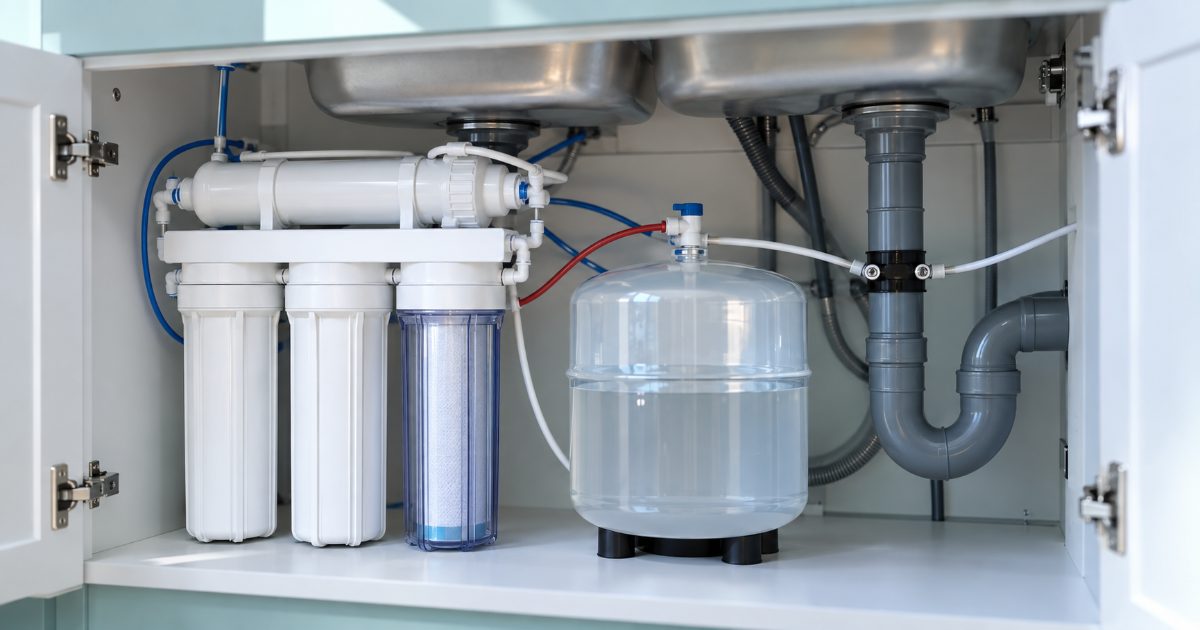
Shop links on this page are affiliate links: a purchase may earn us a commission at no extra cost to you. Disclosure
Short answer
A standard under-sink reverse osmosis system sends 4 to 5 gallons to the drain for every gallon of drinking water it makes, per APEC’s own waste-water ratio test of its RO-45 and RO-90 membranes, and EPA WaterSense describes a typical point-of-use unit as producing 5 or more gallons of concentrate per gallon of permeate. NSF/ANSI 58 defines two labels for this: the efficiency rating and the recovery rating, and the efficiency figure can never exceed the recovery figure. ASSE 1086-2020 sets the high-efficiency bar at 40 percent recovery, which is 1.5 gallons wasted per gallon made. A non-electric permeate pump such as the Aquatec ERP-500 drops a tank system below 3:1 on membranes up to 50 GPD, per Aquatec. Whole-house RO is a different problem: University of Minnesota Extension rates point-of-entry units 50 to 75 percent efficient, but the reject scales with the whole house’s water use and should not go into a septic system. Read the label’s ratio direction first.
If the drain line only runs while the tank refills and stops within an hour or two, the unit is working as rated and you can leave now.
A 4:1 ratio on a family that drinks 4 gallons a day is 16 gallons to the drain per day, and nothing on this page will change that number much.
What does the symptom tell you?
The waste-to-product ratio is the number of gallons an RO system sends to drain for every gallon of treated water it produces, per the NSF/ANSI 330 definition EPA WaterSense quotes; 2.3:1 and 2.3 mean the same thing.
| Symptom | Likely cause | Confirm with |
|---|---|---|
| Drain line runs for an hour or two after each draw, then stops | Normal: APEC’s test puts an unassisted under-sink membrane at 4:1 to 5:1 | The rated ratio on the spec sheet; a bucket under the drain saddle for one tank refill |
| Drain line never stops | Automatic shutoff valve or check valve failed, or a tank that no longer holds pressure | Close the tank valve: if the drain keeps running, the shutoff valve is at fault; see the storage tank page |
| Water bill jumped after installing RO on a city supply | Expected at 5:1 or worse, the baseline EPA WaterSense set out to beat | Multiply daily drinking-water draw by the rated ratio; compare with the bill |
| Ratio measured worse than the spec sheet, output slow | Fouled membrane or low inlet pressure | Inlet pressure gauge, then the RO sizing calculator for the pressure and temperature correction |
| Spec sheet says “3:1” and the bucket says the opposite | Ratio direction: Waterdrop’s G3P800 prints 3:1 as pure-to-drain, one cup wasted per three made | Read whether the maker’s ratio is product-to-waste or waste-to-product |
What does the number mean?
NSF/ANSI 58 is the standard for point-of-use reverse osmosis systems; EPA WaterSense’s specification deck records that it requires 75 percent TDS reduction and defines both an efficiency rating and a recovery rating.
Per that summary the efficiency rating cannot exceed the recovery rating, and NSF’s own standard text was not readable this session, so those are EPA’s words. The NSF/ANSI standards guide covers what the rest of the mark means.
Recovery is the share of feed water that becomes treated water. ASSE 1086-2020 sets a minimum system recovery of 40 percent for a high-efficiency point-of-use RO, tested to NSF/ANSI 58, per the same EPA deck; 40 percent recovery is 60 gallons to drain per 40 made, or 1.5:1.
Converting the makers’ ratios the same way, this page’s arithmetic: APEC’s 4:1 is 20 percent recovery and 5:1 is 16.7 percent. University of Minnesota Extension’s onsite program describes a typical point-of-use RO as 10 to 20 percent efficient, generating 4 to 9 or more gallons of reject per gallon of permeate.
Pressure is the other lever. The membrane needs feed pressure to push permeate through, and a tank system loses that as the tank fills against its own precharge, which is why the sizing calculator corrects rated GPD for inlet psi. No source read for this page publishes a ratio-versus-psi table, so this page does not print one.
Which treatment class fits?
| Configuration | Published waste-to-product ratio | Why, and who should skip it |
|---|---|---|
| Standard under-sink tank RO (APEC RO-45 and RO-90 class) | 4:1 to 5:1 per APEC’s waste-ratio test | Skip on a low-yield well or a septic system near capacity |
| Tank RO plus a non-electric permeate pump (Aquatec ERP-500 ) | Below 3:1 from a 10:1 start, membranes up to 50 GPD, per Aquatec | Does nothing on a tankless unit; the water-saving claim is the maker’s, since EPA WaterSense excludes permeate pumps from its specification |
| Tankless high-efficiency RO (Waterdrop G3P800 class) | 3:1 pure-to-drain, one gallon wasted per three made, up to 800 GPD per Waterdrop | Needs mains power; the tankless RO review compares the class |
| ASSE 1086-2020 listed high-efficiency point-of-use RO | 40 percent recovery or better, 1.5:1 or better, per EPA WaterSense | Look for the ASSE 1086 listing on the maker’s page, not the word “efficient” in the title. Skip if the maker’s page does not show the listing |
| Whole-house (point-of-entry) RO | 50 to 75 percent efficient per University of Minnesota Extension; reject scales with total household use | Confirm the local onsite-wastewater code and well yield before buying. Skip it if the only drain is a septic system, which the same source says should not take POE reject |
The permeate pump uses the pressure of the reject stream to push permeate into the tank, so the membrane no longer works against tank back-pressure; Aquatec rates the ERP-500 for membranes up to 50 GPD and it fits nothing bigger. A tankless unit has no tank to push against, which is why the pump does not apply there.
A whole-house unit is where the reject question becomes a plumbing and code question. Its reject runs against every gallon the house uses, not one faucet’s, and EPA WaterSense defines a point-of-entry RO system as one with a clean-system flow of at least 4.0 gallons per minute at 15 psi drop.
Where that reject goes is a sewer, the septic system, or a separate route such as irrigation or its own trench, and the septic system is the one to check.
University of Minnesota Extension’s onsite sewage program says a working under-sink unit should not overburden a septic system. A point-of-entry system, even at the 50 to 75 percent efficiency the same source gives the class, will likely create a load the septic system was not designed for, and its reject should not go there.
The same source says a wastewater professional should know the reject volume and what it carries before sending it to irrigation or a separate trench. Local codes differ, so the health department, not the maker’s plumbing diagram, decides.
On a private well the reject also adds continuous draw on top of household demand. No extension source read this session ties a gallons-per-minute figure to pump wear, so this page states the mechanism only: a well without a documented sustainable yield, and a pump sized without the reject, is a poor fit.
The well water test panel and arsenic guide cover why a household on a well is considering RO in the first place.
Before you buy anything
Do not buy a permeate pump, a tankless unit or a whole-house RO to fix a waste number you have not measured. Put a bucket under the drain saddle for one full tank refill and compare the gallons collected with the gallons the tank holds: that ratio is your spec. If it reads 4:1 to 5:1 on a tank system rated for 50 GPD or less, the Aquatec ERP-500 is the cheapest lever, and its below-3:1 figure is Aquatec’s own, unverified by any third party. If it reads far worse than the spec sheet, the membrane or the shutoff valve is the problem and no pump fixes that. If the drain goes to a septic tank, ask the health department before anything else.
What should you do first?
- Read the spec sheet’s ratio and note which direction it runs, waste-to-product or pure-to-drain.
- Collect one tank refill’s drain water in a bucket and divide by the tank’s usable volume.
- Multiply the household’s daily drinking-water draw by that ratio; at 4 gallons a day and 5:1 that is 20 gallons a day to the drain.
- If the drain reaches a septic system, check the state onsite-wastewater code and call the local health department.
- Fix a ratio that reads worse than the spec sheet before buying anything to reduce it.
Frequently asked questions
What counts as a good waste-to-product ratio for an under-sink reverse osmosis system?
APEC's own waste-ratio test puts a standard under-sink membrane at 4:1 to 5:1, four to five gallons to the drain per gallon made, and EPA WaterSense calls 5 or more typical. ASSE 1086-2020 certifies a high-efficiency point-of-use system at 40 percent recovery or better, which is 1.5:1 or better. Anything worse than about 5:1 on a unit rated lower suggests a fouled membrane.
Does a permeate pump actually cut reverse osmosis waste water?
Aquatec's ERP-500 copy, as reprinted by US Water Systems, says a system that needs 10 gallons of tap water per gallon of pure water should drop below 3:1 with the pump fitted, on membranes rated up to 50 GPD. The pump is non-electric. EPA WaterSense excludes companion devices such as a permeate pump from its RO specification, so that figure is the maker's own, not third-party certified.
Can reverse osmosis reject water go into a septic system?
It depends on the system type. University of Minnesota Extension's onsite sewage program says an under-sink point-of-use RO should not overburden a septic system unless it malfunctions. Whole-house point-of-entry reject is different: the same source says it will likely create a load the septic system was not designed for and should not be connected to it. Ask the local health department before plumbing a drain.
Is whole-house RO more efficient than under-sink RO?
Per gallon, yes. University of Minnesota Extension puts a typical point-of-use RO at 10 to 20 percent efficient, 4 to 9 or more gallons of reject per gallon made. Point-of-entry systems often add booster pumps or recirculate concentrate and reach 50 to 75 percent. The reject still runs against every gallon the house uses, so the daily volume is far larger.
Is the NSF/ANSI 58 efficiency rating the same as the recovery rating?
No. NSF/ANSI 58 defines both, and EPA WaterSense's summary of the standard states that the efficiency rating cannot exceed the recovery rating. Both are percentages of feed water that become treated water; a 40 percent recovery means 60 percent goes to drain, 1.5 gallons per gallon made. NSF's own standard text was not readable this session, so the definitions here are as EPA summarises them.
Fact sheet and how to cite this page
- Answer
- A standard under-sink reverse osmosis system sends 4 to 5 gallons to the drain per gallon of drinking water per APEC’s own waste-ratio test, and EPA WaterSense describes a typical unit as producing 5 or more. A non-electric permeate pump drops that below 3:1 on membranes up to 50 GPD per Aquatec. University of Minnesota Extension says whole-house RO reject should not go into a septic system.
- Basis
- NSF/ANSI 58 defines the efficiency rating and recovery rating; ASSE 1086-2020 sets a minimum recovery of 40 percent for a high-efficiency point-of-use RO, per EPA WaterSense’s specification deck.
- Assumptions
- Ratios are makers’ published figures under NSF/ANSI 58 test conditions, not field measurements
- Waste-to-product is expressed as gallons wasted per gallon of treated water, the NSF/ANSI 330 definition
- The 4 gallons per day household demand is ready.gov’s 1 gallon per person, 4 people, as used on the RO sizing calculator
- Method
- Ratios and definitions from EPA WaterSense’s December 2024 stakeholder deck, APEC’s waste-ratio article, Waterdrop’s G3P800 page and Aquatec’s ERP-500 copy; septic guidance and point-of-entry efficiency from University of Minnesota Extension, all read on 2026-09-14; nothing was tested.
- Primary source
- EPA WaterSense, Point-of-Use Reverse Osmosis Systems: Specification Overview and Certification Process (stakeholder presentation, 17 December 2024) (government or regulatory source)
- Facts verified
- Last updated
- Cite as
- OwnerSpec, "Reverse osmosis waste water ratio: what the NSF/ANSI 58 efficiency and recovery ratings mean, and where whole-house RO reject water goes", https://ownerspec.com/water/guides/reverse-osmosis-waste-water-ratio-and-drain/, facts verified 14 September 2026.
Every figure above also appears, with its source, in the article. All sources · How OwnerSpec verifies numbers
Sources
- EPA WaterSense, Point-of-Use Reverse Osmosis Systems: Specification Overview and Certification Process (stakeholder presentation, 17 December 2024) (government or regulatory source)
- APEC Water Systems, Waste Water Ratio Test: Importance, Methods, and Results (manufacturer or vendor document)
- Waterdrop, G3P800 tankless reverse osmosis system product page (pure-to-drain ratio, 800 GPD) (manufacturer or vendor document)
- US Water Systems, Aquatec ERP-500 non-electric permeate pump product page (reprinting Aquatec's specification) (manufacturer or vendor document)
- University of Minnesota Extension, Onsite Sewage Treatment Program, Reverse osmosis (RO) and septic systems (university or extension service)