Salt-free water conditioner vs softener: what each changes, what it certifies, and which fits your water
An NSF/ANSI 44 softener drops hardness under 1 gpg. A TAC salt-free conditioner leaves it unchanged; its only pass mark is IAPMO Z601's 70% less-scale test.
- Verified
- Updated
- 7 min read
- 13 sources
Shop links on this page are affiliate links: a purchase may earn us a commission at no extra cost to you. Disclosure
Short answer
A salt-free water conditioner and a water softener do not do the same job. An ion-exchange softener, the device class NSF/ANSI 44 covers, removes calcium and magnesium and delivers water under 1 grain per gallon (gpg), that standard’s definition of soft. A template-assisted crystallization (TAC) conditioner leaves the hardness in the water, so a test strip reads the same before and after. NSF/ANSI 44 does not cover TAC and no NSF/ANSI performance standard exists; the only pass mark is IAPMO/ANSI Z601, at least 70 percent less scale in a water heater than an untreated control. The Arizona State University bench study for the WateReuse Research Foundation measured more than 88 percent less scale from one TAC unit over 21 days at 80°C, then stated there is no method to confirm a unit is working in a house. Municipal water at 7 to 15 gpg with iron under 0.3 mg/L fits a conditioner; over 15 gpg, or with any iron above 0.3 mg/L, fits a softener.
The line in the table below that surprises people: a conditioner working exactly as designed still tests hard, so the strip that picks the device can never tell you whether it is doing anything.
What does each device change, and what does it leave alone?
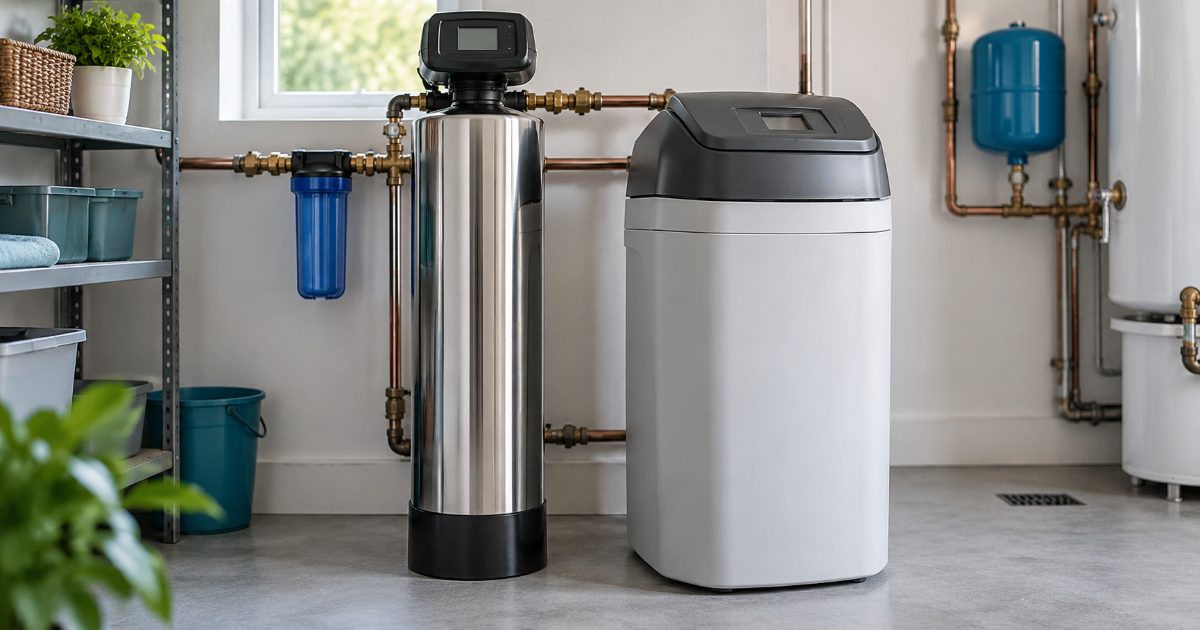
Ion exchange swaps the calcium and magnesium in the water for sodium or potassium held on a resin bed, then flushes the bed with brine to reload it.
Template-assisted crystallization is a media bed that gives dissolved hardness a surface on which to form microscopic crystals that travel with the flow instead of bonding to a heater element. The calcium and magnesium stay in the water: Aquasana’s product page states its conditioner does not reduce hardness or TDS.
| What you measure or notice | Ion-exchange softener (NSF/ANSI 44) | TAC conditioner (no NSF/ANSI performance standard) |
|---|---|---|
| Hardness on a strip or lab report | Drops to under 1 gpg, the NSF/ANSI 44 threshold for soft water | Unchanged; Aquasana: does not reduce hardness or TDS |
| Scale in the water heater and pipes | Stops forming, because the minerals that form it are gone | Reduced; IAPMO/ANSI Z601 pass mark is at least 70 percent less than an untreated control, and the ASU bench test measured more than 88 percent for one unit |
| Soap, detergent, spotting on glass | Soft-water behaviour | Hard-water behaviour; the minerals that react with soap are still present |
| Sodium in the water | About 8 mg/L added per gpg removed (NDSU Extension); potassium chloride is the alternative NSF/ANSI 44 also covers | Nothing added |
| Drain and septic load | Brine discharge on every regeneration | None; no backwash, no drain line |
| Consumables | Salt: 3.0 to 15.0 lb per cycle for a 1.0 cu ft Fleck 5600SXT, depending on the programmed dose (Pentair data sheet) | Media tank: Aquasana rates its tank at 1,000,000 gallons or 10 years |
| Outdoor taps and toilets | Penn State Extension suggests plumbing them to bypass the softener | Whole-house, nothing to bypass |
| Iron and pH window | Penn State: dissolved iron under 5 mg/L, hardness 3 to 20 gpg, pH above 6.7 | Aquasana: iron under 0.3 mg/L (written as 0.3 ppm), hardness under 15 gpg, alkalinity under 250 mg/L, pH under 8.3 |
| Install position | Cold line, before the heater | Aquasana manual: upright, cold line only, before the heater, 40 to 90°F, 20 to 100 psi |
The table cannot fill in the appliance warranty row. If a heater or dishwasher manual conditions its warranty on a maximum hardness, only a softener changes that number.
What does each certification actually certify?
NSF/ANSI 44 sets the requirements for residential cation exchange softeners regenerated with sodium or potassium chloride: hardness reduction, rated capacity, salt efficiency and rated service flow. A TAC conditioner is not cation exchange, so NSF/ANSI 44 cannot apply to it.
Some conditioners carry NSF/ANSI/CAN 61. That certifies that components do not leach contaminants into the water: a materials mark, silent on scale.
The only pass-or-fail performance test for this device class is IAPMO/ANSI Z601, scoped to residential water heating. It sets the requirement at at least 70 percent less scale in the water heater and downstream piping than an untreated control.
Marketing copy also cites DVGW W512. Read that as the German test protocol the ASU study followed, not a certificate on the tank in front of you.
Neither Aquasana’s EQ-AST-WH manual nor SpringWell’s FutureSoft manual prints a certification number or a hardness limit.
What did the Arizona State study show, and what did it not?
The study behind most TAC claims is Evaluation of Alternatives to Domestic Ion Exchange Water Softeners, by Peter Fox of Arizona State University for the WateReuse Research Foundation (WRRF-08-06). The report carries a 2014 copyright; the testing is usually dated 2011. Its funders included the U.S. Bureau of Reclamation and the California State Water Resources Control Board.
It ran TAC and four other device types, electromagnetic and electrically induced precipitation among them, against untreated controls, using the DVGW-W512 protocol, on Tempe tap water, Colorado River water and Scottsdale groundwater.
The headline results are real. TAC reduced scale by more than 88 percent (Conclusions: more than 90); electromagnetic and electrically induced precipitation devices managed approximately 50 percent; the range across every device was 46 to 99 percent.
The limits are in the same document:
- One TAC product from one vendor was tested, not the category.
- Each run was 21 days and 700 gallons, in a bench rig, not a house.
- The protocol runs at 80°C, above the roughly 60°C of a domestic water heater.
- Scale type changed with the water: calcite on Tempe and Colorado River water, aragonite on Scottsdale groundwater.
- The Recommendations section states there is no method for assessing whether a physical water treatment device is working other than observing scale formation, and calls for an ANSI certification protocol. IAPMO/ANSI Z601 is the closest thing that exists; NSF has published none.
Which one fits your water?
USGS puts 1 gpg at 17.1 mg/L, and Penn State Extension puts the practical scaling line at 7.0 gpg (120 mg/L).
| Your reading | Fit | Why |
|---|---|---|
| Municipal water under 7 gpg | Probably neither | Penn State: major scaling is unlikely below 7.0 gpg (120 mg/L); start with the white scale guide |
| Municipal water 7 to 15 gpg, iron under 0.3 mg/L, the complaint is heater and fixture scale | TAC conditioner | Inside Aquasana’s stated window; no salt, no drain, no sodium; accept that no strip confirms it |
| Municipal water above 15 gpg | Softener | Above the conditioner’s stated hardness ceiling |
| Any water where soap use, glass spotting or a soft-water warranty spec is the goal | Softener | Only ion exchange changes the gpg |
| Well water over 7 gpg, dissolved iron 0.3 to 5 mg/L, pH above 6.7 | Softener with compensated hardness | Penn State’s window; iron above 0.3 mg/L exceeds Aquasana’s limit and EPA’s secondary standard for iron |
| Well water with iron above 5 mg/L, or orange at the tap | Iron filter first, then decide | See iron in well water; that iron plugs both device classes |
| Septic or a drain restriction on brine | TAC conditioner, or a softener on potassium chloride | NDSU: about 8 mg/L sodium per gpg removed on sodium chloride; NSF/ANSI 44 covers potassium regeneration |
Before you buy either
Do not buy a conditioner or a softener until you have a hardness number, and on a well an iron number too. The device decision sits on two lines, 7 gpg and 15 gpg, and a WaterWorks 481108 total hardness strip has colour blocks at 0, 2, 5, 7, 11, 15, 25 and 58 gpg, so it lands on both. If the strip reads over 15, or the lab shows iron above 0.3 mg/L, buy a metered softener such as the Fleck 5600SXT 32,000 grain , sized with the softener size calculator before you order. If it reads 7 to 15 with no iron, a conditioner may be all you want, knowing nothing on the shelf will prove it is working.
What should you do first?
- Dip a hardness strip in cold water and read gpg: under 7, Penn State says major scaling is unlikely, so neither device is urgent.
- On a well, get iron, pH and alkalinity from a certified-lab panel before choosing: the conditioner’s window is iron under 0.3 mg/L and pH under 8.3.
- At 7 to 15 gpg with no iron and only scale to fix, choose a conditioner, look for an IAPMO/ANSI Z601 listing rather than an NSF/ANSI 61 mark, and plan to inspect the heater element in a year.
- Above 15 gpg, with iron, or when soft-water behaviour is the point, size a softener with the calculator and program compensated hardness if there is iron.
- Keep the strip: it is the only way to check a softener, and the reminder that it cannot check a conditioner.
Frequently asked questions
Does a salt-free water conditioner make water soft?
No. Template-assisted crystallization leaves the calcium and magnesium in the water, so a hardness strip reads the same before and after the tank. Aquasana's own product page says its conditioner does not reduce hardness or TDS. Soft water, under NSF/ANSI 44, means under 1 grain per gallon, and only a cation exchange softener, the device class that standard covers, delivers that number.
Is there an NSF certification for salt-free water conditioners?
Not for performance. NSF/ANSI 44 covers cation exchange softeners regenerated with sodium or potassium chloride, which a TAC unit is not. NSF/ANSI 61 certifies that materials do not leach contaminants and says nothing about scale. The only pass mark written for this device class is IAPMO/ANSI Z601: at least 70 percent less scale in a water heater and downstream piping than an untreated control.
How can I tell if my salt-free conditioner is working?
Only by watching for scale. The Arizona State University study for the WateReuse Research Foundation stated in its recommendations that there is no method for assessing whether a physical water treatment device is working other than observing scale formation. A hardness strip cannot show it, because the hardness is unchanged by design. Pull the water heater's anode or element after a year and compare.
Can I use a salt-free conditioner on well water?
Inside narrow limits. Aquasana lists hardness below 15 grains per gallon, alkalinity under 250 mg/L, pH below 8.3 and iron under 0.3 mg/L as its conditioner's operating window. SpringWell's FutureSoft manual says not to install on well water without speaking to customer service first. Iron above 0.3 mg/L, which is where EPA's secondary standard sits, is a softener or iron-filter question.
Which needs less upkeep, a softener or a conditioner?
The conditioner, by a wide margin. It has no brine tank, no regeneration cycle and no drain line; Aquasana rates its tank at 1,000,000 gallons or 10 years. A softener needs salt on every regeneration: Pentair's data sheet for a 1.0 cubic foot Fleck 5600SXT lists 3.0 to 15.0 lb per cycle by programmed dose, and NDSU Extension puts the added sodium at about 8 mg/L per grain removed.
Sources
- NSF, NSF/ANSI 44 Technical Requirements
- NSF, NSF/ANSI/CAN 61 Certification for Your Drinking Water Components
- IAPMO, IAPMO/ANSI Z601-2018 (R2023) Scale Reduction Devices
- WateReuse Research Foundation / Arizona State University, Evaluation of Alternatives to Domestic Ion Exchange Water Softeners, WRRF-08-06 (PDF)
- NDSU Extension, Water Softening (Ion Exchange)
- Penn State Extension, Water Softening
- Penn State Extension, Iron and Manganese in Private Water Systems
- USGS Water Science School, Hardness of Water
- EPA, Secondary Drinking Water Standards: Guidance for Nuisance Chemicals
- Aquasana, Salt-Free Water Conditioner product page
- Aquasana, Whole House Salt-Free Water Conditioner Owner's Manual EQ-AST-WH (PDF)
- SpringWell Water Systems, FutureSoft FS1/FS4 Installation Instructions (PDF)
- Pentair, Fleck 5600SXT Softener System Operation Manual and Performance Data 4005293 (PDF)