Sediment and turbidity in well water: what the cloudiness is, and which filter stops it
Cloudy well water above 5 NTU shows in a glass (NDSU); UV needs under 1 NTU (VIQUA). Sand: a spin-down screen. Silt and clay: a 5 micron pleated cartridge.
- Verified
- Updated
- 8 min read
- 10 sources
Shop links on this page are affiliate links: a purchase may earn us a commission at no extra cost to you. Disclosure
Short answer
Cloudy, gritty or hazy well water is suspended particles, measured as turbidity in nephelometric turbidity units (NTU). No federal limit applies to a private well. EPA’s Surface Water Treatment Rule sets 0.3 NTU in 95% of monthly samples and never above 1 NTU, but only for public systems on surface water; NDSU Extension says water systems aim for 1 turbidity unit and that above 5 units the cloudiness is visible in a glass. Particle size picks the filter. Sand stops at a spin-down screen (Rusco’s 100 mesh screen is 150 micron), silt at a 20 to 50 micron pleated cartridge, clay at 5 micron or finer: NDSU Extension rates a drilled well at 10 to 15 micron and a dug or bored well at 2 micron. Every stage downstream depends on this one: VIQUA’s UV owner’s manual requires under 1 NTU and a 5 micron sediment filter ahead of the lamp. First, fill a glass, let it stand an hour, and read what settles.
If the glass turns clear from the bottom up within a minute or two, close this page: that milkiness is air from the pump or the water heater, not turbidity, and no filter changes it.
What does the cloudiness tell you?
A glass of cold water left on the counter sorts the causes before a lab does. What settles, how fast it settles, and what colour it is each point at a different row.
| What you see | Likely cause | Confirm with |
|---|---|---|
| Grit in faucet aerators, sand in the toilet tank, a crunch underfoot in the shower | Sand: 50 to 2,000 micron on the USDA particle scale, coarse enough for a spin-down screen | The glass drops a visible layer within seconds; a spin-down screen fills between flushes |
| Haze that settles within a few hours into a fine, smooth layer | Silt: 2 to 50 micron on the USDA scale | The glass is clear on top after standing; a lab turbidity result |
| Haze that never settles, even overnight | Clay: under 2 micron on the USDA scale. NDSU Extension says dug and bored wells often carry it | Lab turbidity above NDSU’s 5 unit visible threshold with nothing on the bottom of the glass |
| Milky white water that clears from the bottom up in a minute or two | Air, from a pump drawing the well down, a suction fitting leaking air, or a water heater | Watch the glass: air clears upward and leaves nothing behind |
| Orange or brown haze that settles to a rust-coloured layer | Ferric iron above EPA’s 0.3 mg/L secondary standard, which lists sediment among iron’s effects | A lab iron result; then the iron guide |
| Black flecks or a black film that settles | Manganese above EPA’s 0.05 mg/L secondary standard | A lab manganese result; then the manganese guide |
| Yellow to tea-coloured tint that does not settle and does not filter out | Tannins, dissolved organics rather than particles | The tannins guide; a sediment filter changes nothing |
| Grit that began after a pump change, well work or a dry summer | A disturbed well: a pump set lower, a damaged well screen, or a water table drawn down to the sand | Ask the driller before buying a filter; the filter only catches what the well keeps sending |
What does NTU mean, and is there a limit?
Turbidity is the cloudiness of water, measured by how much a beam of light scatters off the particles in it, in nephelometric turbidity units (NTU). It counts every particle at once, so it says how cloudy the water is, not what the particles are.
There is no turbidity limit for a private well. EPA’s National Primary Drinking Water Regulations regulate turbidity as a treatment technique for public systems using surface water, and private wells fall outside the Safe Drinking Water Act. EPA’s Surface Water Treatment Rule guidance sets combined filter effluent at or below 0.3 NTU in at least 95% of each month’s measurements and never above 1 NTU. Those are a utility’s filter-plant figures, used here only as context.
For a well, NDSU Extension gives the working numbers: 1 turbidity unit is what water systems aim for, and anything above 5 units is easily seen in a glass and usually objectionable. Order turbidity with the rest of the well water test panel, because iron and manganese read as sediment too.
Which micron size catches which particle?
A micron is one millionth of a metre. The three particle classes below come from the USDA soil texture scale as taught in Oklahoma State University’s soil science text; filter makers round the silt-to-clay line up to 5 micron, which is why 5 micron is the usual fine cartridge.
| Particle | USDA size range | Filter class that stops it |
|---|---|---|
| Sand | 50 to 2,000 micron | Spin-down screen: Rusco’s polyester screens run from 24 mesh (700 micron) to 1000 mesh (15 micron) |
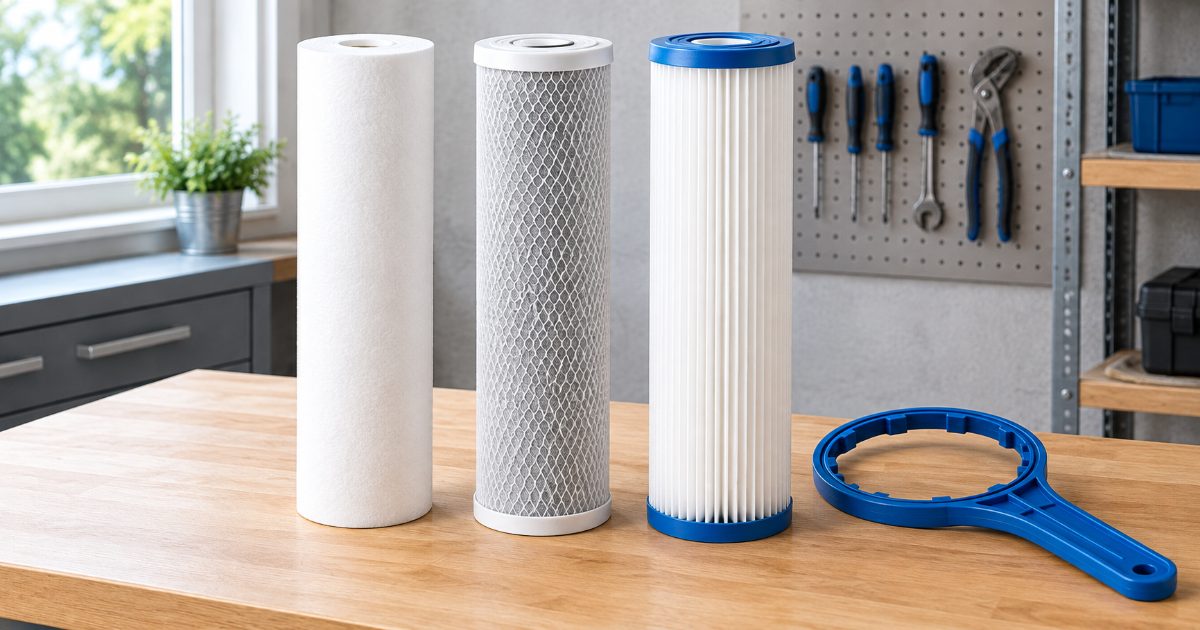
| Silt | 2 to 50 micron | Pleated cartridge, 20 or 50 micron nominal (Pentek ECP20 and ECP50) |
| Clay | under 2 micron | Pleated cartridge at 5 or 1 micron nominal (Pentek ECP5 and ECP1); NDSU calls 2 micron the finest available |
NDSU Extension’s rule for a well is simpler than the scale: a drilled well, with larger particles plus fine iron, gets a 10 to 15 micron filter; a dug or bored well gets 2 micron because fine clay is usually there. NDSU also notes that a 2 to 5 micron filter has smaller pores and needs more pressure to push water through.
Spin-down screens are sold by mesh count; Rusco’s 1 inch product page converts its polyester screens to micron.
| Rusco mesh | Micron | Rusco mesh | Micron |
|---|---|---|---|
| 24 mesh | 700 | 140 mesh | 100 |
| 30 mesh | 500 | 250 mesh | 50 |
| 40 mesh | 350 | 500 mesh | 30 |
| 60 mesh | 250 | 1000 mesh | 15 |
| 100 mesh | 150 |
Spin-down, pleated or string-wound?
The three cartridge types sort by what they are asked to catch and what they cost per gallon.
| Type | How it works | Published figures | Use it for |
|---|---|---|---|
| Spin-down | Water spins inside a clear housing, sand drops against a mesh screen, a valve at the bottom flushes it out; the screen is reused | Rusco: 1 to 25 GPM through the 1 inch model, 150 PSI maximum on every size, screens 700 down to 15 micron | Sand and grit, as the first stage |
| Pleated | Sheet media folded around a core; particles stop on the surface, and the pleats give the area | Pentair’s ECP spec sheet: 36 sq ft of media in a 20 inch Big Blue, under 1 psi initial drop at 20 gpm, 1, 5, 20 or 50 micron nominal, 40 to 125°F | Silt and clay after the spin-down; the 5 micron stage ahead of UV |
| String-wound or spun depth | Fibres wound or spun around a core; particles are trapped through the thickness of the media, not on its face | Rated the same way, by nominal micron; check the maker’s sheet for the pressure drop at your flow | Heavy, mixed loads where a surface cartridge blinds off quickly |
A nominal rating is the maker’s own figure for the particle size the media mostly stops. An absolute rating is a tested cut-off at which nearly every particle of that size is held. Pentair prints “nominal” against every ECP rating, so a 5 micron ECP5-20BB is not a 5 micron guarantee. If a downstream device needs an absolute rating, buy a cartridge whose sheet says so.
In what order do the stages go?
Coarse to fine, following NDSU Extension’s placement rule and VIQUA’s owner’s manual.
- Spin-down first, right after the pressure tank: NDSU says the sediment filter is the first device on a private system’s line after the tank.
- Pleated cartridge next, coarse before fine: VIQUA’s troubleshooting table suggests a 20 micron cartridge followed by a 5 micron cartridge when sediment breaks through a single filter.
- Iron, manganese or softening after that: VIQUA’s feed-water table wants iron under 0.3 ppm, manganese under 0.05 ppm and hardness under 7 grains per gallon before the lamp.
- Carbon after sediment: NDSU says activated carbon does not remove sediment well and wants a sediment filter ahead of it.
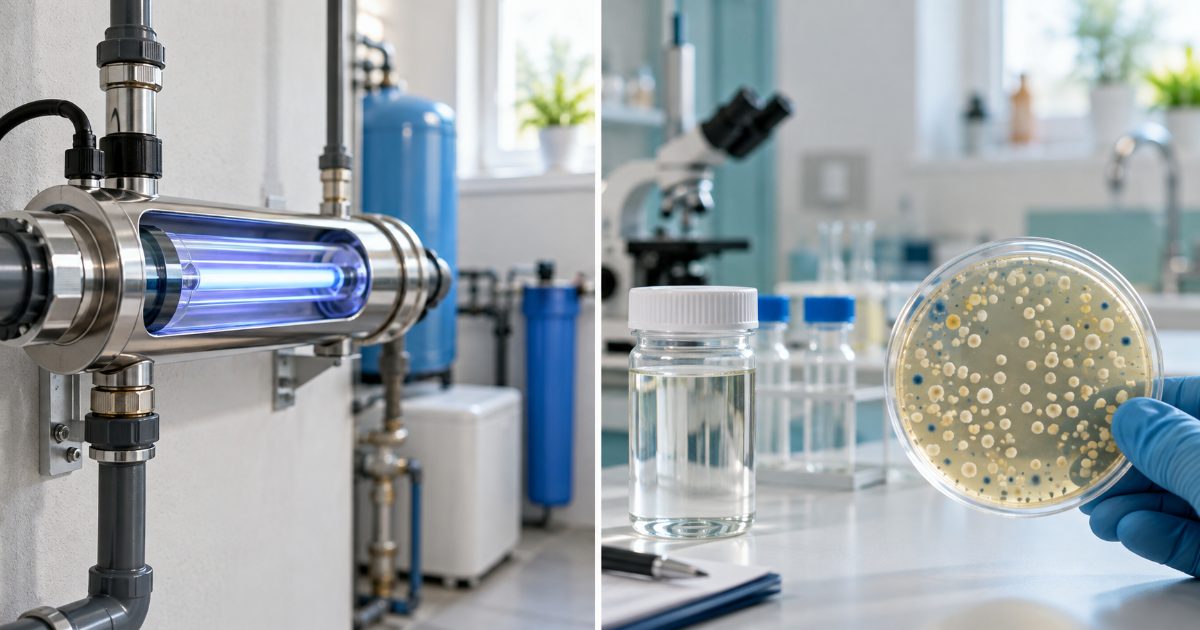
- UV last, on the cold line, after a 5 micron sediment filter, with feed water under 1 NTU and UV transmittance above 75%: VIQUA’s manual makes both the filter and the placement requirements.
Size the housings by peak flow, not by pipe size: the whole-house filter flow rate calculator turns bathrooms and fixtures into gpm. For the housings and cartridges themselves, the sediment filter review compares housings on published specs, and the iSpring WGB32B parts page lists the 20 x 4.5 inch cartridges that cross-fit a Big Blue housing.
Before you buy anything
Do not buy a 1 micron cartridge for grit or a spin-down for haze: sand loads a fine cartridge fast, and haze passes a Rusco 100 mesh screen untouched, because 150 micron is three times the largest silt grain on the USDA scale. The glass test decides the first stage; a lab turbidity number, with iron and manganese, decides whether UV is on the table. Sand you can see: the Rusco 1 inch spin-down, 100 mesh , knowing the screen is 150 micron and swaps for a finer one. Haze: a Pentek ECP 20 inch Big Blue pleated cartridge
in the 5 micron variant, nominal, not absolute.
What should you do first?
- Fill a glass, let it stand an hour, and match it to the table: fast is sand, slow is silt, never is clay, upward is air.
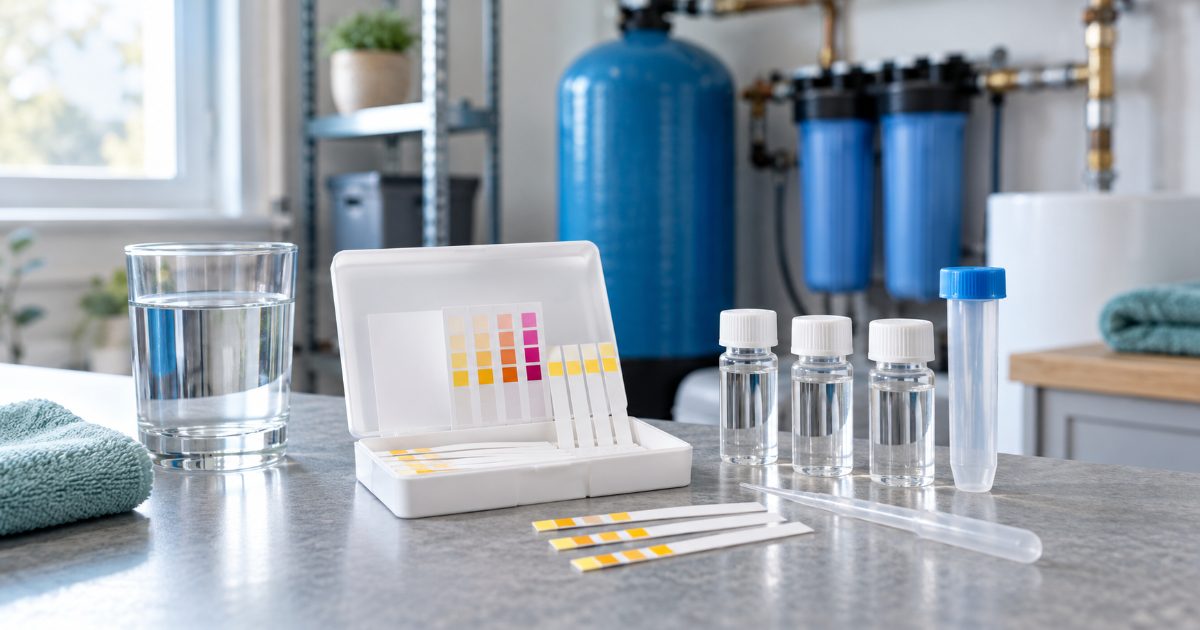
- Order lab turbidity with iron, manganese, hardness and pH, so the coloured rows are ruled in or out by number.
- If the grit is new, call the driller first: a filter only catches what a damaged well keeps sending.
- Fit the stages in order: spin-down at the pressure tank for sand, then a pleated cartridge sized by NDSU’s rule (10 to 15 micron drilled, 2 micron dug or bored), then iron or softening, then carbon.
- Add UV only when the lab turbidity reads under 1 NTU behind the 5 micron stage, as VIQUA’s manual requires.
Frequently asked questions
What turbidity level is acceptable for private well water?
No federal limit exists for a private well. EPA's Surface Water Treatment Rule requires public systems on surface water to keep filtered water at or below 0.3 NTU in 95% of monthly samples and never above 1 NTU, but it does not apply to wells. NDSU Extension says water systems aim for 1 turbidity unit, and that above 5 units the cloudiness is plainly visible in a glass.
What micron sediment filter should I use on a well?
NDSU Extension's rule: a drilled well, which carries larger particles plus fine iron, gets a 10 to 15 micron filter; a dug or bored well gets the finest available, 2 micron, because fine clay is common. Ahead of a UV lamp, VIQUA's owner's manual requires a 5 micron sediment filter, and suggests a 20 micron cartridge before it when sediment breaks through.
Is a spin-down filter better than a cartridge filter for well water?
Neither replaces the other. A Rusco spin-down holds a mesh screen that runs from 24 mesh (700 micron) down to 1000 mesh (15 micron) and is flushed rather than replaced, so it suits sand. A Pentek ECP pleated cartridge is rated 1, 5, 20 or 50 micron nominal and is discarded when it loads, so it suits silt and clay. With both, the spin-down goes first.
Why does a UV water purifier need turbidity under 1 NTU?
Particles shade microorganisms from the lamp and coat the quartz sleeve. VIQUA's owner's manual lists the feed water it expects: turbidity under 1 NTU, UV transmittance above 75%, iron under 0.3 ppm, manganese under 0.05 ppm, hardness under 7 grains per gallon and tannins under 0.1 ppm, with a 5 micron sediment filter ahead of the chamber and the UV unit as the last stage before the tap.
Why is my well water milky white but clears in a glass?
Water that turns clear from the bottom up within a minute or two carries air, not sediment. Fine bubbles enter when a pump draws the well down, a suction fitting leaks air, or a water heater warms the line, and they rise out of a glass leaving nothing behind. A sediment filter changes none of that. Turbidity settles downward or stays in suspension; it never clears upward.
Sources
- EPA, Guidance Manual for Compliance with the Surface Water Treatment Rules: Turbidity Provisions (PDF)
- EPA, National Primary Drinking Water Regulations
- EPA, Secondary Drinking Water Standards: Guidance for Nuisance Chemicals
- NDSU Extension, Drinking Water Quality: Testing and Interpreting Your Results
- NDSU Extension, Filtration: Sediment, Activated Carbon, and Mixed Media (WQ1029)
- Oklahoma State University, Rain or Shine: Scale of Primary Soil Particles (USDA particle classes)
- Rusco, Spin-Down and Sediment Trapper Filters (product line specifications)
- Rusco, 1 inch Spin-Down Filter (mesh to micron table)
- Pentair, Pentek ECP Series Pleated Cellulose Polyester Cartridges spec sheet 310111 (PDF)
- VIQUA, UV System Owner's Manual 520104 Rev AD, S-series (PDF)