Too much water in the water softener brine tank: how much is normal, and the five causes in the order to check them
A brine tank holds about 1 inch over the grid (Fleck) or 2 to 5 inches (GE) by design. Higher means a plugged injector or drain line; check in that order.
- Verified
- Updated
- 7 min read
- 4 sources
Short answer
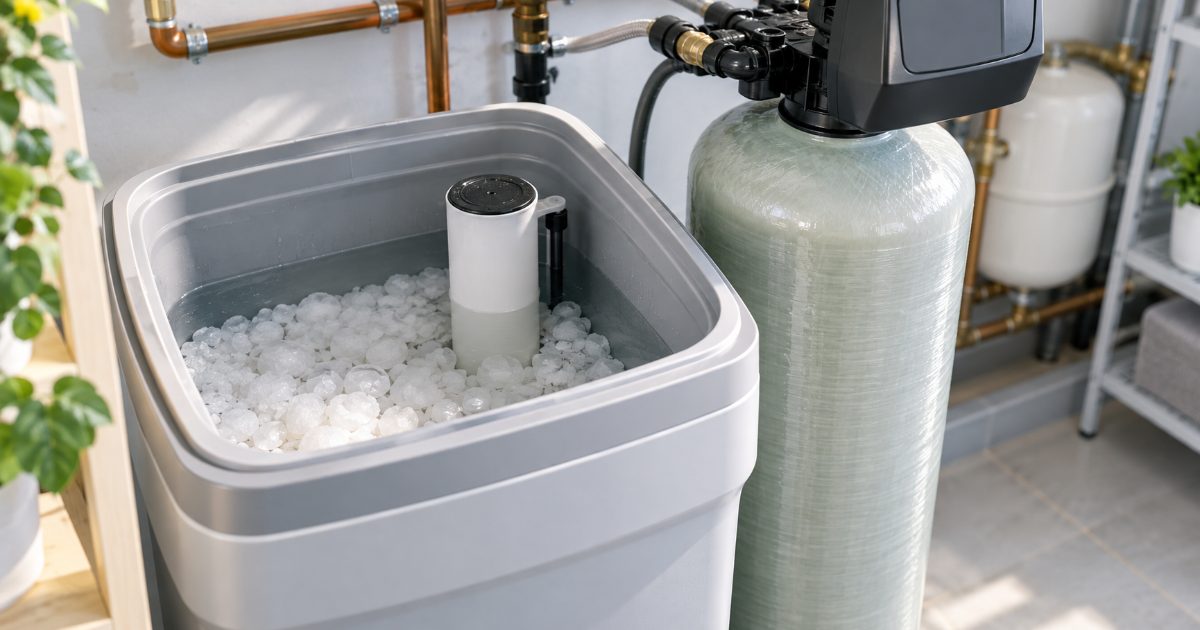
Too much water in a water softener brine tank means the control valve has stopped drawing brine out, not that the tank is being filled wrong. The normal level is shallow by design: Pentair’s Fleck 5600SXT manual has the installer place about 1 inch (25 mm) of water above the grid plate on a dry-grid tank, or fill to the top of the air check when there is no grid, and GE Appliances’ support page calls 2 to 5 inches of standing water normal in its float-style tanks. Water rising past that band, and especially water reaching the salt line, points to one of five causes in order of likelihood: a plugged injector, a restricted drain line flow control, a brine valve or float stuck open, a power failure that parked the valve mid-regeneration, or a Brine Tank Refill time set too long. Check the injector first, and confirm the Fleck manual’s 20 psi minimum line pressure before blaming any part.
If the water level looks normal but the salt is not going down, this is the wrong page: that is a salt bridge, and the salt bridge guide covers it.
What does the water level tell you?
The brine tank is the plastic bin that holds the salt; the control valve pulls a measured amount of salt water out of it during regeneration and puts fresh water back at the end.
| Reading or symptom | Likely cause | Confirm with |
|---|---|---|
| Level sits above the normal band but drops on the next regeneration | Drain line flow control partly plugged, so the draw is slow | Pull the drain line flow control washer and look for grit, per the Fleck manual’s troubleshooting row for a plugged drain line flow control |
| Level climbs every cycle and never draws down; salt use is high | Injector nozzle, throat or screen plugged | Remove the injector cap and screen as the Fleck manual’s injector and screen replacement section shows; look for scale or sediment |
| Water at or near the top of the tank, salt fully submerged | Brine valve or float stuck open, or debris on the brine valve seat | Fleck row for foreign material in the brine valve; on a GE unit, check that the float slides freely on its stand tube |
| Level jumped after an outage; valve display is flashing the time | Power failure parked the valve mid-refill | Fleck manual, control operation during a power failure: reset the time of day and run a manual regeneration |
| Level has been high since install or since a reprogram | Brine Tank Refill minutes set too long for the brine line flow control fitted | Compare the refill minutes with the installer’s worksheet |
| Level normal or low, salt not used, hard crust when probed | Salt bridge, a different fault | The salt bridge guide, not this page |
How much water should be in the brine tank?
No EPA, NSF/ANSI or WQA standard governs a brine tank water level; the normal band is whatever the valve maker designed the tank to hold, and it differs between the two tank designs.
A dry-grid tank has a perforated plate near the bottom that holds the salt above a small reservoir; a wet tank has no grid, so the salt sits in the water and a float on a stand tube sets the fill limit.
| Tank design | Normal water level | Who publishes it |
|---|---|---|
| Dry-grid tank (plate at the base) | About 1 inch (25 mm) above the grid plate at start-up | Pentair, Fleck 5600SXT manual, start-up step 9 |
| Wet tank with float or air check, no grid | Fills to the top of the air check; GE calls 2 to 5 inches of standing water normal | Pentair start-up step 9 for the design; GE Appliances, Normal Water Level, for the range |
| Either design, at the safety stop | Float set approximately 2.5 to 3 inches from the top of the stand tube | GE Appliances, Float Position |
The GE float is the last line of defence, not the normal level: GE’s page says that if the valve malfunctions, the rising float lifts the stem and shuts off the water entering the tank. A tank at the float stop has already had a fault for at least one cycle.
Which cause fits, and how do you check it?
The Fleck 5600SXT troubleshooting row for excessive water in the brine tank names four faults: a plugged drain line flow control, a plugged injector system, a timer not cycling, and foreign material in the brine valve or brine line flow control. The order below puts the most common first.
| Order | Cause | Check | Fix class |
|---|---|---|---|
| 1 | Injector (venturi) plugged | Pull the injector cap, screen, nozzle and throat; hold each to the light | Clean or replace the injector; part numbers are on the Fleck 5600SXT parts page |
| 2 | Drain line flow control restricted | Remove the flow control washer; check the drain hose for a kink or a frozen section | Clean the washer, straighten or shorten the hose |
| 3 | Brine valve or float stuck open | Lift the brine well cover; move the float by hand and inspect the seat for grit | Clean the valve, replace the brine valve seat per the Fleck row |
| 4 | Power failure during regeneration | Display flashing, level jumped after a known outage | Reset the time of day and run a manual regeneration to finish the stalled cycle |
| 5 | Brine Tank Refill set too long | Level high since install; compare the refill minutes with the installer’s worksheet | Shorten the refill time in programming |
The injector is a small nozzle and throat that creates the suction to draw brine, and it clogs before anything else because every gallon of brine passes through it. The Fleck manual also lists line pressure that is too low as a reason the softener fails to draw brine, and gives 20 psi as the pressure to reach, so read a gauge before you buy a part.
The refill setting has no universal correct value. The Fleck installation data sheet records Brine Tank Refill as a blank minutes field filled in per installation, because the right figure depends on the brine line flow control and the tank; the Fleck 5600SXT settings guide covers where that entry sits in programming.
A power failure needs no part. Pentair’s manual says the valve stays in its current position until power returns, and that the installation should include the safety components that guard against an overflow from that stall; a float that is present and free is that component.
Whirlpool’s own support article on excess water in the tank could not be read this session, so this page cites no Whirlpool figure; the checks above apply to the same valve parts, and the Whirlpool WHES30 and WHES40 parts page lists the nozzle and venturi assembly for those units.
Before you buy anything
Do not order an injector, a brine valve or a new float until you have done three free checks: a pressure gauge reading against the Fleck manual’s 20 psi minimum, a look through the injector nozzle and throat against the light, and a hand test that the float moves freely on its stand tube. Two of the five causes on this page, a power stall and a long refill setting, cost nothing to fix, and a plugged injector is cleaned more often than it is replaced. Buy the part only when the check shows a cracked screen, a scored seat or a nozzle that will not clear.
What should you do first?
- Lift the lid and note the level against the design band: about 1 inch over the grid, or 2 to 5 inches in a float tank per GE.
- Bail the tank down to that band so the next regeneration starts from a known level.
- Run a manual regeneration and watch the brine draw step: if the level does not fall, pull the injector and screen and clean them.
- Check the drain line flow control washer and the hose for grit, a kink or ice.
- If the level is still high after a clean injector and a clear drain, compare the Brine Tank Refill minutes with the installer’s worksheet before replacing the brine valve.
Frequently asked questions
How much water should be in a water softener brine tank?
It depends on the tank design. Pentair's Fleck 5600SXT manual has the installer place about 1 inch (25 mm) of water above the grid plate, or fill to the top of the air check when there is no grid. GE Appliances' support page calls 2 to 5 inches of standing water normal in its float-style tanks. Water at the salt line is not normal on either design.
What stops a softener from draining the excess water out of the brine tank?
The Fleck 5600SXT troubleshooting row for excessive water in the brine tank lists a plugged drain line flow control, a plugged injector system, a timer that is not cycling, and foreign material in the brine valve or brine line flow control. Each one either blocks the suction that draws brine out or lets water keep entering, so the puddle grows every regeneration instead of returning to its start-up level.
Does a power outage cause a water softener to overfill its brine tank?
It can. Pentair's Fleck 5600SXT manual states that if power fails while the unit is in regeneration, the valve remains in its current position until power is restored, and that the system should include the safety components needed to guard against an overflow from that stall. A valve parked in the brine refill step keeps water flowing into the tank until the cycle is allowed to finish.
What does the float in a brine tank do?
The float rides a stand tube and acts as a high-level shutoff. GE Appliances' Float Position page sets it approximately 2.5 to 3 inches from the top of the stand tube; if the valve malfunctions, the rising float lifts the stem and shuts off the water going into the brine tank, avoiding an overflow. A float that is stuck, set too high or missing removes that protection.
Is too much water in the brine tank the same problem as a salt bridge?
No. A salt bridge is a hard crust over the salt with the water level normal or low underneath, so the softener stops using salt; that fault has its own diagnosis on the salt bridge page. Too much water is the level itself rising past the normal 1 to 5 inch band because the valve is not drawing brine out; the fix is on the valve side.
Fact sheet and how to cite this page
- Answer
- A brine tank holds a shallow puddle by design: about 1 inch (25 mm) above the grid plate per Pentair’s Fleck 5600SXT manual, or 2 to 5 inches in a float-style tank per GE Appliances. A level rising past that band means the valve is not drawing brine out; check the injector, the drain line flow control, the brine valve or float, a power stall and the refill time, in that order.
- Basis
- No EPA, NSF/ANSI or WQA figure governs a brine tank water level. The normal band is a manufacturer design figure: Pentair, Fleck 5600SXT Upflow Service Manual, start-up step 9 (1 inch above the grid, or to the top of the air check), and GE Appliances support, Normal Water Level (2 to 5 inches).
- Assumptions
- The softener is a conventional demand or timer valve with a separate brine tank, such as a Fleck 5600SXT or a GE or Whirlpool cabinet unit
- The tank was filled at start-up as the manual directs; a tank that has held the same high level since install points at the refill setting
- Line pressure meets the Fleck manual’s 20 psi minimum for brine draw
- Method
- Design levels, troubleshooting rows and power-failure behaviour read from the Pentair Fleck 5600SXT service manual and three GE Appliances support articles on 2026-09-14; nothing was tested. Whirlpool’s support article on excess water could not be read this session, so no Whirlpool figure is cited.
- Primary source
- Pentair, Fleck 5600SXT Upflow Service Manual (start-up, troubleshooting, power failure) (manufacturer or vendor document)
- Facts verified
- Last updated
- Cite as
- OwnerSpec, "Too much water in the water softener brine tank: how much is normal, and the five causes in the order to check them", https://ownerspec.com/water/guides/water-softener-brine-tank-too-much-water/, facts verified 14 September 2026.
Every figure above also appears, with its source, in the article. All sources · How OwnerSpec verifies numbers
Sources
- Pentair, Fleck 5600SXT Upflow Service Manual (start-up, troubleshooting, power failure) (manufacturer or vendor document)
- GE Appliances support, Water Softener: Normal Water Level (manufacturer or vendor document)
- GE Appliances support, Water Softener: Float Position (manufacturer or vendor document)
- GE Appliances support, Water Softener: Brine Tank Not Draining (manufacturer or vendor document)