Water softener vs water filter: what each one removes, and why many homes need both
A softener swaps calcium and magnesium for sodium under NSF/ANSI 44 and leaves chlorine, lead and PFAS alone. A carbon filter (NSF/ANSI 42 or 53) does the reverse.
- Verified
- Updated
- 7 min read
- 15 sources
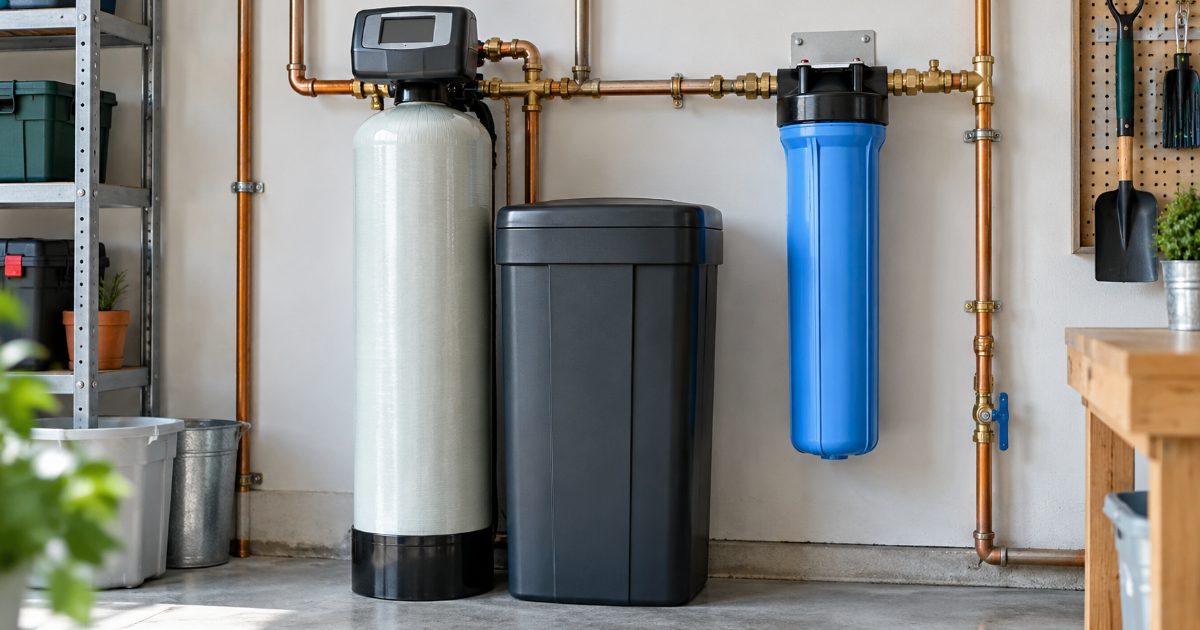
Shop links on this page are affiliate links: a purchase may earn us a commission at no extra cost to you. Disclosure
Short answer
A water softener and a water filter fix different problems. A water softener is a cation exchange tank: NSF/ANSI 44 covers residential softeners that use a cation exchange resin regenerated with sodium or potassium chloride to reduce hardness, and Penn State Extension describes the resin releasing sodium ions in trade for the calcium and magnesium that make water hard. WQA puts soft water under 1 grain per gallon (17.1 mg/L). A carbon filter is the device WQA and the Minnesota Department of Health name for chlorine and chloramine taste, a claim NSF/ANSI 42 covers; lead, VOCs and more than 50 other health claims sit under NSF/ANSI 53. Penn State says a softener will not necessarily remove the more serious contaminants, and EPA lists PFAS under anion exchange, not the cation resin in a softener. White scale is a softener job, chlorine taste is a carbon job, and a chlorinated hard-water home needs both.
If your only complaint is the chlorine smell, you can leave now: none of the sources on this page list a softener for it, and the whole-house carbon filter review is the page you want.
What does a softener do that a filter does not?
A softener removes hardness and nothing the sources credit a filter with. NSF/ANSI 44, in NSF’s words, covers residential softeners that use a cation exchange resin regenerated with sodium or potassium chloride, and says the hardness minerals are replaced with sodium or potassium ions depending on the regenerant.
Hardness is dissolved calcium and magnesium, and WQA defines soft water as under 1 grain per gallon (17.1 mg/L) according to NSF/ANSI standards. That number is what the white scale guide tells you to test for before anything else.
The trade has a cost. Penn State puts the sodium added at 7.5 mg per quart for each grain of hardness removed; NDSU Extension prints it as about 8 mg/L per grain. Potassium chloride avoids the sodium and NSF/ANSI 44 covers both regenerants.
Penn State also sets the softener’s working window on a well: pH above 6.7, hardness of 3 to 20 gpg (50 to 350 mg/L) and dissolved iron below 5 mg/L. NDSU says some softeners handle up to 10 ppm of iron and manganese, but both pages agree that oxidized iron fouls the resin.
If the water is hard and chlorinated, start with the filter and softener combo review; if it is hard and nothing else, the city-water softener review and the softener size calculator are the shorter path.
What does a carbon filter do that a softener does not?
A carbon filter handles the problems a softener passes straight through. The Minnesota Department of Health says granular activated carbon filters remove chlorine taste and smell, and WQA calls activated carbon the most effective nonchemical method for chloramine, working as a catalyst that breaks chloramine down rather than adsorbing it.
NSF’s fact sheet lists the aesthetic claims under NSF/ANSI 42: chlorine, taste and odor, chloramine, particulate, iron, manganese, zinc and total dissolved solids. NSF/ANSI 53 is the health-effects standard, with more than 50 claims including lead, Cryptosporidium, VOCs and chromium. The same sheet notes that NSF certifies water softeners separately, which is the 44 above.
EPA’s treatment overview credits granular activated carbon with taste- and odor-producing compounds, natural organic matter, VOCs and synthetic organic compounds, at up to 99.9 percent removal for many VOCs. Hardness is not on that list, which matches WQA’s statement that antiscaling devices do not reduce total calcium or magnesium: no filter makes water soft.
A softener is not neutral toward chlorine either. Penn State’s iron page says raw water must not meet air or chlorine before the softener, because the chlorine oxidizes dissolved iron into the red form that clogs resin. That is why the chlorine and chloramine guide and the install order guide both put carbon ahead of the softener on city water.
Which problem goes to which device?
The table assigns each complaint the way the cited sources do. “Not listed” means none of the sources on this page name that device for that problem, not that someone has proven it fails.
| Problem | Softener (NSF/ANSI 44) | Carbon filter (NSF/ANSI 42 or 53) | Reverse osmosis | Other, as the sources print it |
|---|---|---|---|---|
| White scale, hardness | Yes: cation exchange trades calcium and magnesium for sodium or potassium (NSF, Penn State); WQA’s soft line is under 1 gpg | Not listed | Not listed for hardness in the sources used here | Salt-free conditioner: WQA says antiscaling devices do not reduce calcium or magnesium |
| Chlorine or chloramine taste | Not listed; chlorine ahead of the resin oxidizes iron that fouls it (Penn State) | Yes: GAC removes chlorine taste and smell (Minnesota DH); activated carbon is the top nonchemical chloramine method, look for an NSF/ANSI 42 chloramine claim (WQA) | Not listed | Letting water stand uncovered a few hours lets the chlorine smell leave (Minnesota DH) |
| Lead | Not listed; Penn State says softeners will not necessarily remove serious contaminants | Only with a lead claim: EPA says use a filter certified to remove lead, which NSF’s sheet places under NSF/ANSI 53; EPA’s action level is 0.015 mg/L | EPA credits RO with many inorganics; NSF certifies RO under its own standard | Boiling does not remove lead (EPA) |
| PFAS (PFOA, PFOS) | Not listed; EPA puts PFAS under anion exchange, not the cation exchange a softener uses | Granular activated carbon with an NSF/ANSI 53 PFOA/PFOS claim (Pennsylvania DEP list); EPA’s limit is 0.0000040 mg/L (4 ng/L) each | Yes: RO is on Pennsylvania DEP’s list of PFOA/PFOS filter types | Anion exchange resin (EPA, Pennsylvania DEP) |
| Dissolved iron, orange stains | Yes for colorless iron below 5 mg/L at pH above 6.7 (Penn State); NDSU says up to 10 ppm iron and manganese on some units; oxidized iron clogs the resin | Not listed for dissolved iron (NSF/ANSI 42 lists an iron claim as aesthetic) | Not listed | Oxidizing filter: greensand for 3 to 10 mg/L combined iron and manganese (Penn State); EPA’s secondary standard is 0.3 mg/L |
| Rotten egg smell (hydrogen sulfide) | No: Penn State says a softener may cause hydrogen sulfide production; Minnesota DH says sulfur bacteria can become established in softeners | Only below about 1.0 mg/L (Penn State, Minnesota DH) | Not listed | Oxidizing filter up to 2–3 mg/L (Penn State) or about 6 mg/L (Minnesota DH); chlorination above 6.0 mg/L (Penn State) |
Each of those rows has its own page: iron in well water, rotten egg smell, lead from a service line, PFAS and which filter and the reverse osmosis contaminant table.
Which one do you need, or both?
Match the device to the complaint you can prove, not the one you assume.
| Your situation | Buy | Why |
|---|---|---|
| City water, white crust on fixtures, no taste complaint | Softener | Hardness is the only NSF/ANSI 44 claim and the only one you have |
| City water, chlorine or pool smell, no scale | Carbon filter | Minnesota DH and WQA name carbon; a softener is not listed |
| City water, scale and chlorine | Carbon then softener | Penn State: chlorine must not reach the resin; see the combo review |
| Lead notice or PFAS in the utility report | Certified NSF/ANSI 53 filter or RO | EPA: a filter certified for lead; Pennsylvania DEP: carbon, RO or anion exchange for PFAS |
| Well water, orange staining | Iron test first | Under 5 mg/L dissolved iron a softener can carry it (Penn State); above that, an oxidizing filter |
| Scale, but salt or a drain is impossible | Read the salt-free conditioner guide | WQA: the hardness stays, so the water never tests soft |
Before you buy anything
Do not buy a softener for a taste problem, and do not buy a carbon filter for scale: the sources above give neither device the other’s job. Get two numbers first. A hardness strip tells you whether you are above WQA’s 1 gpg soft line and inside Penn State’s 3 to 20 gpg softener window, and your utility’s water quality report (or a lab panel on a well) tells you whether chlorine, chloramine, lead, iron or PFAS is actually in the water. The softener size calculator turns the hardness number into a grain capacity; the water test kit review covers the strip and the lab panel.
What should you do first?
- Test hardness in grains per gallon with a strip or a lab: WQA’s soft line is 1 gpg, and the white scale guide shows where scale starts.
- Read the utility’s annual water quality report for chlorine or chloramine (EPA’s residual limit is 4.0 mg/L), lead and PFAS; on a well, order a lab panel instead.
- Scale only: size a softener with the calculator and pick from the softener review.
- Taste only: pick a carbon unit from the whole-house filter review, with an NSF/ANSI 42 chloramine claim if your utility uses chloramine.
- Both: buy a combo or two tanks and plumb carbon ahead of the softener, in the sequence the install order guide gives.
What owners buy for this
The top picks from Best whole house water filter and softener combo: the maker spec sheets sort them into salt-based sets that remove hardness and salt-free sets that do not, and the hardness number decides, compared on published specs and certifications.
City water, 2 to 5 people, hardness known, wants a softener that removes hardness
AFWFilters Fleck 5600SXT 48,000 grain softener with upflow carbon filter
AFWFilters page: 48,000 grains, 10% crosslink resin, up to 12 gpm service flow, 1.5 cu ft coconut-shell carbon in an upflow tank with no backwash and no drain line, 5-year valve and 10-year tank warranty; no NSF/ANSI 44 certification printed
Small home or low hardness, wants the same two-tank set at the lower capacity
AFWFilters Fleck 5600SXT 32,000 grain softener with upflow carbon filter
Amazon listing title only: 32,000 grains, 1 cu ft, 9 x 48 in tanks, 10% crosslink resin, coconut-shell carbon; AFWFilters' own page for this size was not opened, so no flow figure is printed here
Wants a printed NSF/ANSI 44 certification and a full performance data sheet
Aquasana SimplySoft 60,000 grain softener (WH-SF60)
Aquasana manual: 1.5 cu ft 8% resin, 11.1 gpm service flow, 15 psi drop, 20 to 125 psi, 200 gpg maximum hardness, 1 ppm maximum ferrous iron, 230 lb salt storage, 43 in tall; product page: IAPMO certified to NSF/ANSI 44 and CSA B483.1; sold separately from the Rhino
Frequently asked questions
Does a water softener filter the water?
Not in the sense a filter does. NSF describes an NSF/ANSI 44 softener as a cation exchange resin regenerated with sodium or potassium chloride that reduces hardness. Penn State Extension says softeners will not necessarily remove the more serious drinking water contaminants and that softening is often misconstrued as a purifying process. The resin trades calcium and magnesium for sodium; it is not a strainer or a carbon bed.
Does a water softener remove chlorine?
The sources on this page do not list a softener as a chlorine or chloramine method. WQA names activated carbon as the most effective nonchemical way to remove chloramine and points to NSF/ANSI 42 chloramine reduction claims, and the Minnesota Department of Health says granular activated carbon filters remove chlorine taste and smell. Penn State adds that chlorine reaching a softener oxidizes iron, which then fouls the resin.
Does a water filter remove hardness?
A carbon filter does not. NSF/ANSI 42 and 53 list chlorine, chloramine, taste, particulate, lead, VOCs and similar claims; hardness reduction sits under NSF/ANSI 44, which covers cation exchange softeners only. WQA says soft water is under 1 grain per gallon and that antiscaling devices do not reduce total calcium or magnesium. If white scale is the complaint, the softener review is the page you need.
Can one unit do both jobs?
Only as two stages in one package. The combo systems in the combo review pair a carbon tank for chlorine with a separate NSF/ANSI 44 softener tank, and the install order guide puts carbon before the softener on chlorinated city water, because Penn State says raw water should not meet chlorine before the resin. A single tank with mixed media still does each job with a different medium.
Which one removes lead or PFAS?
Neither a softener nor a plain carbon filter without the right certification. EPA's lead page says to use a filter certified to remove lead, an NSF/ANSI 53 claim. For PFAS, EPA's treatment overview lists anion exchange, and Pennsylvania DEP publishes a list of NSF/ANSI 53 PFOA and PFOS units that names granular activated carbon, reverse osmosis and ion exchange resins. A softener's cation resin is not on either list.
Fact sheet and how to cite this page
- Answer
- A water softener is a cation exchange tank: NSF/ANSI 44 covers residential softeners whose resin, regenerated with sodium or potassium chloride, reduces hardness, and WQA puts soft water under 1 grain per gallon (17.1 mg/L). A carbon filter is the device WQA and the Minnesota Department of Health name for chlorine and chloramine taste; NSF/ANSI 42 covers those claims and NSF/ANSI 53 covers lead and other health claims. Neither device does the other’s job.
- Basis
- NSF/ANSI 44’s scope for cation exchange softeners (NSF), NSF/ANSI 42 and 53 claim lists (NSF fact sheet), WQA’s under-1-gpg soft water line, and Penn State, NDSU and Minnesota Department of Health treatment guidance
- Assumptions
- The softener is a conventional cation exchange unit on sodium or potassium chloride, not a salt-free conditioner, which WQA says does not reduce calcium or magnesium
- The filter is activated carbon; a sediment-only cartridge carries none of the NSF/ANSI 42 or 53 claims discussed here
- Iron figures assume dissolved (colorless) iron on a well; oxidized orange iron fouls softener resin per Penn State Extension
- Method
- Scope and claim lists taken from NSF’s NSF/ANSI 44 technical requirements page and its 42/53/401 fact sheet, WQA’s scale and chloramine pages, EPA’s treatment technology overview and lead page, and Penn State, NDSU and Minnesota Department of Health extension pages, all cited in this page’s sources. No product was tested.
- Primary source
- NSF, NSF/ANSI 44 Technical Requirements (standards or certification body)
- Facts verified
- Last updated
- Cite as
- OwnerSpec, "Water softener vs water filter: what each one removes, and why many homes need both", https://ownerspec.com/water/guides/water-softener-vs-water-filter-difference/, facts verified 10 October 2026.
Every figure above also appears, with its source, in the article. All sources · How OwnerSpec verifies numbers
Sources
- NSF, NSF/ANSI 44 Technical Requirements (standards or certification body)
- NSF, NSF/ANSI 42, 53 and 401 Filtration Systems Standards (fact sheet PDF) (manufacturer or vendor document)
- WQA, Scale Deposits (standards or certification body)
- WQA, Chloramine (standards or certification body)
- Penn State Extension, Water Softening (university or extension service)
- Penn State Extension, Iron and Manganese in Private Water Systems (university or extension service)
- Penn State Extension, Hydrogen Sulfide (Rotten Egg Odor) in Water Wells (university or extension service)
- NDSU Extension, Water Softening: Ion Exchange (university or extension service)
- EPA, Overview of Drinking Water Treatment Technologies (government or regulatory source)
- EPA, Basic Information about Lead in Drinking Water (government or regulatory source)
- EPA, National Primary Drinking Water Regulations (government or regulatory source)
- EPA, Secondary Drinking Water Standards: Guidance for Nuisance Chemicals (government or regulatory source)
- Minnesota Department of Health, Chlorination of Drinking Water (government or regulatory source)
- Minnesota Department of Health, Hydrogen Sulfide in Well Water (government or regulatory source)
- Pennsylvania DEP, Point of Use Units Certified under ANSI/NSF 53 for PFOA and PFOS (PDF) (government or regulatory source)