Whole-house water treatment install order: where the sediment filter, softener, carbon filter and UV go, and why
Well: tank, sediment, iron fix, softener, carbon, UV last, since Viqua caps UV inlet at 7 gpg and 0.3 mg/L iron. City: sediment, carbon, softener.
- Verified
- Updated
- 7 min read
- 3 sources
Short answer
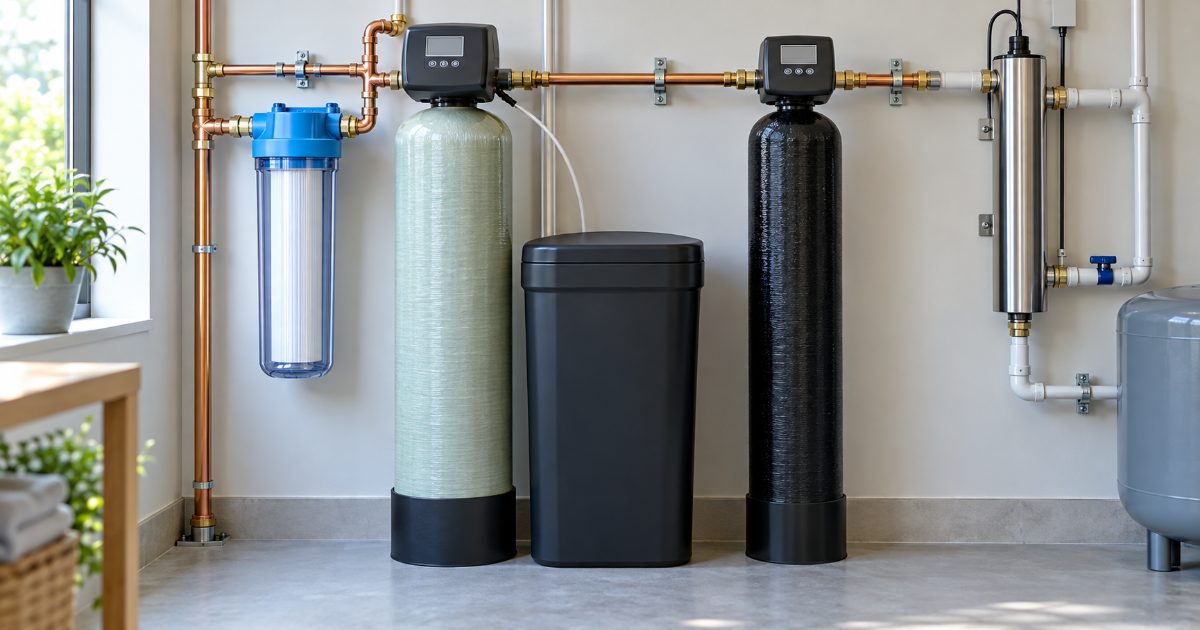
On a private well, the whole-house water treatment train runs pressure tank, sediment filter, iron or pH correction if the test calls for it, water softener, carbon filter, and the UV system last. Each stage sits where it does because the next stage has an inlet limit. Viqua’s UV pretreatment page caps the water reaching a UV lamp at 7 gpg hardness, 0.3 mg/L iron, 0.05 mg/L manganese and 1 NTU turbidity, and only the stages upstream reach those figures. On city water the train is shorter, sediment, carbon, softener, because the utility’s chlorine residual is the main threat: Purolite states that 1 mg/L free chlorine at 15 degrees C cuts softening resin life to under two years, so a carbon stage ahead of the softener protects the resin. Put a three-valve bypass around the softener, tee the outside hose bibs off ahead of it, and size each stage only after the order is fixed.
If you do not have a water test in hand, stop here and get one: the order below is fixed, but which stages your house needs at all is decided by the iron, manganese, hardness and turbidity numbers, not by this page.
What order does the train run in?
Grains per gallon (gpg) is the hardness unit softener makers use, and Viqua prints its 7 gpg UV ceiling with the 120 ppm equivalent beside it.
| Position | Well water | City water | Why it sits there |
|---|---|---|---|
| 1 | Pressure tank | Meter and main shutoff | Not treatment; it sets the pressure every filter downstream sees |
| 2 | Sediment filter | Sediment filter | Grit fouls the screens, injectors and valve seats of every later stage |
| 3 | Iron, manganese or pH correction, if the test needs it | Carbon, if the chlorine residual is high | Resin fouls on iron and manganese; Purolite says chlorine halves resin life per 1 mg/L |
| 4 | Softener | Softener | Brings hardness under the 7 gpg line the UV needs and stops scale downstream |
| 5 | Carbon | Carbon, if not already fitted at position 3 | Taste and odor polish on water that no longer fouls the bed |
| 6 | UV, last | UV, if fitted | Viqua’s inlet limits are met only after every other stage has run |
The city train is the same list with the well-only stages struck out. The one decision on city water is whether carbon goes before the softener or after it, and the chlorine residual on the utility’s report answers that.
Why does each stage sit where it does?
Because the stage after it publishes an inlet limit. UV is the strictest, so it goes last: Viqua’s pretreatment page lists the water a UV system will accept, and every figure in it is something an upstream stage removes.
Nephelometric turbidity units (NTU) measure how much light suspended particles scatter in the water. UV transmittance (UVT) is the share of UV light that passes through the water to reach the far side of the chamber, and it falls as turbidity, iron and tannins rise.
| Viqua UV inlet limit | Figure | Stage that meets it |
|---|---|---|
| Hardness | under 7 gpg (120 ppm) | Softener |
| Total iron | under 0.3 mg/L | Iron filter, or the softener when iron is low and dissolved |
| Manganese | under 0.05 mg/L | Iron and manganese filter |
| Turbidity | under 1 NTU | Sediment filter |
| Suspended solids | under 10 mg/L | Sediment filter |
| UV transmittance | most systems function from 95 percent | Sediment, iron and carbon stages together |
A UV lamp has no media, so it cannot fail loudly. Water above the 7 gpg or 0.3 mg/L lines coats the quartz sleeve with scale or iron, and the dose drops while the water at the tap looks and tastes the same as it did the day the lamp was fitted.
The softener sits behind sediment and iron correction for the same reason. EPA’s secondary standards put iron at 0.3 mg/L and manganese at 0.05 mg/L, and above those figures the iron guide and the manganese guide cover the filter that goes ahead of the resin.
Low pH gets its own stage, the neutralizer in the blue-green stains guide, which also sits ahead of the softener.
Carbon is the one stage that moves. Purolite’s softening resin bulletin states that each 1 mg/L of chlorine in the feed cuts resin life by 50 percent, each additional 1 mg/L halves it again, and 1 mg/L free chlorine at 15 degrees C brings resin life under two years.
On a chlorinated supply that argues for carbon ahead of the softener; the chlorine and chloramine guide covers which carbon handles chloramine.
On a well with no residual, carbon has nothing to protect the resin from, so it goes after the softener as a taste and odor polish and sees water that no longer scales the bed.
Which stages does your water need?
The order never changes; the test decides which positions stay empty.
| Reading or symptom | Stage it adds | Confirm with |
|---|---|---|
| Grit, cloudy water, housings clogging in days | Sediment filter, position 2 | Turbidity result; the sediment guide and the micron picker |
| Orange staining, iron above 0.3 mg/L | Iron filter, position 3 | Well panel; the iron filter calculator |
| Black staining, manganese above 0.05 mg/L | Iron and manganese filter, position 3 | Well panel; the manganese guide |
| Blue-green staining, pH under 6.5 | Acid neutralizer, position 3 | pH result; the neutralizer calculator |
| White scale, hardness at or above 7 gpg | Softener, position 4 | Hardness result; the hard water guide and the softener size calculator |
| Chlorine taste, utility residual on the report | Carbon, position 3 or 5 | The utility’s annual report; the chlorine guide |
| Coliform-positive result | UV, position 6, after a shock treatment | Retest; the coliform guide and the UV size calculator |
Before you buy anything
Do not buy a UV system, or a softener, off this page. Every stage in the table is sized by a number you do not have until the test comes back, and the well water test panel guide lists which parameters that test must include. If the hardness result comes back under 7 gpg and iron under 0.3 mg/L, the UV needs no softener ahead of it and the train is two stages shorter than the table. Fix the order first, then size each stage with the whole-house flow rate calculator so no filter chokes the one behind it.
Where do the bypass loop and the hose bibs go?
A three-valve bypass is two shutoffs on the stage’s inlet and outlet and one valve on a pipe that jumps around it.
Put one around the softener, and on a well put a second around the whole train from the pressure tank to the UV, so the house runs on raw water while a housing is opened or the brine tank is empty.
No maker document reached for this page publishes a figure for the loop, so this is stated as plumbing practice.
Outside hose bibs and any irrigation line tee off ahead of the softener loop. Lawn and garden water does not need softening, and every gallon that skips the resin is salt and capacity kept for the house.
Where a sediment housing is the first stage, the 20-inch Big Blue compatibility page and the whole-house sediment filter shortlist cover the cartridge and housing; this page adds nothing to their specs.
What should you do first?
- Get a well panel or the utility’s annual report, and write down hardness, iron, manganese, turbidity, pH and chlorine residual.
- Strike every stage from the table whose reading is already inside the limit; the order of what remains does not change.
- On city water, read the chlorine residual: at 1 mg/L or above, carbon goes ahead of the softener per Purolite’s resin figures.
- Plumb the softener bypass and the hose-bib tee before the softener is set, not after.
- Check the UV inlet against Viqua’s four figures, 7 gpg, 0.3 mg/L, 0.05 mg/L and 1 NTU, on the treated water, not the raw water.
Frequently asked questions
Does the UV system go before or after the water softener?
After the softener, and last in the train. Viqua's pretreatment page caps the water entering a UV system at 7 gpg (120 ppm) hardness, 0.3 mg/L iron, 0.05 mg/L manganese and 1 NTU turbidity. A UV lamp has no media of its own, so scale or iron on the sleeve lowers the dose without warning at the tap. Only a softener upstream holds hardness under that 7 gpg line.
Should a carbon filter go before or after the softener on city water?
Before the softener when the utility's chlorine residual is high. Purolite's resin bulletin states that each 1 mg/L of chlorine in the feed halves softening resin life, and that 1 mg/L free chlorine at 15 degrees C brings resin life under two years. When the residual is low, carbon after the softener works as a taste and odor polish on already softened, non-fouling water.
What iron and manganese levels need treatment before the softener?
Anything above EPA's secondary standards: 0.3 mg/L for iron and 0.05 mg/L for manganese. EPA lists rusty color, sediment and orange staining for iron above 0.3 mg/L, and black staining and a bitter metallic taste for manganese above 0.05 mg/L. Those same two figures are Viqua's UV inlet ceilings, so an iron or manganese filter goes ahead of both the softener and the UV.
What turbidity does a UV system need at its inlet?
Under 1 NTU, with suspended solids under 10 mg/L, per Viqua's pretreatment page, which also says most UV systems function at UV transmittance values from 95 percent. A sediment filter directly after the pressure tank is what gets a well there. If the water still clouds a glass after sediment filtration, the UV stage may be running below its rated dose and the upstream train needs fixing first.
Where does the softener bypass go, and should outside hose bibs be softened?
A three-valve bypass belongs around the softener, and on a well a second one ahead of the whole train, so the house can run on raw water while a stage is serviced or the salt has run out. Outside hose bibs and any irrigation line tee off ahead of the softener loop, so lawn and garden water is not softened and salt is not spent on it.
Fact sheet and how to cite this page
- Answer
- On a well the train runs pressure tank, sediment, iron or pH correction, softener, carbon, UV last, because Viqua’s pretreatment page caps UV inlet water at 7 gpg hardness, 0.3 mg/L iron, 0.05 mg/L manganese and 1 NTU turbidity. On city water it runs sediment, carbon, softener when the chlorine residual is high, since Purolite states 1 mg/L free chlorine at 15 degrees C cuts softening resin life under two years.
- Basis
- Viqua’s UV pretreatment limits (hardness under 7 gpg, iron under 0.3 mg/L, manganese under 0.05 mg/L, turbidity under 1 NTU, suspended solids under 10 mg/L) and EPA’s secondary standards for iron (0.3 mg/L) and manganese (0.05 mg/L).
- Assumptions
- A single point-of-entry train on a private well or a municipal supply, not a point-of-use system
- The well has a pressure tank; the city supply has a chlorine or chloramine residual
- Each stage is sized separately with the calculators linked on the page; this page fixes only the order
- Method
- Inlet limits from Viqua’s pretreatment page, resin life figures from Purolite’s softening resin bulletin, staining thresholds from EPA’s secondary standards page, all read on 2026-09-15; bypass and hose-bib placement is stated as plumbing practice with no maker figure attached; nothing was tested.
- Primary source
- Viqua, UV pretreatment requirements (manufacturer or vendor document)
- Facts verified
- Last updated
- Canonical URL
- https://ownerspec.com/water/guides/water-treatment-install-order-sediment-softener-carbon-uv/
- Cite as
- OwnerSpec, "Whole-house water treatment install order: where the sediment filter, softener, carbon filter and UV go, and why", https://ownerspec.com/water/guides/water-treatment-install-order-sediment-softener-carbon-uv/, facts verified 15 September 2026.
Every figure above also appears, with its source, in the article. All sources · How OwnerSpec verifies numbers
Sources
- Viqua, UV pretreatment requirements (manufacturer or vendor document)
- Purolite, Factors That Affect Softening Resin Performance and Life (manufacturer or vendor document)
- EPA, Secondary Drinking Water Standards: Guidance for Nuisance Chemicals (government or regulatory source)