Well pump not working, no water: the six checks in the order a homeowner can make them
No water from a well: read the gauge against the switch cut-in (30 or 40 psi), check the breaker, the switch contacts, the tank pre-charge 2 psi below cut-in.
- Verified
- Updated
- 8 min read
- 8 sources
Short answer
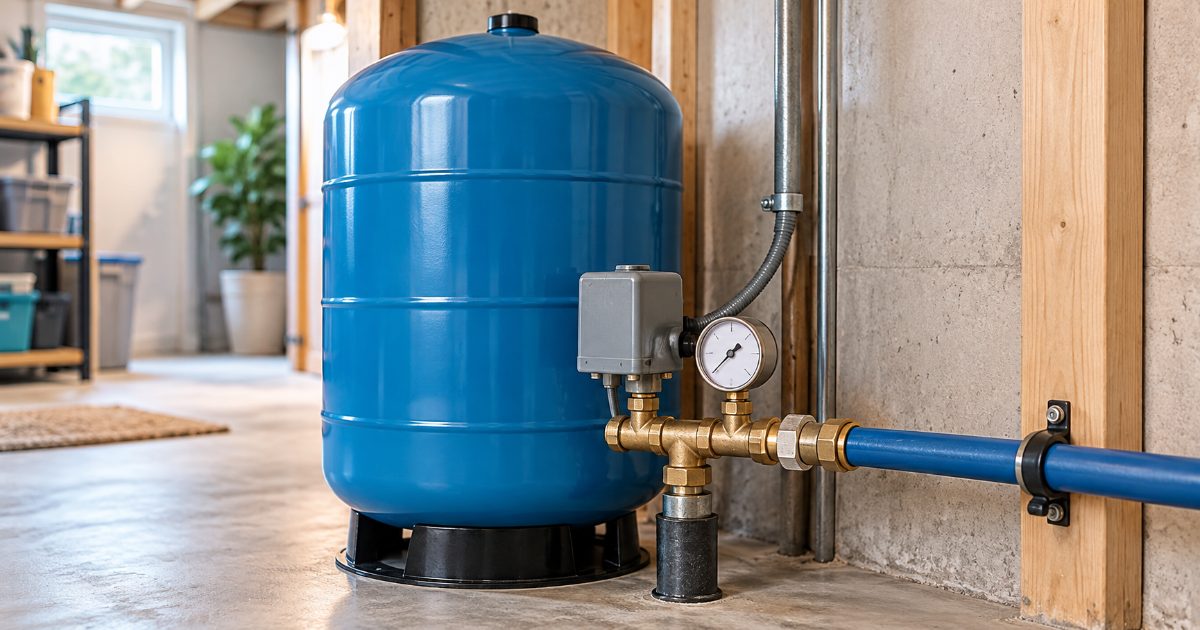
A well pump that gives no water is diagnosed from two things you can see without opening anything: the breaker and the pressure gauge on the tank tee. Nebraska Extension’s order is power first (run an appliance on another circuit), then the well pump breaker or fuse, then a State of Nebraska licensed professional. The gauge is read against the switch’s cut-in: Square D’s Pumptrol FSG2 ships at 20/40, 30/50 or 40/60 psi, and Goulds jet pumps ship with a 30–50 psi switch. A gauge stuck below cut-in with the breaker on means the pressure switch or its feed line, which Schneider Electric’s bulletin inspects only after “Disconnect the power. Remove the cover.” A pump that runs and never fills is Franklin Electric’s “runs continuously” row: low water level first, then screen, check valve, leak. The tank pre-charge, 2 psi below cut-in per Amtrol, Goulds and Nebraska Extension, fixes rapid cycling, not a dead pump.
Which check comes first?
Steps 1 and 2 need no cover removed; anything past them that touches a wire is work the makers and Nebraska Extension assign to a qualified or licensed person.
| # | Check | What you look for | Who says so |
|---|---|---|---|
| 1 | House power, then the well pump breaker or fuse | An appliance runs on another circuit; the pump breaker is tripped or the fuse blown | Nebraska Extension G2153; Franklin AIM Table “Motor does not start” |
| 2 | Pressure gauge against cut-in | Gauge below cut-in (30 psi on a 30/50 switch) with the breaker on, and the switch never clicks | Square D bulletin 9013DB0701 “No water flow” row |
| 3 | Pressure switch, power disconnected | Pitted contacts, pinched or frayed wires, insects; a plugged line so the switch cannot read tank pressure | Square D bulletin 9013DB0701; Goulds IM102 cause 12 |
| 4 | Control box (3-wire submersible) | Box hot to touch, overload tripping; Franklin requires a control box on every single-phase 3-wire motor | Franklin AIM Manual |
| 5 | Tank pre-charge | Air at 2 psi below cut-in with the tank drained; water from the air valve means a failed bladder | Amtrol 9016-868; Goulds IM102; Nebraska Extension |
| 6 | Frozen line, low water in the well | Pump runs but no water: shut off, let the well recover, check static and drawdown level | Franklin AIM Manual; Nebraska Extension |
Frozen lines: see the well winter freeze checklist.
What does the pressure gauge tell you?
The gauge against the cut-in settles most no-water calls before a part is bought. The cut-in is the pressure at which the switch closes and the pump starts; the cut-out is where it opens and the pump stops. Nebraska Extension says the start setting is often 30 or 40 psi; the lid or the inside of the switch case also prints the pressure the drained tank should hold.
Square D’s Pumptrol brochure lists the FSG2 at 20/40, 30/50 and 40/60 psi, rated to 1.5 hp at 115 V or 2 hp at 230 V. Goulds supplies its jet pumps with 30–50 psi switches.
| Gauge reading, breaker on | What it points to | The maker’s row |
|---|---|---|
| Below cut-in, switch silent | Switch contacts, a plugged switch line, or no power reaching the switch | Square D 9013DB0701 “No water flow” and “No power to switch” |
| Below cut-in, switch clicks, pump silent | Control box or motor: voltage at the switch terminals must be within plus or minus 10 percent of rating | Franklin AIM “Motor does not start” |
| Holds pressure, no flow at the tap | A closed valve or a frozen line downstream of the tank | Goulds IM102 cause 7; freeze checklist |
| Climbs to cut-out in seconds, drops, repeats | Short cycling: low tank air or a failed bladder | Nebraska Extension; Franklin “Motor starts too often” |
| Never reaches cut-out, pump running | Low water level, blocked screen, check valve stuck closed, worn pump, line leak | Franklin AIM “Motor runs continuously” |
Nebraska Extension’s leak test: shut off water to the house and watch the gauge. Steady means the lines and check valves hold; dropping means a leak or a check valve.
What is inside the pressure switch, and what may you touch?
The cover, only with the power off. Schneider Electric’s bulletin for the Class 9013 switch begins “Disconnect the power. Remove the cover.”, Goulds prints in capitals that the breaker or disconnect is off first, and Franklin allows 5 minutes for controls that hold lethal voltage to discharge before any cover comes off.
With the cover off, Schneider’s list is pitted contacts, pinched or frayed wires, insects or nests. Pitted contacts are not sanded, filed or cleaned with chemicals. Franklin’s table says poor contact at the switch points passes less than line voltage; the fix is to clean the points or replace the switch.
The small pipe feeding the switch matters as much as the contacts. Schneider names a plugged line that stops the switch reading tank pressure, cleared by qualified service personnel with the switch removed. Goulds lists a plugged switch as a cause of a pump that will not shut off.
Square D’s M4 option adds a low-pressure cut-off lever that trips when pressure falls more than 10 psi below cut-in, below 20 psi on a 30/50 switch, and must be reset by hand. Schneider’s test: hold the lever in Run; if the pump cuts out again within 10 psi of cut-in on release, the water source is low, and the lever stays alone until the well has recharged.
Nebraska Extension says homeowners should not adjust the switch at all because it is connected to electric power. The replacement part, by setting and option, is on the well pump pressure switch page.
Is it the tank, not the pump?
Only if the symptom is cycling, not silence. Nebraska Extension describes a pump that runs a few seconds then shuts off because there is not enough air in the tank; Franklin’s “starts too often” row names a waterlogged tank, a check valve stuck open, a leak and the switch setting.
Amtrol, Goulds and Nebraska Extension set the air pre-charge 2 psi below cut-in with the tank drained: 28 psi for a 30/50 switch, 38 psi for a 40/60 switch. Amtrol ships Well-X-Trol at 38 psig, the figure its manual gives for a 40/60 switch, and Goulds ships HydroPro at 38 PSI, so a 30/50 system starts 10 psi high out of the box. The pump is off and the gauge reads 0 psi before a tire gauge goes on the air valve; Goulds says you lose 1 to 2 psi each check.
| Air valve test | Meaning | Source |
|---|---|---|
| Air only, reads cut-in minus 2 | Tank is fine; look at the check valve and the switch setting | Amtrol; Goulds IM102 |
| Air only, reads low | Add air to cut-in minus 2 and recheck in a week; a drop means the tank is failing | Nebraska Extension |
| Water from the valve stem | Bladder or diaphragm has failed; the tank is replaced | Square D 9013DB0701 waterlogged tank row |
| Tank sounds full when tapped after draining | Water trapped in the air side; tank may need replacing | Nebraska Extension |
Amtrol’s DANGER box is the limit of homeowner work: do not add air after a loss of air, with visible exterior corrosion, or after a shortened cycle time, because re-pressurizing a corroded tank can rupture it, and only qualified professionals should check or re-charge the pre-charge. Sizes and cross-fits are on the well pressure tank cross-reference.
Before you buy a switch or a tank
Do not order a switch because the pump is silent, or a tank because it cycles, until the gauge has been read against the cut-in and the air valve tested with the pump off. A tire gauge decides between a 28 psi correction and a new tank. If water came out of the air valve, or the M4 lever cut out again within 10 psi of cut-in, call a licensed well contractor, not a shop.
What if the pump runs and the well is the problem?
Franklin’s first cause for a motor running continuously is low water level: the pump may exceed well capacity, so shut it off, wait for the well to recover, and check static and drawdown level. Its fixes, throttling output or setting the pump lower, are contractor work.
Nebraska Extension adds that a pump set too high in the well runs dry in drought or heavy use, and a licensed professional resets its height.
What should you do first?
- Run an appliance on another circuit, then reset the well pump breaker or replace the fuse once.
- Read the gauge against the setting on the switch lid: below cut-in with the breaker on points at the switch, above it at the plumbing.
- Shut off water to the house and watch the gauge for a leak.
- With the pump off and the gauge at 0, test the air valve: cut-in minus 2 psi is right, water means a failed tank.
- If the breaker trips again, the pump runs with no water, or the air valve wets, call a licensed well contractor.
Frequently asked questions
Why does the well pump not turn on at all?
Franklin Electric's AIM Manual lists the causes of a motor that does not start in this order: no power or voltage outside plus or minus 10 percent of rating, blown fuses or tripped breakers, a damaged pressure switch passing less than line voltage, a control box fault, damaged wiring, a bound pump, then the cable or motor. The breaker and the switch are the two a homeowner can see.
How do I know if the pressure switch is bad?
Schneider Electric's bulletin for its Square D 9013 switch has the power disconnected before the cover comes off, then checks for pitted contacts, pinched or frayed wires, and insects. Pitted contacts are not sanded, filed or cleaned with chemicals. If the gauge sits below cut-in and the switch never clicks, the switch, or the small line feeding it, is the suspect.
What should the pressure tank be set at if the pump will not start?
Amtrol, Goulds and Nebraska Extension all set the air pre-charge 2 psi below the pump cut-in, measured with the pump off and the tank drained to 0 psi on the gauge: 28 psi for a 30/50 switch, 38 psi for a 40/60 switch. A pre-charge check does not restart a dead pump; it fixes the rapid on-off cycling that wears the switch out.
Why does the well pump run but no water comes out?
Franklin's table puts low water level in the well first for a motor that runs continuously: the pump may exceed well capacity, so shut the pump off and let the well recover. A blocked intake screen, a check valve stuck closed, a worn pump or a line leak are next. Nebraska Extension adds that a pump set too high in the well runs dry in drought or heavy use.
When should I call a well contractor instead of fixing it myself?
Nebraska Extension tells homeowners not to adjust the pressure switch because it is connected to electric power, and sends anything past the breaker to a State of Nebraska licensed professional. Amtrol says only qualified professionals should check, adjust or re-charge a tank, and never to add air to a corroded tank or one whose cycle time has shortened. Pulling a pump is contractor work.
Fact sheet and how to cite this page
- Answer
- With no water at the tap, Nebraska Extension’s order is power first (run an appliance on another circuit), then the well pump breaker or fuse, then a licensed professional. Square D’s own troubleshooting guide for its 9013 pressure switch has qualified personnel read tank pressure against the cut-in setting (30 psi on a 30/50 switch) with the power disconnected before the cover comes off.
- Basis
- Nebraska Extension G2153 for the homeowner checks and the 2 psi rule; Schneider Electric Data Bulletin 9013DB0701 and Pumptrol brochure RP19721017 for the switch; Franklin Electric AIM Manual M1311 for the submersible motor; Goulds IM102 and Amtrol 9016-868 for the tank.
- Assumptions
- A private well with a submersible or jet pump, a pressure switch on the tank tee and a pre-charged bladder or diaphragm tank. Constant-pressure (variable speed) controllers have their own fault codes and are not covered.
- The cut-in and cut-out are read from the switch lid or the pump manual, not assumed. Square D’s FSG2 ships at 20/40, 30/50 or 40/60 psi; Goulds jet pumps ship with 30-50 psi switches.
- Anything behind the switch cover, inside the control box or at the well head is work the makers and Nebraska Extension assign to a qualified or licensed person.
- Method
- Troubleshooting tables, safety text and pressure figures read from the Nebraska Extension publication, the Schneider Electric and Franklin Electric manuals, and the Goulds and Amtrol tank documents on 3 October 2026. No pump was bench tested; the page orders the makers’ own checks.
- Primary source
- University of Nebraska-Lincoln Extension, G2153 Private Drinking Water Wells (troubleshooting, pressure tank and pressure switch sections) (university or extension service)
- Facts verified
- Last updated
- Cite as
- OwnerSpec, "Well pump not working, no water: the six checks in the order a homeowner can make them", https://ownerspec.com/water/guides/well-pump-not-working-no-water/, facts verified 3 October 2026.
Every figure above also appears, with its source, in the article. All sources · How OwnerSpec verifies numbers
Sources
- University of Nebraska-Lincoln Extension, G2153 Private Drinking Water Wells (troubleshooting, pressure tank and pressure switch sections) (university or extension service)
- Schneider Electric / Square D, Data Bulletin 9013DB0701 (12/2007), Preventive Maintenance and Troubleshooting Guidelines for Class 9013F and 9013G Pressure Switches (hosted PDF) (retailer listing or retailer-hosted document)
- Schneider Electric / Square D, Pumptrol Pressure Switches brochure RP19721017 (10/2017): FSG2 20/40, 30/50 and 40/60 settings, M4 low pressure cut-off (hosted PDF) (manufacturer or vendor document)
- Franklin Electric, AIM Manual M1311, 60 Hz Submersible Systems, 2026 edition: System Troubleshooting table (PDF linked from franklinwater.com) (manufacturer or vendor document)
- Franklin Electric, AIM Manual 60 Hz Submersible Systems, 2023 edition: safety text, Table 1 frequency of starts (hosted copy) (manufacturer or vendor document)
- Goulds Water Technology (Xylem), Jet Pumps instruction manual IM102: 30-50 psi standard switch, pre-charge 2 psi below cut-in, lockout warning, troubleshooting (PDF) (manufacturer or vendor document)
- Goulds Water Technology (Xylem), HydroPro Water System Tank technical brochure BHYDRO: 38 PSI pre-charge, 125 psi maximum working pressure (PDF) (manufacturer or vendor document)
- Amtrol, Well-X-Trol Installation & Operation Instructions 9016-868 MC10185: pre-charge 2 psig below cut-in, DANGER text on re-pressurizing, qualified professionals only (PDF) (manufacturer or vendor document)