White flakes or particles in ice or the kettle: hardness scale, dip tube plastic, resin beads, or trapped air
White flecks that fizz in vinegar are hardness scale: 1 gpg is 17.1 mg/L per MSU Extension. Floating plastic curls are dip tube; amber beads are resin.
- Verified
- Updated
- 6 min read
- 5 sources
Shop links on this page are affiliate links: a purchase may earn us a commission at no extra cost to you. Disclosure
Short answer
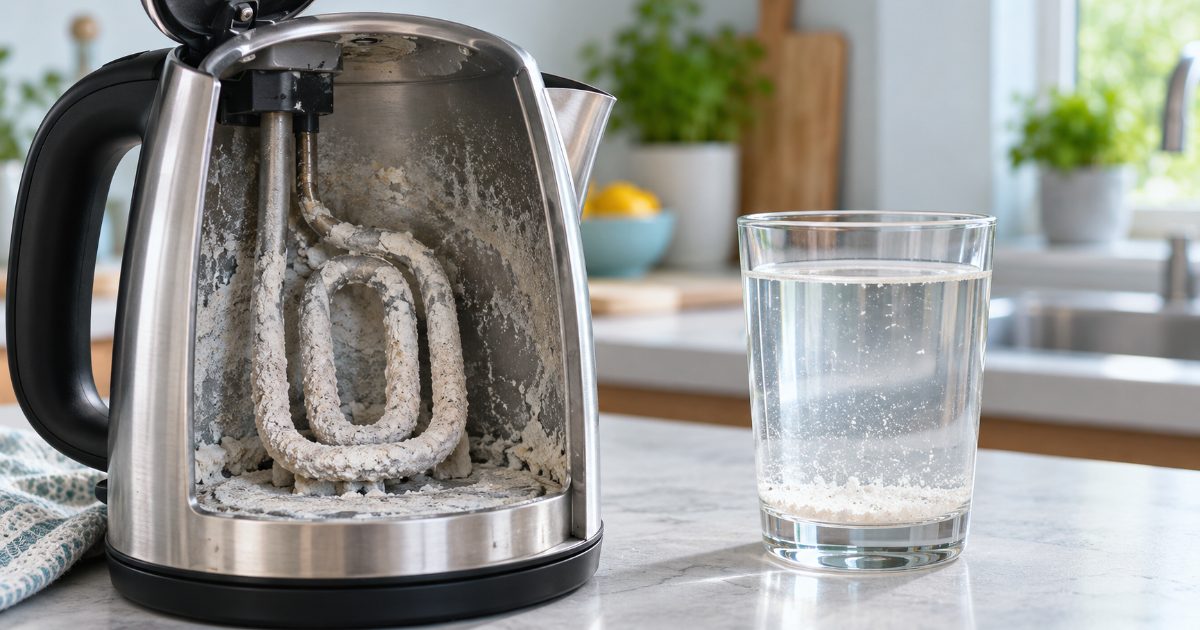
White flakes in water or ice have four common causes, and one kitchen test separates the most common one from the rest. Chalky white flecks that fizz and dissolve in white vinegar within a few minutes are calcium carbonate hardness scale, the mineral deposit that EPA’s secondary standards describe building up inside hot water pipes and heat exchangers; Montana State University Extension puts 1 grain per gallon (gpg) of hardness at 17.1 mg/L. Flexible white or clear plastic curls that float and never dissolve are fragments of a water heater dip tube. Amber, spherical beads about 0.3 to 1.2 mm across are softener resin escaping through a cracked riser tube or a failed underdrain. Ice that is milky all the way through, with nothing gritty when the cube is crushed, is trapped air, which iSpring’s WGB32B manual says clears in a day or two after a filter change. Do the vinegar test first: it decides whether the fix is a softener, a plumber, or nothing.
If the specks are black rather than white, this is the wrong page: that is carbon dust from a new cartridge, and the black specks guide covers the flush.
What do the flakes tell you?
Put a few of the particles in a spoon of white vinegar and watch for five minutes. That one step sorts the table.
| What you see | Likely cause | Confirm with |
|---|---|---|
| White, chalky flecks in ice, or a white crust in the kettle that crumbles | Calcium carbonate hardness scale | Fizzes and dissolves in white vinegar within a few minutes |
| White or clear plastic curls or shards, flexible, floating | Water heater dip tube breaking up inside the tank | Floats, does not fizz or soften in vinegar, shows up in hot water or hot-tap ice only |
| Amber or gold round beads, roughly 0.3 to 1.2 mm | Softener resin carried over from a cracked riser tube or failed underdrain | Spherical, coloured, unchanged by vinegar; check the softener’s riser tube and underdrain screen |
| Black specks, not white | Carbon fines from a new carbon cartridge | Per iSpring’s WGB32B manual, a cold-faucet flush of about 10 minutes clears them |
| Ice milky all over, clearing from the outside in as it melts | Trapped air and dissolved gas pushed to the cube’s centre as it freezes | Nothing gritty when the cube is crushed; a glass of the same water stands clear |
Hardness is the calcium and magnesium dissolved in the water, reported as calcium carbonate. Scale is what that hardness leaves behind when the water is heated or dries.
What does the number mean?
Montana State University Extension’s hardness fact sheet states the conversion: 1 gpg equals 17.1 mg/L as calcium carbonate, and mg/L and ppm are the same figure. A strip that reads 7 gpg is therefore about 120 mg/L.
That 7.0 gpg (120 mg/L) figure is Penn State Extension’s practical treatment line, and the hard water white scale guide carries the full table and the softener sizing path. This page does not repeat it: below that line scale is a nuisance in the kettle, above it the fix is the same softener that guide describes.
EPA’s Secondary Drinking Water Standards guidance defines scale as a mineral deposit that builds up on the insides of hot water pipes, boilers and heat exchangers, restricting or even blocking flow, and lists total dissolved solids at 500 mg/L with “hardness; deposits” among the effects. Both are non-mandatory secondary levels, so nothing here is a violation of anything.
For resin, ResinTech’s CG8 product page describes the bead as amber, spherical and graded at 16 to 50 US mesh, which ResinTech gives as 1,190 to 297 microns, or about 1.2 mm down to 0.3 mm. Nothing about scale is round, coloured or that uniform in size.
The dip tube is the plastic pipe that carries cold water to the bottom of a water heater tank. A CPSC.gov recall search for dip tubes on 2026-09-15 returned no matching recall, and no heater maker publishes a service life for the tube. The diagnosis rests on the fragment’s behaviour: it floats, it bends, and vinegar does nothing to it.
Which fix fits?
| Cause | Deciding number | What to do |
|---|---|---|
| Hardness scale | Above Penn State Extension’s 7.0 gpg (120 mg/L) line | Size and fit a softener per the hard water white scale guide; below the line, descale the kettle and leave the plumbing alone |
| Dip tube fragments | No published lifespan or recall figure | Replace the water heater’s dip tube, or the heater if it is old; this is a plumbing part, not a water-quality problem |
| Resin bead carryover | Any visible bead is a fault; there is no threshold | Repair the riser tube or underdrain, then refill per the resin replacement page |
| Carbon fines | About 10 minutes of cold-faucet flush per iSpring’s manual | Flush; not a defect and not a white-particle problem |
| Cloudy ice | Clears in a day or two once trapped gas escapes per iSpring’s manual | Nothing; not a water-quality issue |
Only the first row leads to a purchase. The second row is a plumber or a part, the third is a repair on equipment you already own, and the last two cost nothing.
Before you buy anything
Do not order a softener because the kettle has a crust. A crust proves the water carries some hardness; it does not tell you whether the number is 3 gpg or 20 gpg, and only the second one justifies a tank in the basement.
The WeAQUA DoubleCheck hardness test strips read 0 to 25 gpg (0 to 425 ppm) per the listing, which is enough to place the water above or below the 7.0 gpg line. The flaw is that a strip is a colour band, not a titration: it decides whether scale is plausible, and it is not precise enough to size a softener.
For that step, get a lab number, then use the sizing path on the hard water guide.
Why does the hot tap matter?
Collect a sample from the cold tap and a sample from the hot tap into two clean glasses and let both stand. Scale and resin beads arrive in both, because they come from the supply or the softener upstream of the heater.
Dip tube fragments come only from inside the tank, so they appear in hot water and in ice made from a line teed off the hot side, and never in the cold glass. If the cold glass is clean and the hot glass has floating plastic, the water quality is fine and the heater is the job.
What should you do first?
- Drop a few particles in white vinegar and wait five minutes: fizz and dissolve means scale, no change means plastic or resin.
- Fill a cold-tap glass and a hot-tap glass; particles in the hot glass only point at the water heater dip tube.
- Look at the shape: round amber beads are resin, so open the softener and check the riser tube and underdrain before anything else.
- If it is scale, read a hardness strip and compare with Penn State Extension’s 7.0 gpg line on the hard water guide.
- If the ice is uniformly milky and nothing is gritty, wait a day or two, and if the whole cube still looks the same the freezer, not the water, is the variable.
Frequently asked questions
How do I convert grains per gallon to mg/L to see if my water is hard enough to leave scale?
Multiply grains per gallon by 17.1. Montana State University Extension's hardness fact sheet gives that conversion and notes that mg/L and ppm are the same unit for this purpose. So a strip reading of 7 gpg is about 120 mg/L as calcium carbonate, which is the line Penn State Extension uses for when a softener starts to make sense on this site's hard water guide.
What is scale, chemically, and where does it build up?
EPA's Secondary Drinking Water Standards guidance defines scale as a mineral deposit that builds up on the insides of hot water pipes, boilers and heat exchangers, restricting or even blocking water flow. In a home that means the kettle element, the water heater and the ice maker feed line. The same EPA table lists total dissolved solids at 500 mg/L with hardness and deposits among its effects.
What colour and size are water softener resin beads, so I can tell them apart from scale?
ResinTech's CG8 product page describes a standard softening resin as amber in colour and spherical, graded at 16 to 50 US mesh, which is about 1.19 mm down to 0.297 mm. Scale is white, flat and chalky and fizzes in vinegar; a resin bead is round, coloured, slightly springy and does nothing in vinegar. Beads in the water mean the softener's riser tube or underdrain has failed.
Why is my ice or filtered water cloudy right after a new filter went in?
iSpring's WGB32B manual says the cloudiness after a new filter is tiny air bubbles being purged from the cartridges, that it is normal, and that it clears in a day or two; the same manual allows a cloudy or grey look for the first 3 to 5 days. Cloudy fridge ice is the same mechanism: dissolved gas is pushed to the centre as the cube freezes from the outside in.
Why did my water run black for a few minutes after a new carbon filter went in?
That is residual carbon dust from the new cartridge, not the white particle problem this page covers. iSpring's WGB32B manual says the water might be blackish on the initial flush, that this is expected, and that the fix is to open the nearest cold faucet and run it for about 10 minutes to expel the fines. The manual also says not to use a hot faucet for that first flush.
Fact sheet and how to cite this page
- Answer
- White flecks that fizz and dissolve in white vinegar are calcium carbonate hardness scale; Montana State University Extension puts 1 grain per gallon at 17.1 mg/L, and the treatment line is Penn State Extension’s 7.0 gpg (120 mg/L). Floating plastic curls that never dissolve are water heater dip tube fragments, amber beads of 0.3 to 1.2 mm are softener resin, and ice that is milky throughout is trapped air.
- Basis
- Penn State Extension’s 7.0 gpg (120 mg/L) scaling line, as cited on this site’s hard water guide; Montana State University Extension’s 17.1 mg/L per gpg conversion; EPA’s secondary standards definition of scale and its 500 mg/L TDS level
- Assumptions
- The flakes are collected from cold and hot taps separately so the hot-only case can be seen
- Resin bead size is ResinTech’s published CG8 range of 16 to 50 US mesh; other resins may differ slightly
- The vinegar test is a household identification step, not a laboratory analysis
- Method
- Limits and definitions from EPA’s secondary standards page and Montana State University Extension, resin bead specifications from ResinTech’s CG8 page, flush and cloudiness figures from iSpring’s WGB32B manual, all read on 2026-09-15; nothing was tested.
- Primary source
- Montana State University Extension Water Quality, Hardness fact sheet (university or extension service)
- Facts verified
- Last updated
- Cite as
- OwnerSpec, "White flakes or particles in ice or the kettle: hardness scale, dip tube plastic, resin beads, or trapped air", https://ownerspec.com/water/guides/white-flakes-particles-in-ice-or-kettle/, facts verified 15 September 2026.
Every figure above also appears, with its source, in the article. All sources · How OwnerSpec verifies numbers
Sources
- Montana State University Extension Water Quality, Hardness fact sheet (university or extension service)
- EPA, Secondary Drinking Water Standards: Guidance for Nuisance Chemicals (government or regulatory source)
- ResinTech, CG8 product page (resin colour, form, mesh size) (manufacturer or vendor document)
- iSpring, WGB32B Series Heavy Duty Water Filtration System User Manual (PDF) (manufacturer or vendor document)
- Penn State Extension, Water Softening (the 7.0 gpg line, cited on the hard water guide) (university or extension service)