Best portable RV water softener: 16,000 and 8,000 grain exchange units, sized from a hardness number, by published spec
On The Go OTG4-VM-DBLSOFT and Glacier Fresh at 16,000 grains cover most hookups; divide grains by hardness in gpg for gallons between regenerations.
- Verified
- Updated
- 11 min read
- 8 sources
Shop links on this page are affiliate links: a purchase may earn us a commission at no extra cost to you. Disclosure
OwnerSpec compares published manufacturer specifications, certification listings and sourced technical documents. Unless a page explicitly states otherwise, OwnerSpec has not laboratory-tested or used the products it compares. Editorial policy
Short answer
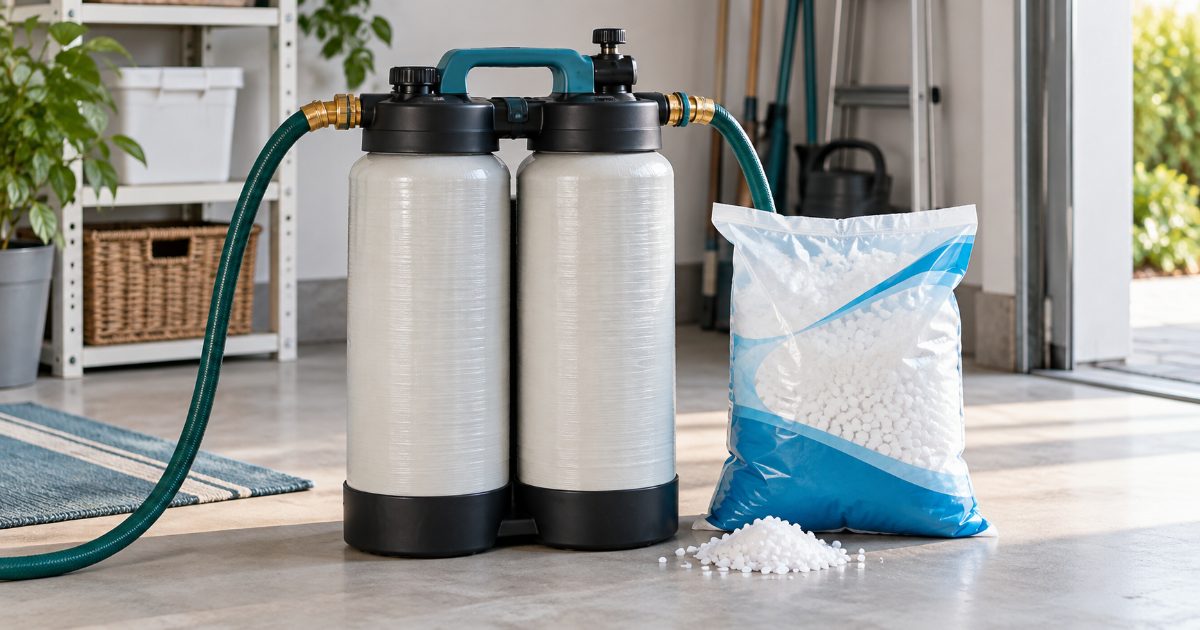
For a portable RV water softener chosen on published spec, the On The Go OTG4-VM-DBLSOFT is the pick: its listing rates it at 16,000 grains across two tanks with brass hose fittings, the largest capacity in this class with a confirmed listing. The runner-up is the Glacier Fresh portable RV softener, also rated 16,000 grains on the maker’s page and regenerated with table salt through stainless quick connects. Size either one from a hardness number, not a brand: divide the grain rating by hardness in grains per gallon (gpg), where WQA’s ion exchange fact sheet puts 1 gpg at 17.1 mg/L as calcium carbonate, so 16,000 grains at 10 gpg is roughly 1,600 gallons between regenerations. Skip every portable softener if the source water carries more than 2 mg/L of iron or more than 750 mg/L of dissolved solids, the WQA thresholds above which resin fouls and hardness leaks through, and skip the 8,000-grain OTG3NTP3M on a full-time hookup.
Fact sheet
- Answer
- For a portable exchange softener on an RV or boat, the 16,000-grain On The Go OTG4-VM-DBLSOFT is the pick on published capacity, with the Glacier Fresh 16,000-grain unit the runner-up. Divide the grain rating by hardness in gpg (1 gpg = 17.1 mg/L per WQA) for gallons between regenerations, about 1,600 at 10 gpg. Skip any portable softener above 2 mg/L of iron.
- Comparison basis
- Published grain capacity, tank count, fitting type and regeneration method from each maker’s page or listing, compared against the WQA ion exchange conversion, the NSF/ANSI 44 salt-efficiency protocol and Penn State Extension’s softening limits, read on 2026-09-13.
- Assumptions
- Hardness is known in gpg or mg/L as CaCO3 from a test, not guessed from a campground name
- The rig is on intermittent hookups, not a fixed full-time installation drawing a household’s daily volume
- Source water carries under 2 mg/L of iron and under 750 mg/L of dissolved solids, the WQA range for efficient softening
- Method
- OwnerSpec compared the makers’ published capacity figures and the WQA, USGS and Penn State Extension documents; it did not test any portable softener hands-on, and no flow, weight or dimension figure was published for any softener on this page.
- Primary source
- WQA, Ion Exchange technical fact sheet (PDF) (standards or certification body)
- Facts verified
- Last updated
- Cite as
- OwnerSpec, "Best portable RV water softener: 16,000 and 8,000 grain exchange units, sized from a hardness number, by published spec", https://ownerspec.com/water/reviews/best-portable-rv-water-softener/, facts verified 13 September 2026.
Every figure above also appears, with its source, in the page below. All sources · How OwnerSpec verifies numbers
The picks
Most hookups, longest run between regenerations
On The Go OTG4-VM-DBLSOFT
16,000 grains, double tank, brass hose fittings, table-salt regeneration; flow, weight and dimensions not published
Same capacity, stainless quick connects
Glacier Fresh portable RV softener
16,000 grains, single tank, stainless garden-hose quick connects, table-salt regeneration; flow, weight and salt amount not published
Weekend rigs and boats, half the capacity
On The Go OTG3NTP3M
8,000 grains per the listing description, single tank; no other figure published
Listing-only budget option, no maker page
Filterelated 16,000-grain
16,000 grains and a 3/4 in brass fitting per the listing title; nothing else published
If the rig sits on a full-time hookup and draws a household’s volume every day, this is the wrong page: a tank regenerated in a campsite bucket is a travel tool, and the well-water softener page sizes a fixed installation instead.
How was this shortlist built?
Every figure on this page is a maker’s published specification, read from the product page or listing named beside it on 2026-09-13, or the text of a WQA, USGS, EPA or Penn State Extension document. Nothing was tested.
The units were compared on grain capacity, tank count, hose fitting, regeneration method, rated flow, dimensions and weight, then set against three published limits: the WQA ion exchange conversion of 1 gpg to 17.1 mg/L, the NSF/ANSI 44 salt-efficiency protocol as WQA states it, and Penn State Extension’s range for when softening is recommended at all.
The gaps are printed rather than filled. On The Go’s own domain had lapsed to a reseller on the day of reading, so every On The Go figure comes from the retailer listing, and no page states any unit’s flow, resin volume, dimensions, weight, salt amount or regeneration time.
One candidate from the original list could not be found on its maker’s site or on Amazon and is left out. The Filterelated unit has a live listing but no maker page.
No unit here displays an NSF/ANSI 44 listing on any page read. NSF/ANSI 44 is the performance standard for cation exchange softeners; on this page it is the benchmark for salt efficiency, not a certification any of these units holds.
How do the units compare on paper?
Makers’ figures. “Not published” means no page or listing read on 2026-09-13 prints a value.
| Unit | Grain capacity | Tanks | Fitting | Regeneration | Flow (GPM) | Dimensions and weight | NSF/ANSI 44 |
|---|---|---|---|---|---|---|---|
| On The Go OTG4-VM-DBLSOFT | 16,000 (listing title) | 2 | Brass, garden-hose style | Table salt; amount and time not published | Not published | Not published | Not claimed |
| Glacier Fresh portable RV softener | 16,000 (maker’s page) | 1 | Stainless garden-hose quick connects | Standard table salt; amount and time not published | Not published | Not published | Not claimed |
| On The Go OTG3NTP3M | 8,000 (listing description) | 1 | Not published | Not published | Not published | Not published | Not claimed |
| Filterelated 16,000-grain | 16,000 (listing title) | 1 | 3/4 in brass (listing title) | Not published | Not published | Not published | Not claimed |
| Camco 40043 TastePURE (hose filter, not a softener) | None: KDF and carbon, no resin | 1 | Garden hose with flexible protector | None | Not published | 2.56 x 3.88 x 12.19 in, 1.15 lb (Camco’s page) | Not stated |
How do you size one from a hardness number?
Hardness in gpg is the only input that matters. WQA’s ion exchange fact sheet gives the conversion, 1 gpg equals 17.1 mg/L expressed as calcium carbonate, so a lab result in mg/L divides by 17.1; the hardness unit converter does the arithmetic.
Gallons between regenerations is rated grains divided by gpg. Regeneration is the salt-brine rinse that puts the sodium back on the resin and restores its capacity; WQA’s softener guide notes that delivered capacity runs below the label, so the table below is a ceiling.
| Hardness | USGS class | 8,000-grain unit | 16,000-grain unit |
|---|---|---|---|
| 5 gpg (86 mg/L) | Moderately hard | About 1,600 gal | About 3,200 gal |
| 10 gpg (171 mg/L) | Hard | About 800 gal | About 1,600 gal |
| 15 gpg (257 mg/L) | Very hard | About 533 gal | About 1,067 gal |
| 20 gpg (342 mg/L) | Very hard | About 400 gal | About 800 gal |
USGS draws the class lines at 60, 120 and 180 mg/L, with anything above 180 mg/L, about 10.5 gpg, classed as very hard. Penn State Extension says softeners are generally only recommended between 3 and 20 gpg, at a pH above 6.7 and with dissolved iron under 5 mg/L.
Daily use is the rig’s own number: WQA’s 200 gallons per day describes a household of four in a house, not an RV, and no document read prints an RV figure.
Salt is arithmetic too, since no maker prints a weight. WQA states the NSF/ANSI 44 protocol as 4,000 grains removed per pound of salt using no more than 5 gallons of water per 1,000 grains, so a full 16,000-grain regeneration is about 4 lb of salt and at most 80 gallons of rinse, and an 8,000-grain regeneration about 2 lb and 40 gallons. More salt than that buys nothing.
On The Go OTG4-VM-DBLSOFT: buy it or skip it?
Buy it if the rig moves between hookups of unknown hardness and the goal is the longest run between bucket regenerations. The listing title rates it at 16,000 grains across a double tank with brass fittings, assembled in Indiana, and no other confirmed unit in this class carries more.
The flaw is that this page can prove nothing else about it. With the maker’s site lapsed, flow in GPM, resin volume, dimensions, weight, salt dose and soak time are all unpublished.
Skip it if the water carries more than 2 mg/L of iron, the WQA limit for efficient softening, or if the rig is a weekend boat where 8,000 grains would regenerate twice a season anyway.
Alternative: the Glacier Fresh portable RV softener , same rated capacity, one tank, stainless quick connects.
Glacier Fresh portable RV softener: buy it or skip it?
Buy it if the deciding spec is a maker’s page that can actually be read. Glacier Fresh rates the unit at 16,000 grains, fits it with stainless steel garden-hose quick connects and says it regenerates with standard table salt, and its Amazon listing title matches the page on capacity and fittings.
The flaw is what the page adds. Its copy claims reductions and benefits outside what a cation exchange resin does; this comparison takes the 16,000-grain figure and the fitting type from it and nothing else. Flow, resin volume, weight, salt amount and regeneration time are not published, and its stated frequency, “weeks for a family of four”, is not a number.
Skip it if the source is a private well without a lab report: iron and manganese foul resin, and the iron guide and manganese guide come first.
Alternative: the On The Go OTG4-VM-DBLSOFT , same capacity, split across two tanks with brass fittings.
On The Go OTG3NTP3M: buy it or skip it?
Buy it if the rig is a small trailer or a boat on short hookups and space beats run length. The listing description gives it 8,000 grains in a single tank with no timer, which at 10 gpg is roughly 800 gallons between regenerations.
The flaw: the 8,000-grain figure comes from a listing description, not a maker’s document, and no fitting type, flow, dimension or weight is published.
Skip it on a full-time hookup, where 8,000 grains at very hard water means a regeneration inside a week, and skip it if hardness tests above 20 gpg, the top of Penn State Extension’s recommended range.
Alternative: the On The Go OTG4-VM-DBLSOFT , twice the rated grains.
Filterelated 16,000-grain: buy it or skip it?
Buy it only on price and only knowing what is missing. The listing title states 16,000 grains and a 3/4 in brass fitting, and the listing was live and in stock on 2026-09-13; no maker page exists to confirm either figure.
The listing also notes a newer version of the item, so the model may be superseded by the time it arrives. Nothing on regeneration, flow, dimensions or weight is published.
Skip it if any spec beyond the grain rating matters.
Alternative: the Glacier Fresh portable RV softener , same rated capacity with a maker’s page behind it.
Before you buy a portable softener
Do not order one until two numbers are known: hardness in gpg and dissolved iron in mg/L. A test kit that reads both decides whether a tank is worth carrying, since Penn State Extension puts the softening range at 3 to 20 gpg and WQA puts efficient softening under 2 mg/L of iron.
Under 3 gpg, buy nothing. Between 3 and 20 gpg on intermittent hookups, the On The Go OTG4-VM-DBLSOFT or the Glacier Fresh portable RV softener at 16,000 grains runs longest between regenerations. Iron above 2 mg/L means an iron filter, not a softener, and the iron filter review is the next page.
What goes wrong?
Iron fouls the resin. Penn State Extension says oxidized iron and manganese foul softener resin, and WQA says hardness leakage may occur above 2 mg/L of iron, 750 mg/L of dissolved solids or 30 gpg of hardness. The unit still passes water; it stops removing hardness.
The salt bridges. A crust forms over the brine and the resin below never sees saturated solution, so the tank comes out of regeneration at a fraction of its rating. WQA’s guide says potassium chloride bridges more readily than sodium chloride and needs a 13 to 15% higher concentration, so a bucket regeneration with potassium is the case most likely to go wrong; the salt-bridge diagnosis page being written for this site covers the fix.
The tank is undersized for the hookup. At 20 gpg an 8,000-grain unit gives about 400 gallons, which a full-time rig draws in days. Buy the tank the table above says, not the one that fits the bay.
A hose filter is mistaken for a softener. Camco’s page for the TastePURE 40043 describes a KDF and carbon cartridge 12.19 in long and 1.15 lb with no resin in it, so it leaves a hardness reading where it was. The inline hose filter review being written for this site compares that class on its own terms.
Frequently asked questions
How do I size a portable RV water softener from a hardness number?
Convert hardness to grains per gallon first: WQA's ion exchange fact sheet puts 1 gpg at 17.1 mg/L as calcium carbonate. Then divide the unit's rated grain capacity by that number. A 16,000-grain unit at 10 gpg gives roughly 1,600 gallons between regenerations, and an 8,000-grain unit gives roughly 800. Treat both as a ceiling, since real capacity runs below the label.
What hardness level makes an RV softener worth carrying?
USGS classifies water above 180 mg/L as calcium carbonate as very hard, which is about 10.5 gpg. Penn State Extension says softeners are generally only recommended between 3 and 20 gpg, so a campground reading under 3 gpg does not justify a tank in the bay, and a reading over 20 gpg is outside the range the extension service recommends softening at all.
Can I use a portable softener on well water that has iron in it?
Only within limits. Penn State Extension recommends softening only when dissolved iron is under 5 mg/L and pH is above 6.7, and says oxidized iron and manganese foul the resin. WQA sets the efficient range tighter, under 2 mg/L of iron and 750 mg/L of dissolved solids. Above those numbers an iron filter comes first, and a portable softener is the wrong tool.
How much salt should a regeneration take?
The makers' pages read for this comparison print no salt weight or soak time, so the only benchmark is the NSF/ANSI 44 protocol. WQA states it as 4,000 grains removed per pound of salt using no more than 5 gallons of water per 1,000 grains. On that ratio a full 16,000-grain regeneration is about 4 pounds of salt, and more than that ratio wastes salt and water.
Can I regenerate an RV softener with potassium chloride instead of salt?
Yes, with two costs. WQA's softener guide says potassium chloride needs a 13 to 15% higher concentration than sodium chloride to do the same work, and that it forms salt bridges more readily. In a portable unit regenerated in a bucket, that means more product per cycle and a higher chance of a crust that stops the brine dissolving.
Sources
- WQA, Ion Exchange technical fact sheet (PDF) (standards or certification body)
- WQA, Getting Smart with Softeners (PDF) (standards or certification body)
- USGS Water Science School, Hardness of Water (government or regulatory source)
- EPA, Secondary Drinking Water Standards: Guidance for Nuisance Chemicals (government or regulatory source)
- Penn State Extension, Iron and Manganese in Private Water Systems (university or extension service)
- Glacier Fresh, Portable RV Water Softener product page (manufacturer or vendor document)
- Camco, TastePURE Water Filter with Flexible Hose Protector (40043) product page (manufacturer or vendor document)
- On The Go, OTG4-VM-DBLSOFT retailer listing (maker's own site unreachable on 2026-09-13) (retailer listing or retailer-hosted document)