Best spin-down sediment filter for well water: screen micron and mesh, port size, GPM, pressure and auto-flush, by published spec
iSpring WSP-50: 50 micron stainless mesh, 20 GPM, 25 to 80 psi. Auto-flush: WSP50ARB, 25 GPM. High flow: Rusco 1-1/2 in, 18 to 100 GPM, 150 psi.
- Verified
- Updated
- 12 min read
- 10 sources
Shop links on this page are affiliate links: a purchase may earn us a commission at no extra cost to you. Disclosure
OwnerSpec compares published manufacturer specifications, certification listings and sourced technical documents. Unless a page explicitly states otherwise, OwnerSpec has not laboratory-tested or used the products it compares. Editorial policy
Short answer
For a reusable spin-down sediment filter on a well, the iSpring WSP-50 is the pick for a standard 1 inch line: iSpring’s spec page lists a 50 micron stainless steel mesh, 1 inch MNPT and 3/4 inch FNPT ports, 20 GPM, a 25 to 80 psi recommended operating range and a manual flush valve. If nobody will remember to open that valve, the iSpring WSP50ARB adds a touch-screen auto-flush module that iSpring presets to a 15 second flush every 15 days, on a 25 GPM body. For a pump that moves more than 20 GPM, or a 1-1/2 inch line, the Rusco 1-1/2 inch spin-down is the high-flow option: Rusco rates it at 18 to 100 GPM and 150 psi, with the mesh chosen at purchase, 100 mesh being about 150 micron on Rusco’s own table. Skip a spin-down as the only filter: a 50 micron screen stops sand and grit, and a cartridge filter downstream takes what passes through it.
Fact sheet
- Answer
- The iSpring WSP-50 is the pick for a standard 1 inch well line: 50 micron stainless mesh, 1 inch MNPT and 3/4 inch FNPT ports, 20 GPM and a 25 to 80 psi working range on iSpring’s spec page. The iSpring WSP50ARB adds a touch-screen auto-flush on a 25 GPM body, and the Rusco 1-1/2 inch spin-down covers 18 to 100 GPM at 150 psi with the mesh chosen at purchase.
- Comparison basis
- Published manufacturer specifications compared on screen rating in micron and mesh, screen material, port size, rated flow in GPM, pressure and temperature range, manual or automatic flush, housing material and lead-free listing, read from each maker’s product or spec page on 2026-09-12.
- Assumptions
- The spin-down sits after the pressure tank and ahead of a cartridge filter, the order Rusco’s own installation guidance gives
- The well delivers sand and grit coarser than 50 micron; a finer cartridge downstream handles what the mesh passes
- Method
- OwnerSpec compared the makers’ published figures and Rusco’s published mesh-to-micron table; it did not test any spin-down filter hands-on, and none of the makers states whether its micron figure is nominal or absolute.
- Primary source
- iSpring, WSP-50 reusable spin-down sediment filter product and spec page (manufacturer or vendor document)
- Facts verified
- Last updated
- Cite as
- OwnerSpec, "Best spin-down sediment filter for well water: screen micron and mesh, port size, GPM, pressure and auto-flush, by published spec", https://ownerspec.com/water/reviews/best-spin-down-sediment-filter-well-water/, facts verified 12 September 2026.
Every figure above also appears, with its source, in the page below. All sources · How OwnerSpec verifies numbers
The picks
Standard 1 inch line, manual flush, the default pick
iSpring WSP-50
50 micron stainless mesh, 1 in MNPT and 3/4 in FNPT, 20 GPM, 25 to 80 psi, 40 to 100 F, brass head
Nobody will remember to flush it
iSpring WSP50ARB
50 micron 316L stainless mesh, 1 in MNPT and 3/4 in FNPT, 25 GPM, touch-screen auto-flush 1 to 99 days, built-in scraper, brass head
Pump moves more than 20 GPM, or the line is 1-1/2 inch
Rusco 1-1/2 inch spin-down, 100 mesh
Mesh chosen at purchase, 100 mesh about 150 micron on Rusco's table; 1.5 in FPT, 18 to 100 GPM, 150 psi, 200 F at 40 psi, PVC body
Plastic body, four port options including push-fit
Waterdrop RPFK
50 micron 316L alloy screen, 1 in MNPT, 3/4 in MNPT, 3/4 in FNPT and 3/4 in push-fit, 20 GPM, 14.5 to 72 psi, 41 to 100 F, PA12 shell
If the well water is cloudy rather than gritty, this is the wrong first stage: a 50 micron mesh passes silt and clay, so read the sediment and turbidity guide first and let the micron picker choose the cartridge, because the spin-down on this page is only the coarse screen in front of it.
How was this shortlist built?
Every figure on this page is the manufacturer’s published specification, read from the product or spec page named beside it on 2026-09-12. Nothing was tested, and no unit carries a rating from this site.
The units were compared on the specs that decide whether a spin-down fits a well line: screen rating in micron and mesh, screen material, port size and thread, rated flow in GPM, pressure and temperature range, manual or automatic flush, housing material, and whether a lead-free listing is named.
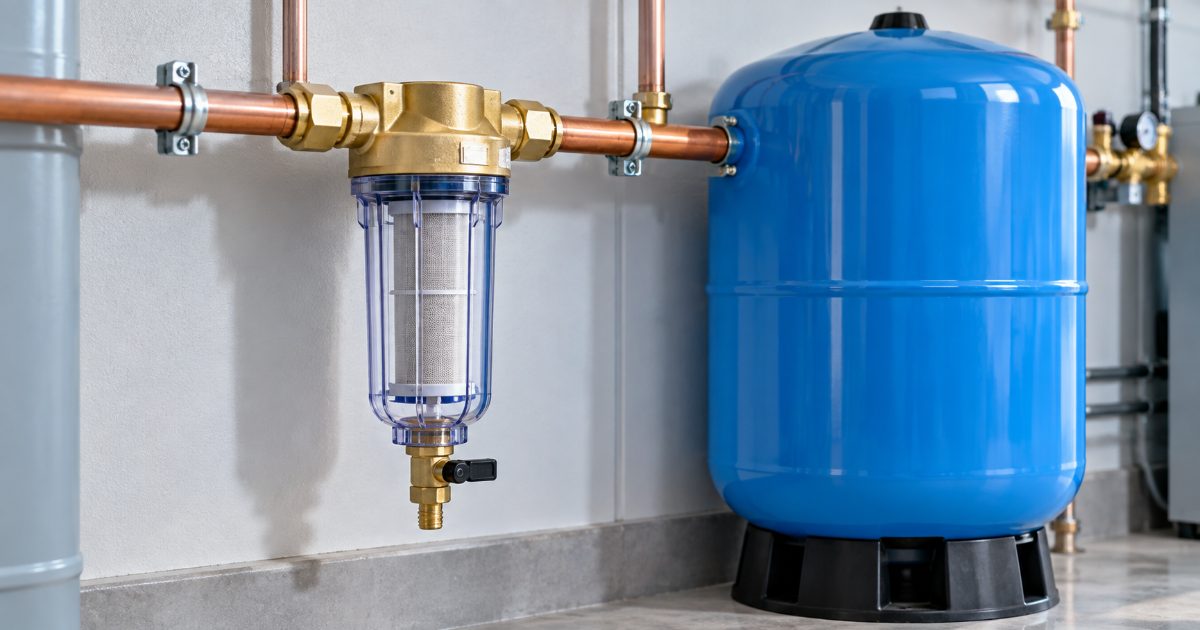
A spin-down filter is a clear bowl with a cylindrical mesh screen inside; water enters tangentially, heavier particles spin to the bottom, and a valve at the base flushes them to drain without opening the housing.
Mesh counts openings per linear inch, so a higher mesh number is a finer screen; micron measures the opening, so a higher micron number is a coarser screen. Rusco’s published table puts 100 mesh at about 150 micron and 250 mesh at about 50 micron, and Rusco labels it as its own conversion, not a standard.
Three gaps are flagged rather than filled. None of the iSpring, Waterdrop or Rusco pages says whether its micron figure is nominal or absolute.
No maker’s page shows a certificate number for NSF/ANSI 372, the lead-content standard, so “listed per the maker’s page” means the maker’s own claim, not a database record. And one retailer’s title lists the iSpring WSP50ARB at 35 GPM while iSpring’s own page and the Amazon listing body say 25 GPM, so this page uses 25.
How do the units compare on paper?
Manufacturer figures. “Not published” means the cited page prints no value. Lead-free is named as listed per the maker’s page unless the cell says otherwise.
| Unit | Screen | Ports | Max flow | Pressure | Temperature | Flush | Housing | Lead-free |
|---|---|---|---|---|---|---|---|---|
| iSpring WSP-50 | 50 micron stainless mesh | 1 in MNPT and 3/4 in FNPT | 20 GPM | 25 to 80 psi recommended; burst test above 500 psi | 40 to 100 F | Manual valve | Brass head, clear bowl | Lead-free brass in the listing title, no standard named |
| iSpring WSP-50SL | 50 micron 316L stainless, plus Siliphos scale-inhibitor media replaced every 3 to 6 months | 1 in MNPT and 3/4 in FNPT | 20 GPM | 20 to 100 psi | 40 to 100 F, indoor only | Manual valve | 316L stainless head, clear bowl | Lead-free brass in the listing title, no standard named |
| iSpring WSP50ARB | 50 micron 316L stainless mesh with built-in scraper | 1 in MNPT and 3/4 in FNPT | 25 GPM (one retailer title says 35) | Burst test above 500 psi; operating range not published | Not published | Auto, touch-screen, 1 to 99 day interval, 15 to 90 s runtime | Brass head, clear bowl | Not published |
| iSpring WSP50ARJ-BP (sold on Amazon bundled with two FP220B 20 micron cartridges) | 50 micron 316L stainless mesh | 1 in MNPT and 3/4 in FNPT | 25 GPM | Burst test above 500 psi; operating range not published | Not published | Auto, touch-screen, 4 modes: filtration, shut-off, bypass, backwash; leak-detector shut-off | Brass top with bypass valve, 1 gallon clear bowl | NSF/ANSI 372 listed per the maker’s page; not named on the Amazon listing |
| Waterdrop RPFK | 50 micron on Waterdrop’s page, 40 to 50 micron in the listing title; 316L molybdenum alloy | 1 in MNPT, 3/4 in MNPT, 3/4 in FNPT, 3/4 in push-fit | 20 GPM | 14.5 to 72 psi | 41 to 100 F | Manual backwash | Non-BPA PA12 plastic shell | NSF/ANSI 372 named in the Amazon listing bullets, not on Waterdrop’s page |
| Rusco 1-1/2 inch spin-down (family; 1-1/2-100-F is the 100 mesh polyester SKU) | Mesh chosen at purchase: 24 to 1000 mesh polyester or 30 to 200 mesh stainless; 100 mesh about 150 micron | 1.5 in FPT on Rusco’s page (the Amazon bullet says slip) | 18 to 100 GPM on Rusco’s page (10 to 50 GPM on the 100 mesh listing) | 150 psi | 200 F at 40 psi | Manual drain valve | PVC body, clear cover | Not published |
Where does a spin-down go in the line?
Rusco’s installation guidance puts the spin-down after the pressure tank and ahead of any cartridge filter, softener or UV unit, the order this page assumes.
The spin-down is the coarse stage: a 50 micron mesh stops sand and grit, and the micron picker chooses the cartridge behind it. The whole-house sediment filter comparison covers the housings that cartridge sits in.
iSpring WSP-50: buy it or skip it?
Buy it if the line is 1 inch or 3/4 inch, the pump moves 20 GPM or less, and someone will open the flush valve when the bowl fills.
iSpring’s spec page lists a 50 micron stainless steel mesh, 1 inch MNPT and 3/4 inch FNPT ports on both ends, 20 GPM, a 25 to 80 psi recommended range and 40 to 100 F.
iSpring says the screen usually lasts 1 to 2 years and that the housing passed a burst test above 500 psi. The Amazon listing also sells the body with 100, 200, 500 and 1000 micron screens, so confirm the 50 micron variant at checkout.
Skip it if incoming pressure sits above 80 psi without a pressure-reducing valve ahead of it, because that is the top of iSpring’s recommended range. Skip it if nobody will flush it: a manual spin-down that never gets flushed is a sand-filled bowl with a pressure drop.
Alternative: the iSpring WSP-50SL is the same 20 GPM body with a Siliphos scale-inhibitor cartridge that iSpring says to replace every 3 to 6 months, rated 20 to 100 psi and indoor only. For sediment alone the plain WSP-50 is the cheaper fit.
iSpring WSP50ARB: buy it or skip it?
Buy it if the well throws enough sand that a manual flush would be weekly work, and a power outlet or three AA batteries can reach the install point. iSpring’s page lists a 50 micron 316L stainless mesh, a built-in scraper, 1 inch MNPT and 3/4 inch FNPT ports and a maximum flow of 25 GPM.
The touch-screen module ships preset to flush for 15 seconds every 15 days, adjustable from 1 to 99 days and 15 to 90 seconds, on iSpring’s page, which also says the housing passed a burst test above 500 psi.
Skip it if the maximum operating temperature or the recommended pressure range is load-bearing, because iSpring publishes neither for this model, and size it on 25 GPM, not the 35 GPM one retailer’s title prints.
Alternative: the iSpring WSP50ARJ-BP is the same auto-flush idea on a 1 gallon bowl with a bypass valve, a leak-detector shut-off and four modes, at 25 GPM, and the only unit here whose maker page names NSF/ANSI 372. On Amazon it ships only bundled with two FP220B 20 micron cartridges, and it needs the most space.
Rusco 1-1/2 inch spin-down: buy it or skip it?
Buy it if the pump delivers more than 20 GPM, the main is 1-1/2 inch, or the water arrives hot. Rusco’s spec page lists 18 to 100 GPM depending on mesh, a 150 psi maximum, 200 F at 40 psi and a 1.5 inch FPT port on a PVC body.
The mesh is a separate decision. Rusco sells the body across 24 to 1000 mesh polyester and 30 to 200 mesh stainless screens, and its own table puts 100 mesh at about 150 micron. The linked listing is the 1-1/2-100-F, the 100 mesh polyester screen, and its bullets say 10 to 50 GPM for that screen.
Skip it if auto-flush is wanted, because every Rusco mesh drains by hand. Skip it if the port type is load-bearing before it arrives: Rusco’s page says 1.5 inch FPT, the Amazon bullet says slip, and this page did not resolve which the boxed unit carries.
Alternative: the iSpring WSP-50 at 20 GPM on a 1 inch line, with the micron rating fixed at purchase and a brass head instead of PVC.
Waterdrop RPFK: buy it or skip it?
Buy it if the install needs a push-fit connection or a metal-free body. Waterdrop’s page lists a 50 micron 316L molybdenum alloy screen, 20 GPM, four port options at 1 inch MNPT, 3/4 inch MNPT, 3/4 inch FNPT and 3/4 inch push-fit, a 14.5 to 72 psi working range, 41 to 100 F and a non-BPA PA12 shell.
The Amazon listing bullets name NSF/ANSI 372 and the title says 40 to 50 micron; Waterdrop’s own page says 50 micron and names no standard. This page prints both and does not pick one.
Skip it if static pressure runs above 72 psi, the lowest ceiling in this set, unless a pressure-reducing valve sits ahead of it. Skip it if a brass or stainless head is the requirement, because the RPFK body is plastic.
Alternative: the iSpring WSP-50 , same 20 GPM and micron rating, brass head, 25 to 80 psi.
Before you buy a spin-down
Do not order a spin-down until two numbers are known: the pump’s peak flow in GPM and the static pressure at the install point. A cheap gauge on a hose bib gives the second one; the flow rate calculator gives the first.
Above 20 GPM the iSpring WSP-50 is out and the Rusco 1-1/2 inch is in. Above 72 psi the Waterdrop RPFK is out. If the sand is fine enough to pass a 50 micron screen, none of these is the answer alone: the micron picker chooses the cartridge that goes behind it.
What goes wrong?
The mesh is too coarse for the sediment. A 50 micron screen passes silt and clay, so a well with cloudy rather than gritty water loads the cartridge behind it as fast as before. The sediment and turbidity guide sorts the two cases.
The bowl never gets flushed. A manual unit that fills with sand becomes a pressure drop that shows up at the shower before anyone looks at the bowl. That is the case for the auto-flush WSP50ARB on a well that throws sand after every pump cycle.
The static pressure was never measured. iSpring’s WSP-50 range tops out at 80 psi and the Waterdrop RPFK at 72 psi; Rusco’s 150 psi body is the one with headroom.
Iron is mistaken for sand. Rust-colored grit that smears rather than settles is usually iron, and no mesh on this page is the treatment for it; the well water test panel is the step before buying either.
Frequently asked questions
What is the difference between a spin-down filter's mesh number and its micron rating?
Mesh counts openings per linear inch, so a larger mesh number means smaller holes; micron measures the hole itself, so a larger micron number means bigger holes. The two run in opposite directions. Rusco's published conversion table puts 100 mesh at about 150 micron and 250 mesh at about 50 micron, and Rusco labels it as its own table rather than a universal standard.
Where does a spin-down filter go relative to the pressure tank and a cartridge filter?
Rusco's installation guidance places the spin-down after the pressure tank and ahead of any cartridge filter, softener or UV unit. The coarse mesh takes the sand and grit first, so the finer cartridge behind it loads more slowly. That order is the manufacturer's own guidance; no extension-service source specific to spin-down placement was found for this page.
What does lead-free mean on a brass spin-down filter head?
EPA's Safe Drinking Water Act page defines lead free as a weighted average of 0.25% lead across the wetted surfaces of a pipe, fitting or fixture, and 0.2% for solder and flux. NSF/ANSI 372 verifies against that figure. On this page only the iSpring WSP50ARJ-BP names NSF/ANSI 372 on its maker page, and the Waterdrop RPFK names it on its Amazon listing.
How often does an auto-flush spin-down filter run its cycle?
iSpring's page for the WSP50ARB says the module ships preset to flush for 15 seconds every 15 days, and that the interval is adjustable from 1 to 99 days with a runtime of 15 to 90 seconds. A well that throws visible sand after every pump cycle wants the short end of that range; a clean well can sit at the preset.
What pressure is a reusable spin-down housing rated for?
The two makers state it differently. Rusco publishes a 150 psi maximum for its 1-1/2 inch body. iSpring publishes a 25 to 80 psi recommended operating range for the WSP-50 and says the housing passed a burst test above 500 psi, which is a test figure, not an operating rating. Waterdrop's RPFK carries the lowest ceiling here at 72 psi.
Sources
- iSpring, WSP-50 reusable spin-down sediment filter product and spec page (manufacturer or vendor document)
- iSpring, WSP-50SL spin-down sediment filter with Siliphos product page (manufacturer or vendor document)
- iSpring, WSP50ARB auto-flushing spin-down sediment filter product page (manufacturer or vendor document)
- iSpring, WSP50ARJ-BP jumbo auto-flushing spin-down filter with bypass product page (manufacturer or vendor document)
- iSpring, WSP50ARJ-BP flow rate and pressure page (manufacturer or vendor document)
- Waterdrop, WD-RPFK spin-down sediment filter product page (manufacturer or vendor document)
- Rusco, 1-1/2 inch spin-down filter specifications (manufacturer or vendor document)
- Rusco, What is a micron and how does mesh size correlate (mesh-to-micron table) (manufacturer or vendor document)
- Rusco, Where do I install a spin-down filter on my well water filtration system (manufacturer or vendor document)
- EPA, How does the Safe Drinking Water Act limit lead in pipes, plumbing fittings, fixtures, faucets and solder (government or regulatory source)